Acts 2 describes a sound like a violent wind, appearances like divided tongues of fire, Spirit-filled speech, a bewildered multilingual crowd, Peter’s sermon, and mass baptism. It also leaves several questions open.
Pentecost has accumulated a large visual vocabulary: a neat upper room, twelve apostles arranged symmetrically, Mary at the center, identical flames hovering like candles over every head, and a dove representing the Spirit. Some of those images can serve devotion. Not all of them come from Acts 2. Luke’s actual account is vivid, but it is also surprisingly restrained about several details artists have had to decide for themselves.
A careful reading begins by separating what Luke says from what Christians have imagined. That is not an attack on art. It is a way of letting the text surprise us again. Pentecost in Acts is not mainly a posed religious tableau. It is a disruptive event that moves almost immediately from a gathered community to public speech, confusion, explanation, repentance, baptism, and a new pattern of shared life.
They were together, but Luke does not give us a floor plan
Acts says the believers were all together in one place and that a sound filled “the whole house where they were sitting.” The story does not identify the building with enough precision to settle every later question. Many readers picture the same upper room mentioned in Acts 1. Others have proposed a location associated with the Temple complex because a large crowd gathers quickly. The text itself does not require us to choose with confidence.
That uncertainty is useful. Luke’s emphasis falls on the people and the divine action, not on preserving an address for pilgrims. The Spirit’s arrival is not made sacred by a particular room. The narrative soon spills beyond whatever indoor space is meant and becomes a public Jerusalem event.
Luke describes analogies: “like” wind and “as of” fire
The sound comes “like” a rushing violent wind; the visible sign appears “as of” fire. Those comparison words matter. Luke is reaching for ordinary language to describe an extraordinary event. He does not simply say a hurricane tore through the building or that ordinary flames ignited on human bodies. The signs are real within the story, but their mode is described analogically.
That keeps the account from becoming either flatly naturalistic or needlessly fantastical. Wind and fire already carry strong biblical associations with divine presence, power, purification, and revelation. Luke uses sensory imagery that Israel’s Scriptures have prepared readers to hear, while still presenting Pentecost as a new moment.
The speech is public and intelligible to the crowd
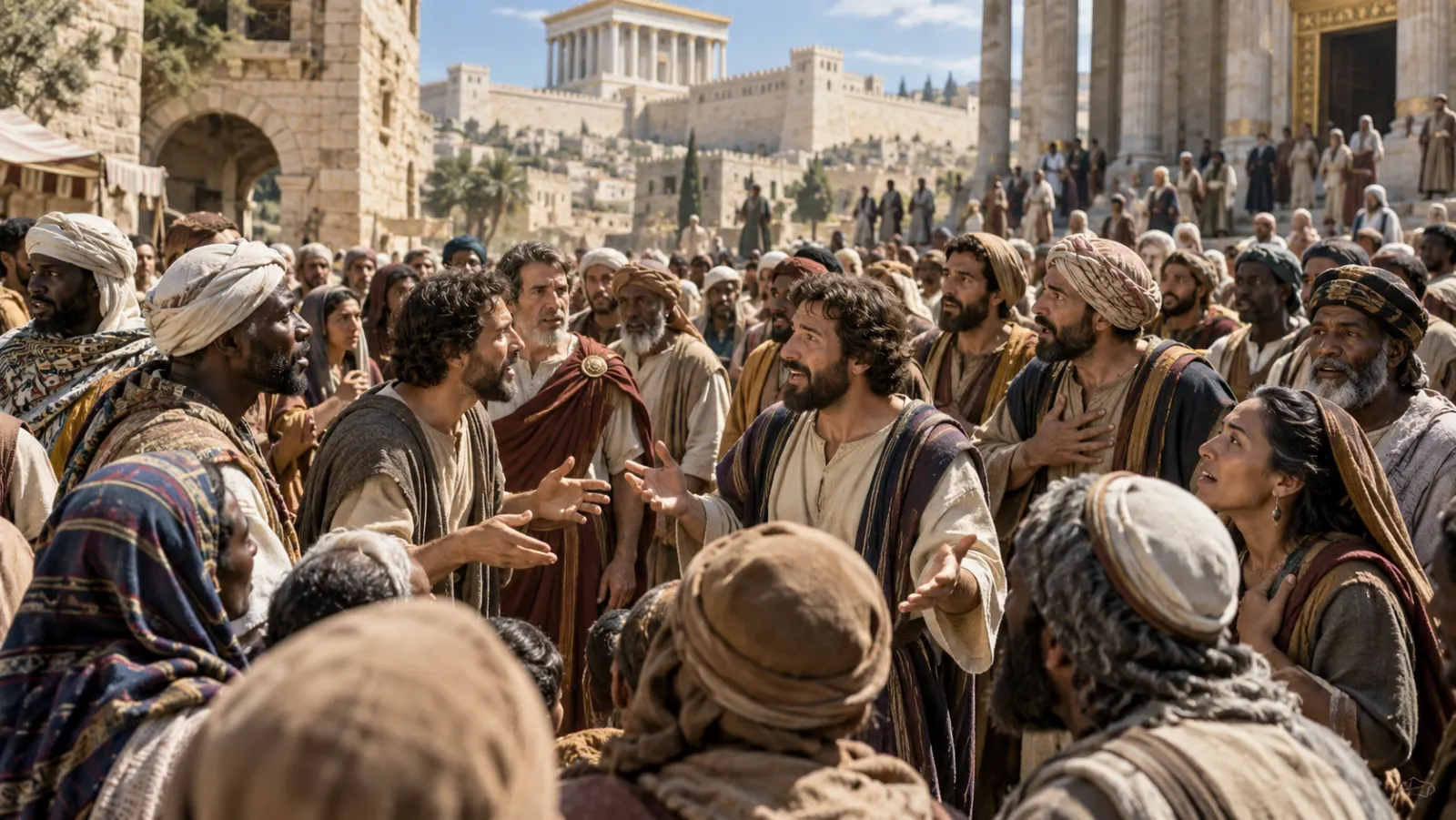
Whatever one concludes about the wider New Testament phenomenon of “tongues,” Acts 2 repeatedly stresses comprehension. Visitors say they hear the disciples speaking in their own languages or dialects about God’s mighty works. Luke names regions across a wide geographic span. The wonder is not merely that unusual sounds are produced; it is that the message crosses linguistic boundaries.
Some bystanders respond with amazement, while others mock and accuse the speakers of drunkenness. That mixed reaction is also important. Miraculous signs do not mechanically produce faith. The same event can be heard as divine communication or dismissed as absurdity. Peter’s sermon becomes necessary because experience still requires interpretation.
Peter explains Pentecost with Scripture, not hype
Peter does not tell the crowd to focus on the emotional intensity of the moment. He opens Joel, then turns to Jesus’ death, resurrection, exaltation, and Davidic promise. For Luke, the meaning of Pentecost is inseparable from the risen and exalted Jesus. The Spirit is not an independent spiritual thrill floating free from the gospel story.
This is one reason Acts 2 should not be reduced to a debate about whether modern churches reproduce the same signs. Luke’s theological center is the identity of Jesus and the fulfillment of God’s promises. The signs lead to proclamation; proclamation leads to a call for repentance and baptism; the Spirit creates witness rather than celebrity.
About three thousand respond—and Luke keeps moving
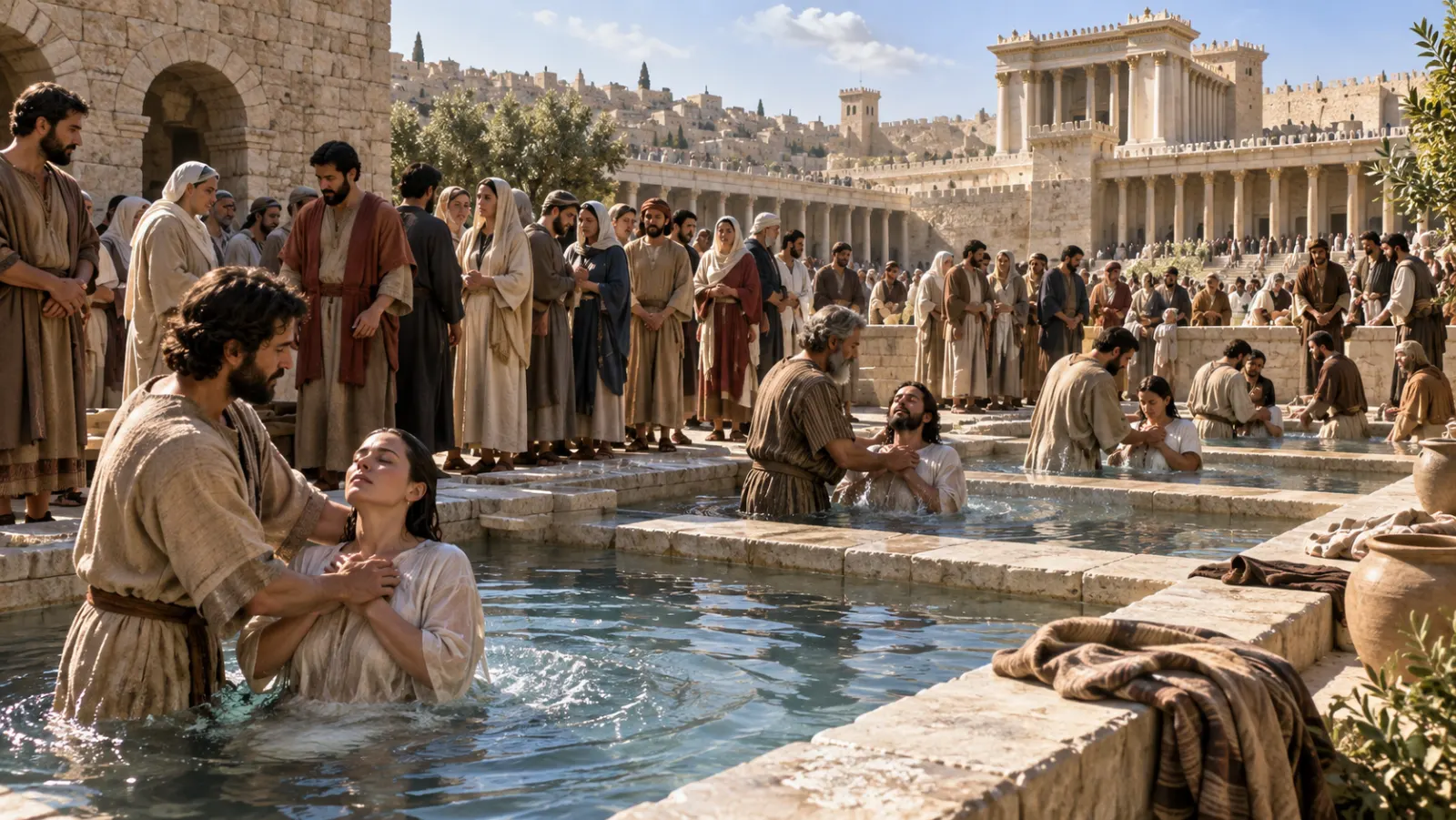
Acts reports that about three thousand people received Peter’s message and were baptized. Modern readers often stop to ask logistical questions, and they are reasonable questions. Jerusalem had abundant water installations, including numerous ritual baths associated with Jewish purification practice, so large-scale immersion is not automatically implausible. Still, Acts does not tell us which pools were used, how many baptizers worked, or how long the process took.
Luke’s interest lies elsewhere. The crowd is incorporated into a community devoted to apostolic teaching, fellowship, meals, and prayers. Pentecost is not finished when the sermon ends. The narrative measure of the Spirit’s work includes the social shape of the people who remain.
What the familiar artwork gets right—and what it can hide
Christian art often captures something true: Pentecost is communal, luminous, startling, and centered on God’s initiative. But a static image can hide the event’s movement. Acts 2 runs from waiting to filling, from filling to speaking, from speaking to hearing, from hearing to preaching, from preaching to baptism, and from baptism to a transformed community.
That sequence matters for theology. The Holy Spirit is not given merely so believers can have an inward experience. Acts 1:8 had already framed the promise in missionary terms: power to bear witness from Jerusalem outward. Pentecost is the first great enactment of that promise.
What we can reconstruct—and what we should leave open
Luke gives enough sequence to reconstruct the event’s basic movement but not enough detail to produce a documentary storyboard. The believers are gathered; an overwhelming sound fills the place; fire-like appearances are distributed; the Spirit fills them; speech begins; a crowd gathers or becomes aware of the event; reactions divide; Peter addresses the public; hearers respond; baptisms follow. That narrative skeleton is firm even when the exact room, street, crowd flow, and time required for each stage remain uncertain.
The distinction between event and reconstruction matters because confident visual details can quietly become “Bible facts” after generations of repetition. Acts never says there were exactly twelve people in the room, that everyone sat in a circle, that Mary occupied the center, or that a dove flew overhead. Those are artistic choices. A historically responsible retelling should mark them as such or avoid them when they distract from Luke’s actual emphases.
The chapter also resists reducing Pentecost to one spectacular minute. The signs occupy only the opening portion. Most of Acts 2 is interpretation and response: Scripture, proclamation, questions, repentance, baptism, teaching, fellowship, prayer, and shared economic life. Luke’s literary proportions are revealing. The visible wonders matter, but the lasting evidence of the Spirit’s arrival is a people reordered around Jesus.
That proportion is useful for churches that long for dramatic experiences. Acts does not teach suspicion toward spiritual experience; it records one of the most dramatic experiences in the New Testament. It does teach that authentic experience bears theological and communal fruit. The Pentecost story moves from sensation to meaning, from meaning to allegiance, and from allegiance to a durable pattern of life.
The event is extraordinary, but Luke writes soberly
One of the most striking features of Acts 2 is how little Luke tries to sensationalize what is already sensational. He does not describe people collapsing, glowing, levitating, or losing consciousness. They sit, hear, see, speak, listen, reason, preach, ask questions, receive baptism, eat, pray, and share. The supernatural enters ordinary human actions rather than replacing them.
The safest way to picture Pentecost is to let Luke’s verbs do more work than later paintings. A gathered community is interrupted by God, filled by the Spirit, and propelled into intelligible witness.
Some visual details remain uncertain: the exact room, the physical appearance of the “tongues,” the arrangement of the disciples, even the precise mechanics of how the crowd encountered them. Those gaps are not defects. They keep readers focused on the narrative’s claims rather than our preferred reconstruction.
Pentecost is dramatic, but Luke’s drama has direction. The Spirit points to Jesus, opens speech across boundaries, summons repentance, and forms a people. That is the event beneath the stained glass.