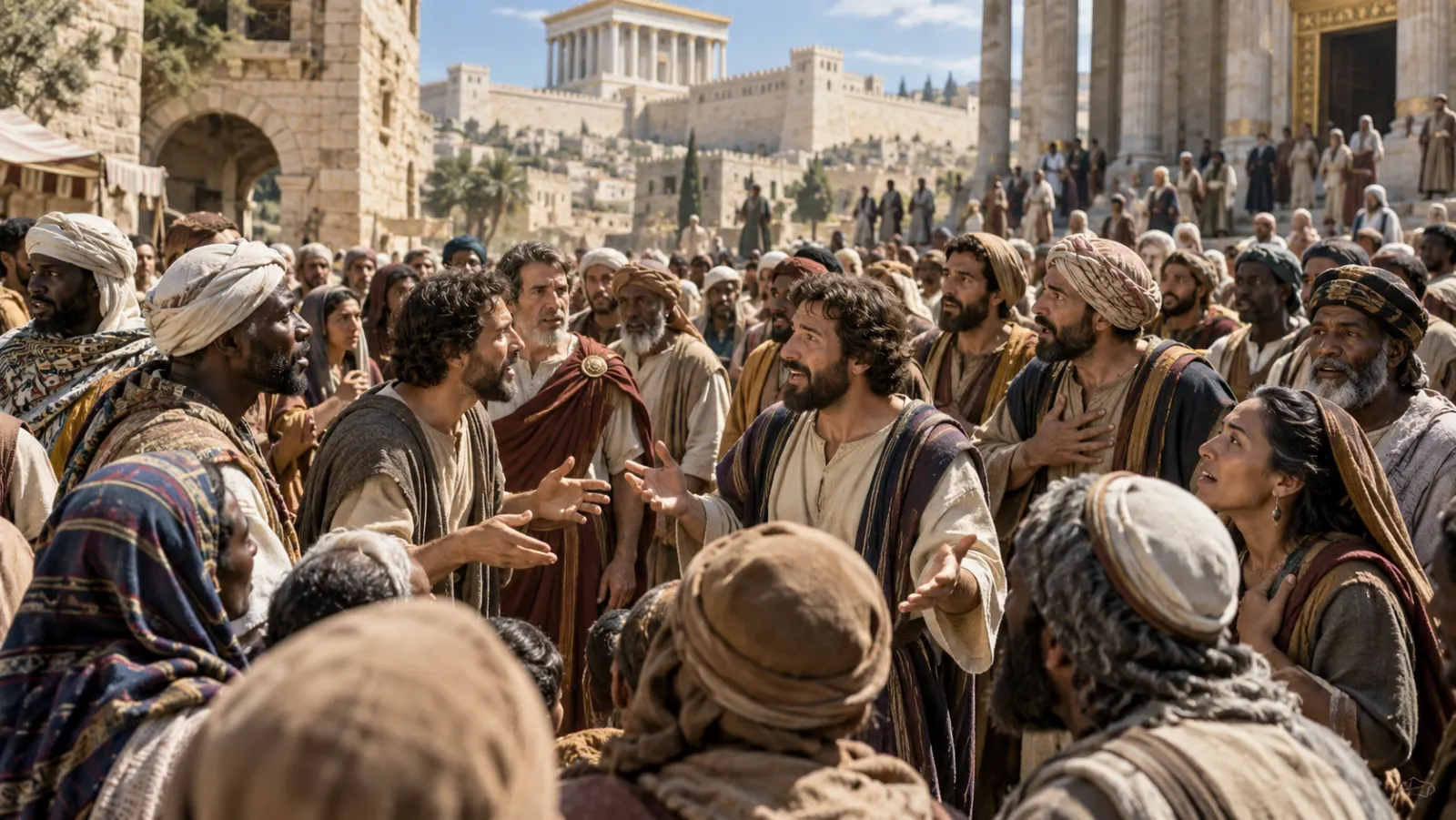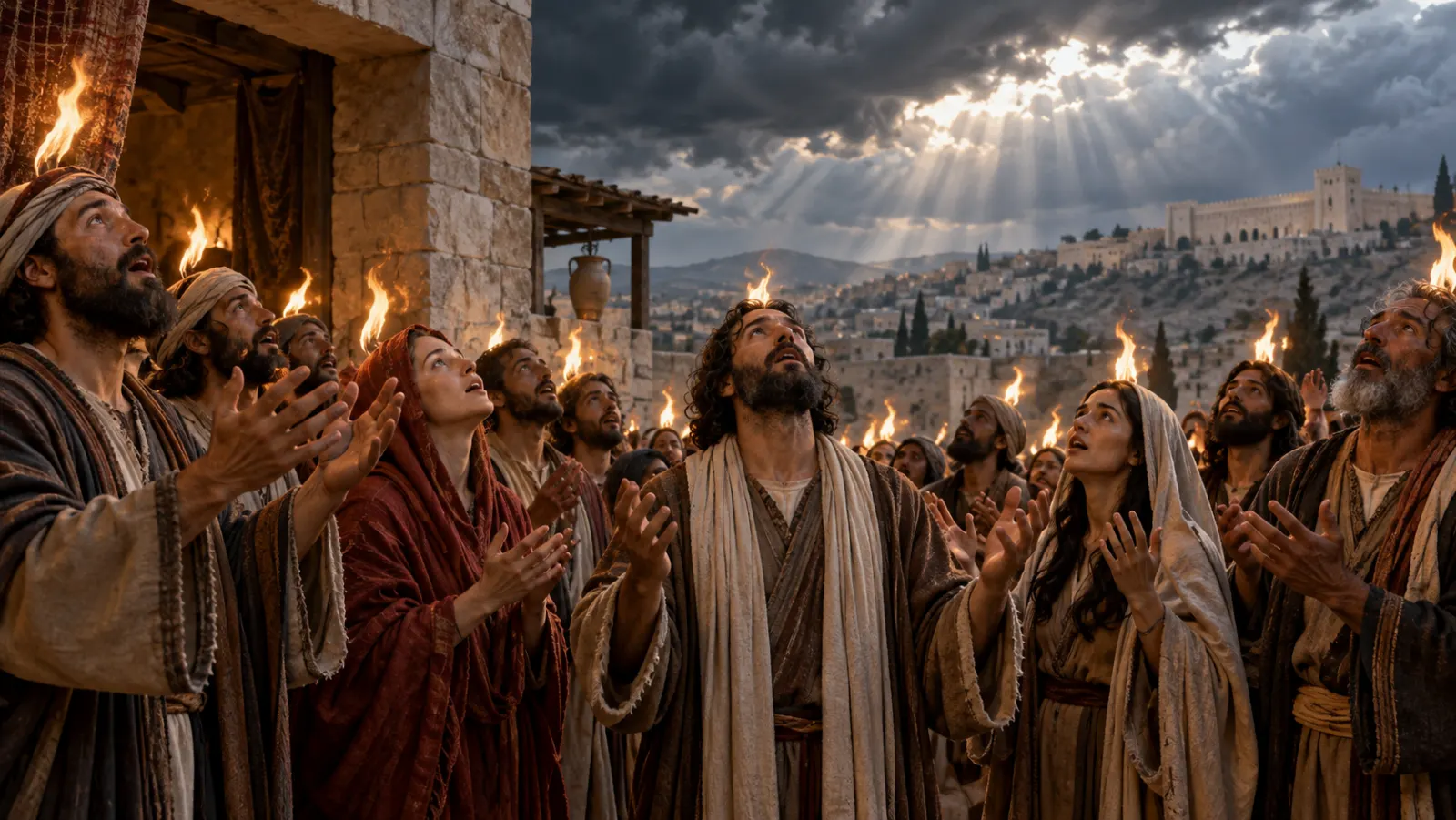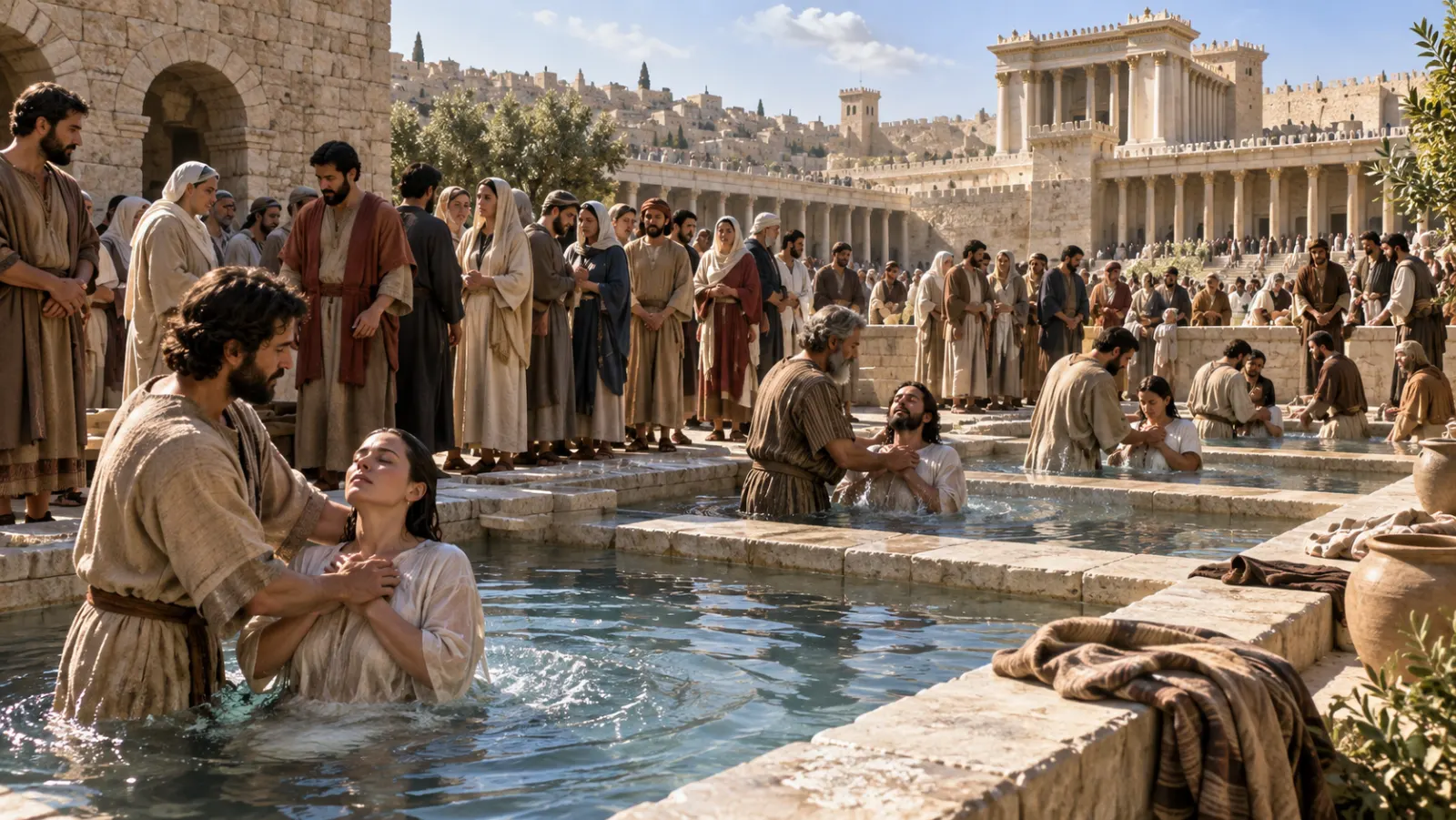
Luke says about three thousand people accepted Peter’s message and were baptized on Pentecost. The claim raises practical questions: where could that many people be immersed, and does ancient Jerusalem offer any clues?
The number lands with a thud: about three thousand people. For some readers, Acts 2:41 is inspiring. For others, it sounds logistically impossible. If baptism involved immersion, how could a small apostolic group baptize thousands in Jerusalem on one day? Where did the water come from? Would the city have had enough suitable facilities?
Those are fair historical questions. They do not have a complete archaeological answer because Acts does not name the baptism site or describe the procedure. But discoveries from late Second Temple Jerusalem have changed the conversation. The city contained many Jewish ritual immersion baths—miqva’ot—especially in areas connected with pilgrimage and ritual purity. That makes large-scale immersion far easier to imagine than it would be in a dry city with no bathing infrastructure.
Jerusalem was a ritual-purity city
Archaeologists have identified numerous stepped immersion pools from the late Second Temple period in Jerusalem and elsewhere in Judea. These installations were used within Jewish practices of ritual purification. Biblical Archaeology Society summaries note how important such miqva’ot are for understanding the Jewish background of early Christian baptism, even though the two practices should not simply be treated as identical.
The Temple drew pilgrims who cared about purity requirements, so the city needed water systems and purification spaces on a scale that modern readers may not expect. Jerusalem was not a city with one ceremonial bathtub. Its religious life had already generated infrastructure for repeated full-body immersion.
That does not prove which pool Acts 2 used
It is tempting to move too quickly from archaeology to certainty: “We found ritual baths near the Temple, therefore these exact baths are where the three thousand were baptized.” The evidence cannot carry that claim. Acts gives no address, and archaeology cannot attach an apostolic name tag to a particular pool.
What archaeology can do is change the plausibility question. If many suitable immersion installations existed, the logistical objection becomes weaker. We can say Jerusalem possessed the kind of water infrastructure that could support many immersions. We cannot say we have excavated “the Pentecost baptismal.”
How long would three thousand baptisms take?
The answer depends almost entirely on assumptions the text does not specify. If Peter alone had to baptize every person sequentially, the process would be extremely long. Acts never says Peter worked alone. The apostolic group was larger than one person, and Acts 1 describes about 120 believers gathered before Pentecost. The narrative does not tell us who performed each baptism.
With multiple pools and multiple baptizers, the arithmetic changes dramatically. Ten stations processing people in parallel are different from one; dozens are different again. Ancient immersion could also be less ceremonially elaborate than many modern church baptisms, with no microphone, testimony video, music cue, or changeover between candidates.
Baptism grew from Jewish soil but carried new meaning
Christian baptism cannot simply be reduced to a Jewish ritual bath. Jewish immersion practices involved repeated purification under various circumstances. Christian baptism quickly becomes associated with repentance, identification with Jesus, forgiveness, reception into the community, and participation in his death and resurrection. The meanings overlap at points but are not interchangeable.
Acts 2 itself makes that new christological focus explicit. Peter calls the crowd to repent and be baptized in relation to Jesus Christ. The Jewish setting supplies familiar water practice; the apostolic proclamation supplies the new covenantal meaning.
The number “about three thousand” sounds measured, not magical
Luke does not say exactly 3,000 to the last person; he says “about” three thousand were added. That is the kind of rounded figure ancient historical narratives often use. Readers are free to ask how Luke or his sources knew the scale, but the wording itself does not pretend to modern registration precision.
The narrative point is unmistakable: the Jesus movement changes size dramatically. A group counted in the low hundreds becomes a public community numbered in the thousands. Pentecost is not only an inward spiritual experience; it produces visible social growth.
Why this question matters beyond apologetics
It would be easy to treat the archaeology only as ammunition in a “Bible versus skeptics” argument. The more interesting result is historical texture. Ritual baths remind Christians that baptism did not fall into a cultural vacuum. The earliest believers lived in a Jewish world where water, purity, repentance, Temple pilgrimage, and bodily religious practice were already familiar categories.
That background also helps modern churches recover the physicality of Acts 2. Three thousand baptisms mean wet clothes, crowded steps, waiting lines, helpers, conversation, and hours of human movement. Luke’s number describes a community being embodied, not merely a statistic being recorded.
What the archaeology really contributes
The strongest archaeological contribution is contextual rather than identificatory. Miqva’ot show that first-century Jewish communities in and around Jerusalem were accustomed to purpose-built immersion spaces with steps allowing entry and exit. They also show that purification before Temple participation could involve substantial numbers of people. This does not make Christian baptism identical with ritual purification, but it removes the assumption that mass immersion would have required inventing an unfamiliar technology on the spot.
Jerusalem’s broader water system also included cisterns and major pools, though assigning any one of them to Acts 2 is speculative. Proposals sometimes mention areas near the Temple or large pools such as Siloam. The text does not choose among them. A responsible article therefore uses archaeology to establish capacity and cultural familiarity, not to turn a possible site into a discovered certainty.
There is also a narrative reason Luke may not care about the mechanics. Ancient authors routinely omit logistics that modern readers want quantified. Luke wants his audience to understand that the response was massive and that baptism marked entry into the Jesus movement. The exact workflow matters less to his purpose than the transformation of the community’s scale.
That does not mean questions are unwelcome. Historical faith should be able to ask where, how, and how long. The best answer is neither “miracles make logistics irrelevant” nor “if we cannot reconstruct every station the report must be false.” The evidence supports a middle position: the logistics are underdescribed, but the known immersion culture of Jerusalem makes them historically conceivable.
A logistical question should not become the whole story
Even a successful reconstruction of the logistics would not explain why the baptisms mattered. In Acts, baptism follows the crowd being “cut to the heart” by Peter’s proclamation about Jesus. The water marks a public response to a theological claim. Archaeology can illuminate the setting, but it cannot excavate repentance, faith, or the communal meaning Luke assigns to the act.
That distinction keeps historical investigation in its proper place. Material evidence can test whether a scene fits its environment and can correct modern assumptions about ancient practice. It cannot replace literary and theological reading. Pentecost asks both kinds of questions, and neither needs to fear the other.
No archaeological discovery can prove the exact mechanics of Acts 2:41. We do not know the site, number of baptizers, order of candidates, or duration of the process.
We do know that late Second Temple Jerusalem contained many ritual immersion installations and substantial water infrastructure. That makes the idea of large-scale baptism historically imaginable rather than absurd on its face.
The best conclusion is modest but meaningful: archaeology cannot verify the three thousand one by one, yet it shows that the city where Luke sets the event had precisely the kind of immersion culture and facilities that make the scene far more plausible than modern intuition might suggest.
The historical question is therefore narrower than either defenders or critics sometimes make it. Acts does not supply a modern event plan, but Jerusalem was not lacking the physical culture of immersion that such a large baptismal response would require.