Christians often connect Pentecost with Sinai: Torah given after Passover, Spirit given after Easter, fire on the mountain, fire-like signs in Jerusalem. Some echoes are compelling; others depend on later Jewish tradition.
Pentecost sermons often draw a straight line from Mount Sinai to Acts 2. Israel leaves Egypt, reaches Sinai, and receives Torah; Jesus passes through death and resurrection, and his followers receive the Spirit. Sinai has fire and overwhelming sound; Pentecost has a wind-like sound and fire-like appearances. The parallels can be powerful enough to feel self-evident.
The challenge is historical precision. The biblical Feast of Weeks is explicitly tied to harvest and firstfruits. The firm identification of Shavuot as the anniversary of the giving of Torah becomes especially prominent in later rabbinic tradition. So the interpreter has two separate questions: Does Acts 2 contain Sinai-like imagery? And did Luke’s audience already celebrate Shavuot primarily as “the day Torah was given”? The first has stronger textual evidence than the second.
Theophany has a recognizable biblical vocabulary
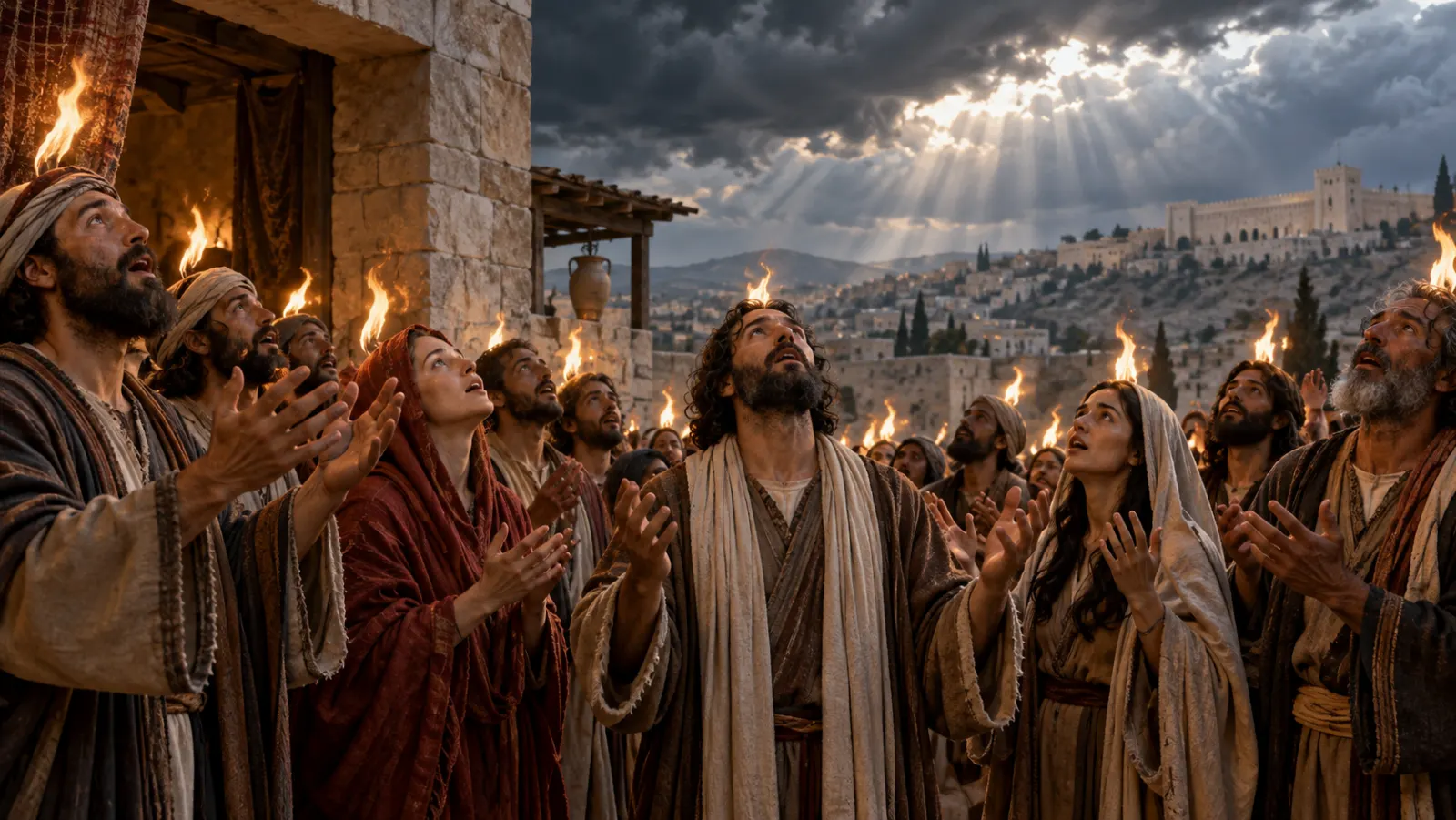
Exodus 19 describes thunder, lightning, thick cloud, trumpet-like sound, smoke, fire, trembling, and the descent of God upon Sinai. Acts 2 describes a sound from heaven like a violent wind and visible appearances like divided tongues of fire. The scenes are not identical, but they share a sensory register associated with divine self-manifestation.
Biblical writers reuse such imagery because it carries theological memory. Fire can signal holy presence; overwhelming sound can signal divine arrival. Luke does not have to copy Exodus line by line for readers to sense that God is again acting in covenant-shaping power.
Divine speech is central in both scenes
At Sinai, Israel receives divine words that shape covenant life. At Pentecost, the Spirit enables human speech that proclaims God’s mighty works and is then interpreted through apostolic preaching. The direction differs, but in both scenes divine action creates a speaking-and-hearing people.
Theresa Abell Haynes argues that Acts 2 uses Sinai fire imagery to reinforce continuity with Judaism while expanding the people addressed by the Spirit’s work. That kind of reading is stronger when it is presented as literary-theological analysis rather than as a claim that Luke explicitly labels Pentecost “Sinai 2.0.”
Later Jewish tradition makes the comparison even richer
Rabbinic Judaism came to celebrate Shavuot explicitly as the time of the giving of Torah. Later Jewish texts also develop striking traditions about divine speech at Sinai reaching the nations or being divided into multiple voices or languages. Christian readers have often placed those traditions beside Acts 2 and found the resemblance compelling.
The dating matters. Later rabbinic texts can preserve earlier memories, but they cannot simply be projected backward without argument. Responsible interpretation can say that Jewish tradition eventually articulated Sinai-Shavuot connections that resonate strongly with Acts 2, while remaining cautious about claiming every such motif was already fixed in the first century.
Law versus Spirit is too crude
A common Christian contrast says Sinai gave “dead law” while Pentecost gave “living Spirit.” That caricature misrepresents both Judaism and the New Testament. The Torah is celebrated within Scripture as God’s gracious covenant instruction. Paul can contrast letter and Spirit in specific theological arguments without teaching Christians to despise Israel’s law or Jewish devotion to it.
A better comparison sees continuity and escalation: the God who formed a covenant people now pours out the Spirit promised by Israel’s prophets through the exalted Messiah. Pentecost does not require Christians to turn Sinai into a failed religious experiment. It depends on the God revealed there.
From one people to a mission toward all peoples
Sinai forms Israel as a covenant people with a vocation among the nations. Pentecost begins in Israel and immediately displays a diaspora horizon: Jews and proselytes from many regions hear God’s mighty works. Acts will then move outward geographically as the gospel crosses Samaria and reaches Gentiles.
That movement gives the Sinai comparison missionary force. The Spirit does not sever the church from Israel’s Scriptures; he propels the message rooted in those Scriptures toward the nations. Continuity and expansion belong together.
Why the echo matters for Christian identity
If Pentecost evokes Sinai, then the church’s life in the Spirit cannot be reduced to spontaneity without covenant, experience without holiness, or power without obedience. Sinai reminds readers that divine presence creates a people accountable to God. Acts 2 immediately confirms that pattern by describing teaching, fellowship, prayer, generosity, and shared life.
The Spirit’s freedom is not chaos. Pentecost forms a community with practices, memory, proclamation, and moral shape. The fire that amazes the crowd eventually becomes a life together that outsiders can observe.
The safest way to use later Jewish traditions
Later rabbinic traditions sometimes describe the divine voice at Sinai in ways that resonate strikingly with Pentecost—speech divided into multiple voices or reaching many nations. These parallels are valuable for reception history and for seeing how Jewish interpreters reflected on Sinai. They are not automatic proof of what Luke had in mind. A later text can preserve an older motif, develop a new one, or do both, and dating the underlying tradition requires separate argument.
That caution is particularly important in Christian teaching because it is easy to enlist Jewish tradition only when it seems to confirm a Christian typology. Respectful use lets Jewish texts speak in their own historical contexts. Christians can notice resonances without treating rabbinic literature as a set of footnotes written to authenticate Acts.
Even without those later traditions, the Exodus echo remains substantial. Fire, overwhelming sound, gathered people, divine initiative, and covenantal speech are already present in the biblical narrative of Sinai. Luke’s readers could perceive those scriptural patterns directly. The later Shavuot-Sinai association enriches the history of interpretation but is not the only foundation for the comparison.
This layered approach also explains why Pentecost theology should be more than a clever parallel chart. Luke is not simply replacing stone tablets with inward feeling. The Spirit creates witnesses, interpreters of Scripture, a baptized community, shared economic responsibility, and sustained prayer. The new-covenant work is public and communal, just as Sinai formed a people rather than isolated spiritual consumers.
For Christians, then, Sinai and Pentecost belong together most fruitfully when the comparison produces humility. The church receives Israel’s Scriptures as its own scriptural inheritance through Israel’s Messiah. It does not own the story by erasing the people through whom that story came. Pentecost begins in Jerusalem because continuity is part of the claim.
The comparison should end in worship, not scorekeeping
Christian typology can become distorted when it is used to prove that the church is superior to Judaism. Sinai is not a foil created so Pentecost can look better. It is a foundational revelation of the same God whom Christians confess. Any comparison that breeds contempt has misunderstood the continuity Luke’s narrative depends on.
A healthier reading receives Sinai with gratitude and Pentecost with wonder. God forms a people, speaks, gives, calls, and sends. The later event intensifies the mission through the risen Messiah and the Spirit without requiring Christians to mock the earlier covenantal story that makes the later one intelligible.
Sinai is one of the most plausible biblical backdrops for Pentecost, especially in the shared language of divine presence, fire, sound, speech, and people formation. The echo deserves attention.
The historical caution is equally important: the biblical Feast of Weeks began as a harvest festival, and the later Jewish identification with Sinai should not be projected backward as though Acts explicitly stated it.
With those distinctions in place, the comparison becomes stronger rather than weaker. Pentecost can be read as Israel’s God acting again in covenantal power—this time through the exalted Jesus and the poured-out Spirit, launching a mission that will move from Jerusalem toward the ends of the earth.