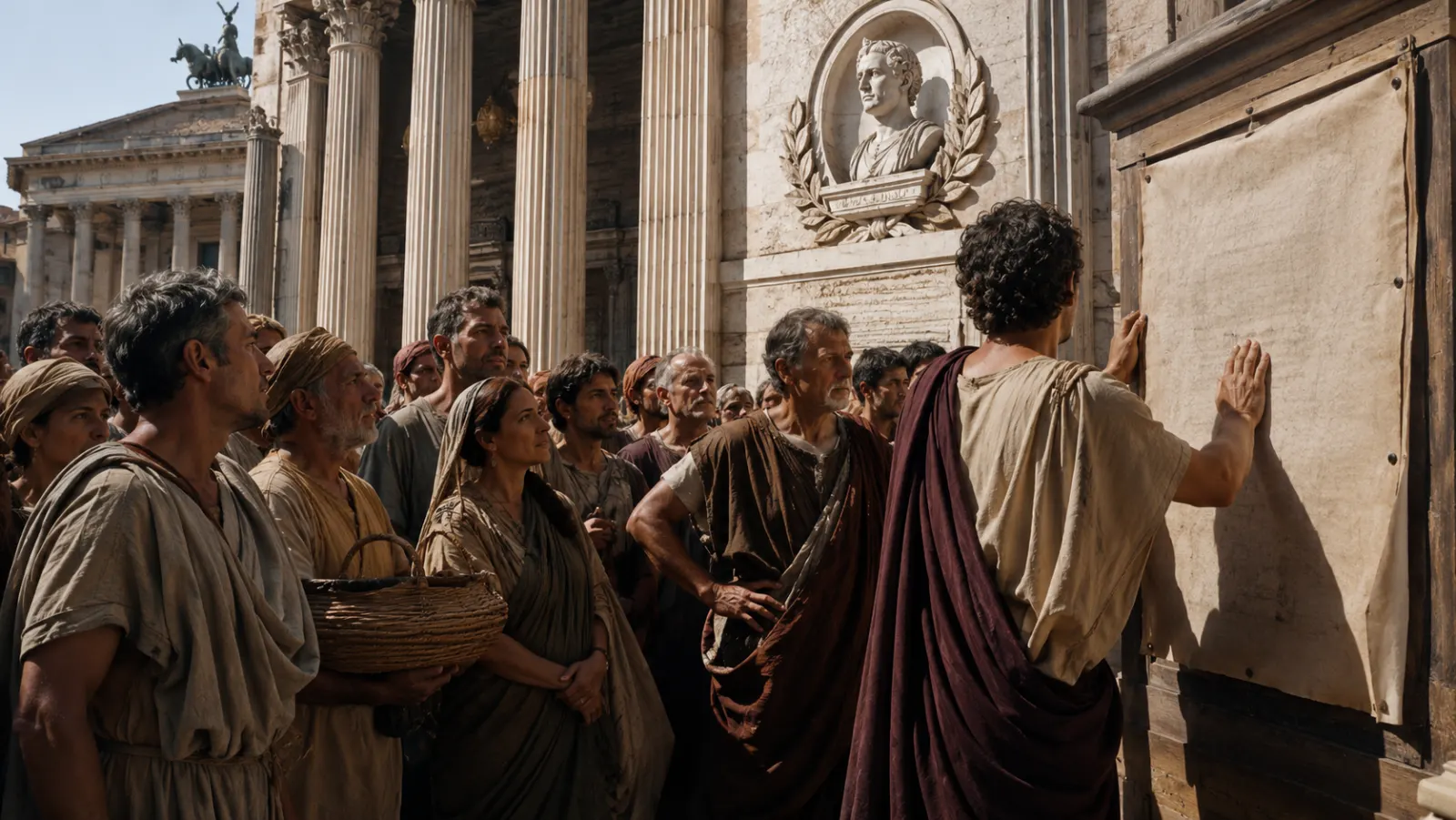
Luke connects Jesus’ birth with an imperial registration and Quirinius. Roman census practices are historically real, but the best-attested Judean census under Quirinius belongs to A.D. 6. Readers deserve to know both facts.
For many Christians, the opening of Luke 2 is so familiar that it can pass by like stage directions: Augustus issues a decree, everyone registers, Joseph goes to Bethlehem, and Jesus is born. For historians, however, those opening lines contain one of the most discussed questions in the Christmas narratives. We know Rome conducted censuses and property registrations. We also know a famous census took place in Judea under Publius Sulpicius Quirinius. The difficulty is the date.
If we want a faith that is not frightened by evidence, we do not need to pretend the problem is imaginary. Nor do we need to jump from “there is a chronological difficulty” to “therefore nothing in Luke is historical.” We can begin with what the sources actually say, separate firm evidence from proposed solutions, and allow the text to be more complicated than either a skeptical slogan or an apologetic shortcut.
Rome did not have only one kind of census
The English word census can make us picture a single modern process: a national form used mainly to count population. Roman practices were broader. Censuses could establish civic status, register property, support taxation, organize obligations, and create administrative knowledge. The procedures differed according to place and political status.
Augustus himself records three censuses of Roman citizens in his Res Gestae. Those were not worldwide head counts of every subject of the empire. In the provinces, Rome and its rulers also used local registrations and assessments, and scholarship shows provincial census practices developing under Augustus. We therefore should not ask, “Did Romans ever register people before A.D. 6?” They clearly did. The sharper question is what Luke means by this particular registration.
The A.D. 6 census of Judea is unusually well attested
Josephus describes a major change after Augustus removed Archelaus, the son of Herod the Great, from power. Judea was placed under more direct Roman administration, and Quirinius came to Syria with authority that included an assessment of property. Josephus connects the assessment with resistance led by Judas the Galilean.
That event also appears indirectly in Acts 5:37, where Gamaliel connects Judas the Galilean with the period of the census. The event therefore had a long memory. It was politically charged because an assessment was not merely statistical. It was bound up with the transfer of Judea from a Herodian ruler to direct Roman administration and taxation.
The chronological difficulty is straightforward to state
Matthew places Jesus’ birth during the reign of Herod the Great. Luke 1 likewise begins by locating its events during Herod’s reign in Judea. Herod is generally dated as dying in 4 B.C. Luke 2 then connects the birth journey with a registration and names Quirinius in relation to Syria. The securely documented Quirinian census described by Josephus occurred around A.D. 6—roughly a decade after Herod’s death.
That is the problem. It is not that Rome lacked censuses. It is not that Quirinius was imaginary. It is that the best-attested census associated with Quirinius seems too late for a birth under Herod. Good historical discussion should state that tension in one clean paragraph before considering any proposed answer.
Several harmonizations have been proposed
One proposal is that Luke refers to an earlier registration carried out before the famous A.D. 6 census. Another is that Quirinius held some earlier special authority in the region. A third focuses on how the Greek sentence should be translated, suggesting a sense such as a registration occurring “before” Quirinius was governor. Still other approaches argue that Luke has compressed or confused chronological information.
Each proposal has arguments and objections. Evidence for Roman administrative activity before A.D. 6 makes an earlier registration possible in a general sense, but possibility is not documentation of Luke’s specific event. Proposed earlier offices for Quirinius have not produced a consensus. The alternative translation of the Greek is debated. And simply declaring Luke wrong does not explain every feature of his narrative. The responsible conclusion is that the question remains historically disputed.
What about traveling to an ancestral town?
Luke says Joseph went from Nazareth to Bethlehem because he belonged to the house and line of David. Critics often note that Roman censuses normally concerned where property and taxable obligations existed, not sentimental journeys to ancient ancestral towns centuries removed. That objection deserves to be taken seriously. We do not possess a Roman decree saying that everyone in Herod’s kingdom had to travel to a distant ancestral city in precisely the way Luke describes.
At the same time, census procedures were not mechanically identical in every province, and local systems could account for family, property, domicile, and legal status in ways shaped by regional institutions. The evidence is not rich enough to reconstruct the exact registration Luke has in mind. That uncertainty should make us modest, not inventive. We should not fill the gap with confident details the sources do not give us.
Ancient chronology is reconstructed from sources that were never designed for us
Our frustration with Luke 2 can come partly from expecting an archive that does not exist. No complete Roman census registry for Herod’s Judea survives. Josephus writes decades later and selects events important to his history. Inscriptions preserve fragments. Administrative careers are sometimes reconstructed from scattered evidence. Luke has his own narrative aims. Historians compare these sources, but they cannot make missing documents appear by force of argument.
That does not mean “anything is possible.” Historical reasoning still ranks explanations according to evidence. A proposal that requires an otherwise unknown census, an otherwise uncertain office for Quirinius, and an unusual translation carries more evidentiary burden than a claim directly attested by Josephus. At the same time, absence of a surviving record is not identical to proof that an event never occurred. The right posture is calibrated confidence: firm where evidence converges, tentative where reconstruction does more of the work.
Luke’s theological purpose does not make chronology irrelevant
Some readers try to solve the problem by saying Luke is making a theological point, not writing history. But Luke himself repeatedly locates events in relation to rulers, offices, towns, journeys, and public chronology. His theology is expressed through claims about events in the world. Historical questions are therefore legitimate questions to ask of his narrative.
Yet history also works with uneven evidence. Ancient records are incomplete. Authors can preserve accurate information alongside compressed chronology, use terms in ways we do not fully recover, or select details for narrative reasons. The honest Christian position does not require us to know more than we know. It requires us to refuse both fabricated certainty and reflexive dismissal.
What we can responsibly say in a Christmas article
We can say that Augustus used censuses and that Rome developed provincial registration practices. We can say that Quirinius was a real Roman official and that Josephus places a consequential Judean assessment under him in A.D. 6. We can say that Luke connects Jesus’ birth journey to a registration and names Quirinius. We can also say that the chronology of those claims is difficult to reconcile with a birth during Herod the Great’s reign.
What we should not say is that archaeology has “proved Luke’s census,” that a specific inscription has settled Quirinius’ earlier career, or that Roman law unquestionably required every subject to return to an ancestral town. Those stronger claims circulate widely in popular apologetics but exceed the evidence. Intellectual honesty does not weaken the article. It tells readers which parts are documented, which are plausible, and which remain proposals.
The safest conclusion is twofold. First, Roman census and registration practices under Augustus are historically well grounded. Second, the precise relationship between Luke 2, Quirinius, Herod’s reign, and the A.D. 6 Judean census remains debated. Those statements can stand together.
For Christians, that is not a defeat. The Gospel invites serious reading in public history, and serious history sometimes leaves us with unresolved questions. We can continue to confess what Luke is announcing about Jesus while being candid about where the surviving administrative record does not give us a tidy answer.