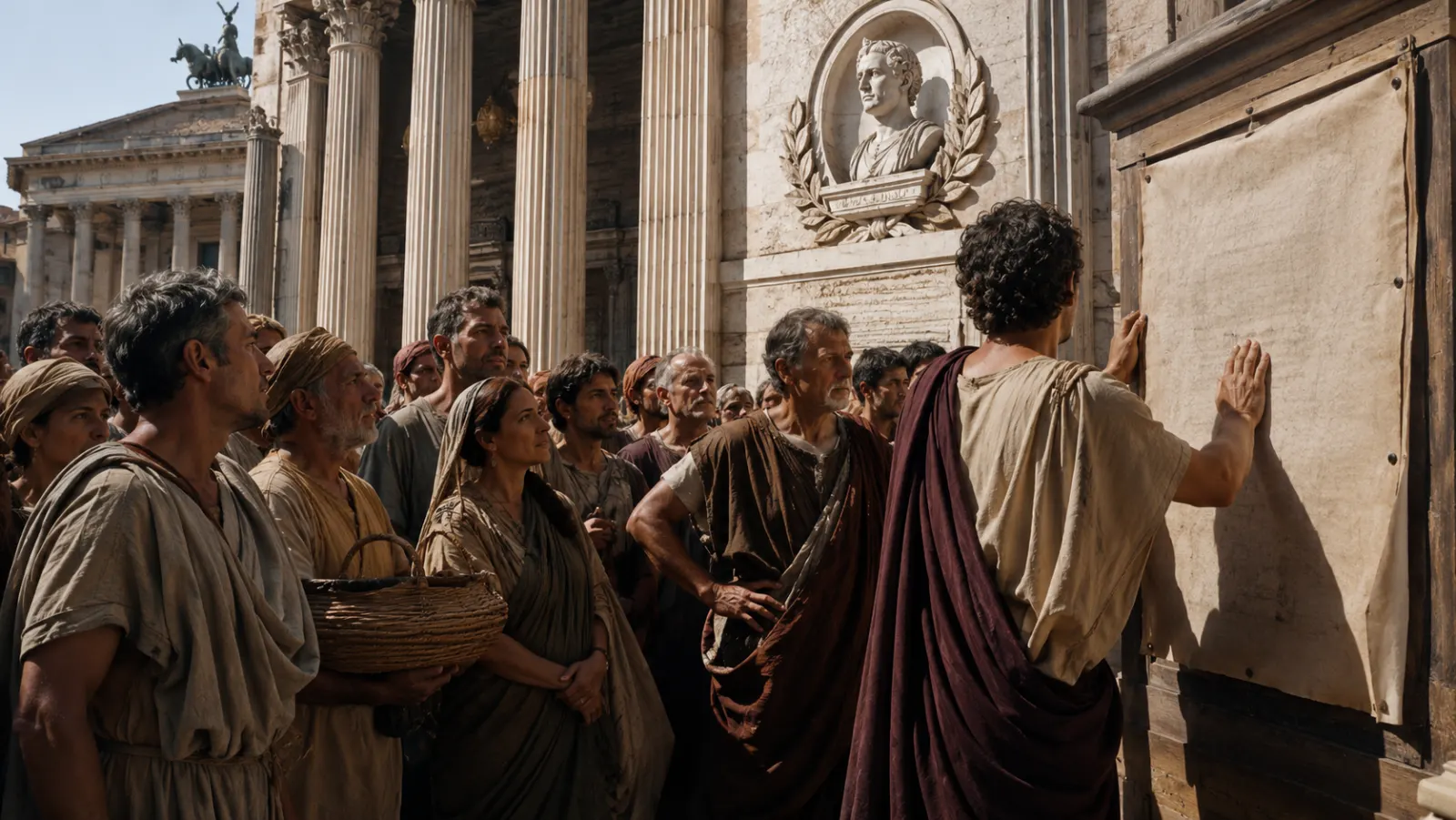
Luke could have introduced Jesus without naming the emperor. Instead, Caesar Augustus stands in the first sentence of the birth scene—and then almost disappears as the narrative turns toward Bethlehem, shepherds, a manger, and the child called Savior and Lord.
Luke 2 opens at the top of the world: “Caesar Augustus.” The emperor can issue a decree that sets administrative machinery in motion across territories he rules or influences. Joseph and Mary, by contrast, are introduced as travelers moving toward a small town because of a registration. One figure acts through an empire. The others look like people acted upon by forces much larger than themselves.
Then Luke changes the scale. The emperor receives no speech. He never meets Jesus. He does not know the shepherds exist. The narrative’s attention moves away from Rome to Bethlehem, from decree to birth, from imperial administration to a feeding place, and from public power to an angelic announcement made to working people at night. That movement is not accidental. Luke is teaching us where to look.
Naming Augustus makes a historical claim
Luke consistently places events alongside public rulers and offices. Augustus, Quirinius, Tiberius, Pontius Pilate, Herod Antipas, Philip, Lysanias, Annas, and Caiaphas appear across the opening chapters of Luke. The effect is to locate the story within recognizable political time rather than in a mythic “once upon a time.”
That does not remove every chronological question; the census associated with Quirinius is famously debated. But the naming itself shows Luke’s narrative ambition. The story of Jesus belongs to the same world as governors, kings, taxes, cities, and public decisions. Christian theology begins with claims about God acting in history, not with escape from history.
Augustus already carried the aura of a world-changing ruler
Augustus’ achievement was enormous. He ended a devastating cycle of Roman civil war, reorganized imperial government, stabilized frontiers in many regions, encouraged monumental building, and became the central figure in a new political order. Public honors could describe his reign in language of peace, benefaction, salvation, and good news.
The Priene calendar inscription is one striking example. In a civic context in Asia Minor, Augustus’ birth is praised as the beginning of good news for the world. We should not imagine that Luke’s shepherds had memorized the inscription or that every word in Luke 2 is a secret quotation from imperial propaganda. The point is simpler: terms such as savior, lord, peace, and good news had public resonance as well as biblical resonance.
Luke’s vocabulary is even more deeply rooted in Israel’s Scriptures
If we focus only on Caesar, we can make Luke sound as though he built his theology mainly by reversing Roman slogans. But Luke’s first two chapters are saturated with Israel’s story. Mary’s song echoes the language of Hannah and the Psalms. Zechariah speaks of covenant promises, David, Abraham, enemies, mercy, and prophetic hope. Bethlehem recalls David and Micah. The promised throne belongs to the house of David before it belongs to any argument about Rome.
This matters because Jesus is not simply “a nicer Caesar.” His identity comes from God’s covenant purposes. The titles announced at His birth draw meaning from Israel’s hopes for God’s saving rule and Messiah. Imperial echoes may sharpen the contrast, but Scripture supplies the deepest grammar.
The word Savior asks who can truly rescue
Rulers in the ancient world could be called saviors because they delivered cities from enemies, famine, instability, or political danger. Augustus could plausibly be experienced as a rescuer from civil war. Luke does not need to deny every earthly benefit of competent government in order to call Jesus Savior.
Instead, the Gospel expands the horizon. Jesus will bring forgiveness of sins, release, restoration, healing, reconciliation, and ultimately victory over death. His salvation reaches places no imperial decree can reach. Rome can suppress a revolt. It cannot reconcile sinners to God. An emperor can distribute grain. He cannot raise the dead.
The word Lord asks where final allegiance belongs
“Lord” was a flexible ancient title, ranging from respectful address to claims of sovereignty. In Luke’s theological world, however, the title applied to Jesus gathers extraordinary weight. The child’s authority is not created by a Senate vote, battlefield victory, or inherited Roman office. It belongs to who He is in God’s saving purpose.
That does not turn the Gospel into a handbook for rejecting every civil authority. Luke and Acts can portray Roman officials in varied ways, and the New Testament elsewhere recognizes legitimate governmental functions. Christian confession becomes politically significant at a deeper level: no earthly ruler is ultimate. Obedience to government has boundaries because worship and final allegiance belong to God.
The word peace asks what kind of order God intends
Augustan peace meant the ending of civil war and the stabilization of Roman power. Those achievements mattered. Yet imperial peace depended on hierarchy, taxation, military superiority, and the capacity to punish resistance. Luke’s peace grows out of God’s favor and saving action. It will be embodied in a Messiah who teaches enemy-love, welcomes outsiders, confronts hypocrisy, forgives sinners, suffers unjustly, and rises from death.
That difference keeps Christian reading from becoming simplistic. The Gospel is not saying every Roman achievement was fake. It is saying political order, even at its best, is not the peace for which humanity was made. The deepest peace is reconciliation with God that creates a people learning a different pattern of life with one another.
Luke’s contrast is about scale as much as slogans
One of the most striking features of Luke 2 is how quickly the narrative leaves the imperial center. Augustus’ decree can affect populations he will never meet. The birth itself happens without imperial attention. Shepherds, not senators, receive the announcement. Mary treasures words that have no place in Rome’s official records. Luke lets enormous political scale and tiny human scale occupy the same chapter, then asks readers which scale finally interprets the other.
From a Christian theological perspective, the answer becomes clear only over the whole Gospel and Acts. Jesus will not seize Augustus’ office. He will teach, heal, suffer, die under Roman authority, rise, and send witnesses outward. Acts eventually reaches Rome, but by then Rome is no longer the source of the story’s meaning; it is another place to which the message goes. The geographic center of power becomes a mission field.
The manger is not powerful because smallness is automatically holy
Christmas preaching sometimes romanticizes weakness: palace bad, poverty good, small town pure, powerful people corrupt. Luke is subtler. Scripture contains faithful kings and corrupt peasants, generous wealthy people and oppressive poor people. Humble circumstances are not a magic guarantee of virtue.
The wonder of Bethlehem is that God’s promised King does not depend on the usual machinery by which rulers make themselves important. Jesus’ identity is given by God before the world recognizes Him. He can enter obscurity without losing authority. His kingdom will advance through witness, service, sacrifice, Spirit-empowered mission, and resurrection rather than through the methods by which Augustus secured the Mediterranean.
Christian claims about Jesus outlast the ruler used to date His birth
There is a quiet historical irony in Luke’s opening. Augustus was one of the most consequential rulers of antiquity, and his political settlement helped shape the Mediterranean for generations. Yet billions of people now encounter his name each Christmas because Luke used him to locate the birth of Jesus. The emperor who seemed to define the age becomes, in the Gospel’s narrative, a chronological marker in someone else’s story.
That observation should not become a cheap taunt at political power. Augustus deserves serious historical study on his own terms. Luke’s theological claim is stronger than ridicule: earthly power is real but not final. Empires organize time, territory, and public memory for a season. The Gospel announces that God’s purposes in Christ operate on a horizon no dynasty can contain.
Luke names the emperor because Jesus was born under a real empire. He names Bethlehem because Israel’s promises matter. He names shepherds because the announcement is not confined to palaces. And he gives Jesus titles large enough to make us reconsider what salvation, lordship, and peace ultimately mean.
Augustus remains an important figure in world history. Luke does not need to make him small in order to make Jesus great. He simply moves Caesar to the edge of the frame. The decree begins the chapter; the child defines the story.