
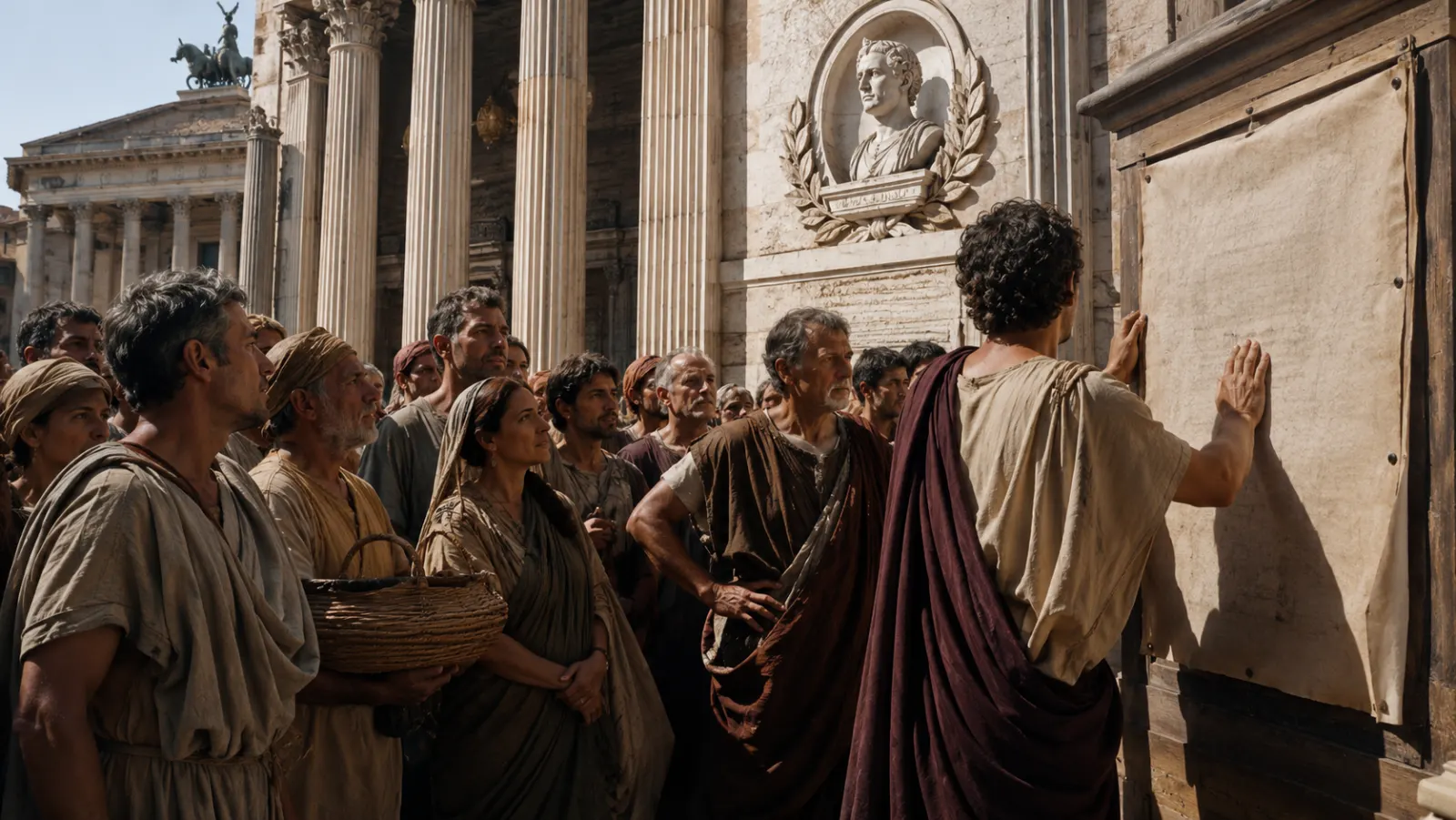
Augustus was praised for ending civil war and restoring order. Luke’s announcement of peace arrives in a world where Rome already had a public story about who brought peace and what peace required.
Americans hear the word peace and often think first of the absence of war, a cease-fire, or a private sense of calm. In the age of Augustus, peace was also a political claim. Rome had been torn by civil wars. Powerful men had raised armies against one another. Assassination, confiscation, and instability had scarred public life. When Octavian emerged victorious and became Augustus, many people had compelling reasons to celebrate a ruler who promised order after chaos.
That is why the language surrounding Augustus matters when we read Luke’s account of Jesus’ birth. The angels’ announcement of good news, a Savior, and peace did not introduce those words into an empty dictionary. The wider Roman world already used exalted language for rulers and benefactors. The similarity does not mean Luke copied a propaganda slogan line for line. It does mean the Christmas story speaks in a world where public claims about salvation and peace were already being made.
Augustus inherited a society exhausted by civil war
Octavian’s rise followed a century of political violence in the Roman Republic and a final struggle against Mark Antony and Cleopatra. His victory at Actium in 31 B.C. and the subsequent defeat of his rivals allowed him to present his rule as the restoration of stability. The Senate granted him the title Augustus in 27 B.C., and over time he accumulated a combination of powers that made him the dominant figure in Roman government.
The peace associated with Augustus was not mere advertising. Major civil wars did end. Trade benefited from greater stability. Roads, ports, provincial administration, and a professional army helped connect the Mediterranean world. For communities that had endured armies marching back and forth during elite power struggles, predictable government could feel like deliverance.
Roman peace was peace from the victor’s point of view
Yet “peace” in imperial language did not mean equality among peoples. Rome’s order rested on conquest and the credible threat of force. Provinces and client kingdoms were expected to remain loyal, pay revenue, and accept the strategic priorities of the empire. Rebellion could be answered with devastating violence. The same political system that reduced civil war within Rome expanded Roman control over other societies.
This is the tension inside the phrase Pax Romana, the Roman Peace. It names a genuine period of relative stability, especially when compared with previous civil conflict, but it can sound very different depending on where one stands. A merchant may value safer routes. A local ruler may value Roman backing. A heavily taxed peasant may experience the same system as extraction. A community defending its religious practices may worry about how far imperial demands will reach.
Augustus was honored with language larger than politics
In the Greek-speaking eastern Mediterranean, civic honors for Augustus sometimes used religious and cosmic language. The famous calendar inscription preserved from Priene in Asia Minor, dated to 9 B.C., celebrates Augustus as a benefactor and savior whose birth marked the beginning of “good news” for the world. Such inscriptions belonged to the civic and imperial culture of particular cities; they should not be treated as if every person in Judea repeated the same formulas. Still, they show what kinds of public praise were available in the age.
Imperial cult practices also varied from place to place. Jewish communities had strong theological reasons to resist worshiping the emperor as a god. Rome often worked with local arrangements rather than imposing one identical cultic pattern everywhere. That diversity is important. The New Testament’s Roman world was not one giant temple to Caesar. But claims about imperial benefaction, peace, loyalty, and honor were part of the political atmosphere.
Luke places a surprising announcement far from the imperial center
Luke begins chapter 2 with Augustus and an imperial decree, then shifts the reader’s attention to a family traveling to Bethlehem. The narrative moves downward in social scale: from emperor to local registration, from centers of power to a crowded town, from official authority to a newborn child. Later, the angelic message goes not to a Roman Senate or Herodian court but to shepherds in the fields.
The literary contrast is easy to feel even before we decide how explicitly political Luke intends it to be. Augustus can issue decrees across a vast realm, but the saving event Luke wants his readers to notice is not happening in Rome. The child called Savior and Lord appears within a family that does not control armies, provinces, or tax systems.
“Peace on earth” is not a promise of instant geopolitical calm
Christians sometimes read the angelic announcement as though Jesus’ birth should have immediately ended armed conflict. The rest of Luke makes clear that this is not the claim. Jesus grows up in a violent political world. He is eventually executed under Roman authority. His followers face conflict, persecution, and division. The Gospel’s peace is deeper than a temporary imperial settlement and also more demanding.
Luke connects peace with God’s saving work, reconciliation, forgiveness, the arrival of God’s promised Messiah, and the restoration announced by Israel’s prophets. That peace has social consequences, but it is not maintained by a legion. Jesus will teach enemy-love, mercy, generosity, and a kingdom in which status is overturned. The shape of His peace cannot be separated from the shape of His life.
Peace also became something Rome could display
Augustan political culture made order visible. Monuments, coins, civic calendars, public ceremonies, and building programs communicated the message that a new age had arrived after civil war. The famous Ara Pacis in Rome belongs to this world of public symbolism: peace was not only something people hoped to feel; it was something the regime represented, celebrated, and attached to Augustus’ rule. Across the provinces, local communities developed their own ways of honoring the emperor and participating in imperial culture.
That public dimension helps modern readers hear Luke more sharply. The angelic message is not delivered on an official monument and does not require a city council to ratify it. It is announced outside Bethlehem to shepherds. The Gospel’s peace is presented as news from God before it has political recognition. Luke does not deny that rulers can restrain disorder. He relocates humanity’s deepest hope for peace away from the prestige of the imperial center and toward the Messiah whom God has given.
The comparison warns modern readers against confusing order with salvation
Americans know the appeal of political promises: safety, prosperity, restored greatness, unity, peace. Those hopes are not foolish. Governments really can restrain violence, protect communities, or fail to do so. Christians are not required to treat public institutions with contempt. Romans 13, 1 Peter, and other New Testament texts show early Christians reasoning seriously about civil authority even under pagan rulers.
But Christmas places a limit on what politics can claim. No administration can bear the full weight of salvation. No president, emperor, party, army, or economy can reconcile humanity to God. When political order becomes a substitute gospel, Christians have forgotten where Luke directs the shepherds: not to Caesar’s palace, but to Jesus.
The phrase Pax Romana is useful only if we keep both words in view
“Pax Romana” is a later scholarly label, not a slogan that every first-century subject used. It describes a broad period in which Rome’s internal political order became more stable and the Mediterranean was increasingly integrated under imperial control. That stability had real human value. It could reduce the disruption caused by rival Roman armies and make long-distance trade more predictable.
But the peace was Roman: defined and defended by the victorious power. Frontier wars continued, revolts occurred, and conquered peoples did not receive equal political standing. Holding those facts together prevents two opposite distortions. Augustus was not merely a propagandist who accomplished nothing, and the empire was not a neutral peacekeeping system. Luke’s announcement lands in a world where political peace was both genuinely desired and morally incomplete.
Augustus mattered. His policies reshaped the Mediterranean world, and the stability associated with his reign was real enough to be celebrated. Historical honesty does not require Christians to deny that achievement. It requires us to see the whole picture: Roman peace was an imperial peace, secured by power and enjoyed unevenly.
Luke’s birth story does something quieter and more radical than a slogan war. It names the emperor and then moves past him. The center of the story is a child whose kingdom will not look like Rome’s. In a world already praising powerful men for bringing peace, the Gospel asks its readers to reconsider where lasting peace begins.


