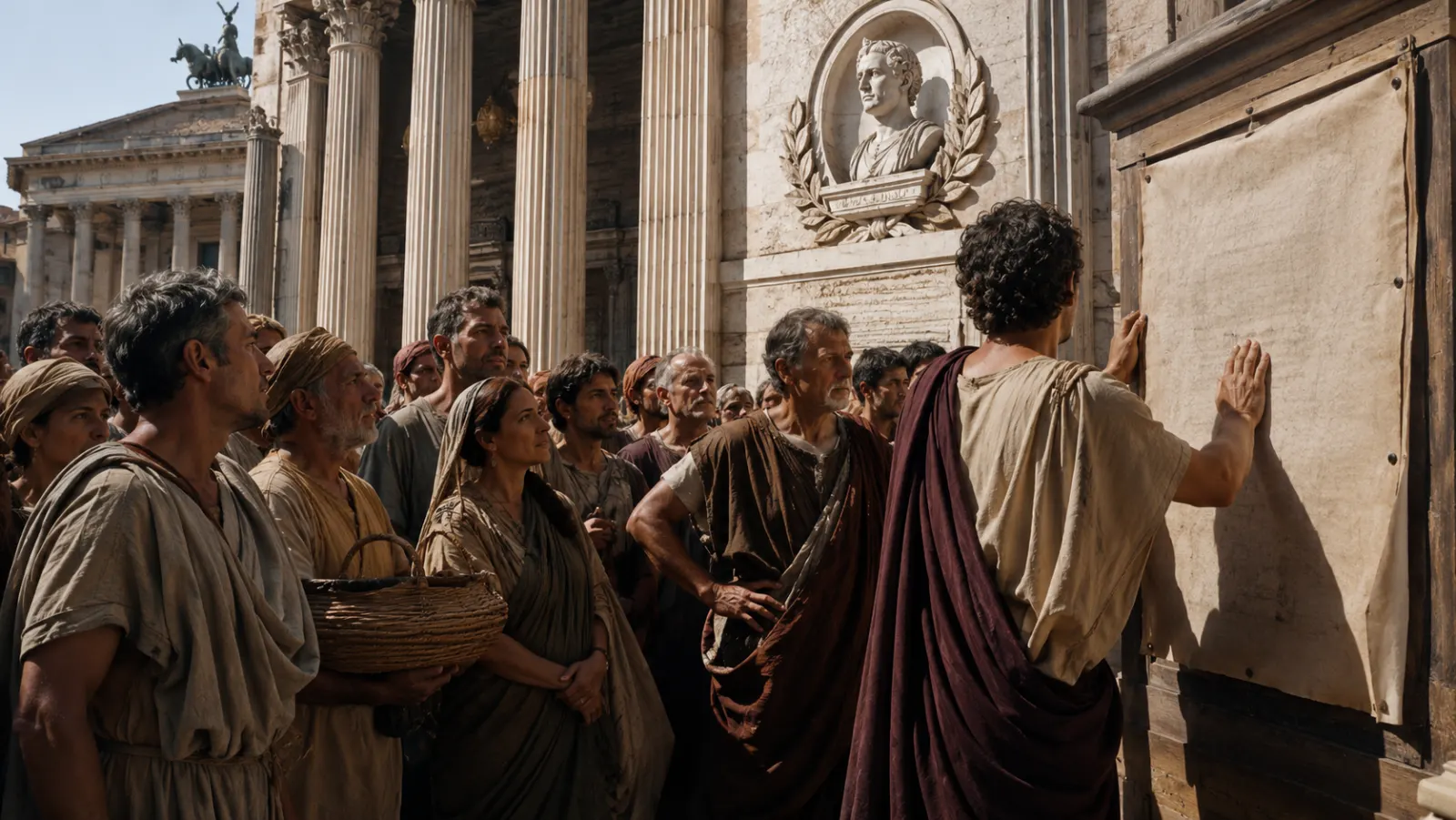
Augustus and Herod dominate the political record, but most people experienced history while carrying water, grinding grain, repairing tools, watching children, tending fields, sharing meals, and preparing for Sabbath.
Ancient history is unfair to ordinary people. Kings leave coins. Governors leave inscriptions. Armies leave camps. Wealthy families leave monumental houses. A woman kneading dough before sunrise rarely leaves a written record. A child carrying a small jar from a village water source does not get a chapter in Josephus. Yet these quiet routines made up most human life in the age of Augustus.
To imagine Judea around the birth of Jesus responsibly, we have to work from fragments: excavated houses, pottery, grinding stones, storage jars, agricultural installations, ritual baths, coins, animal bones, roads, and later literary evidence. Archaeology cannot give us a photograph of Mary’s kitchen or Joseph’s workshop. It can, however, rescue the Christmas story from the polished emptiness of a pageant and return it to a world of work, kinship, worship, dust, food, and weather.
Most lives were closer to the soil than to the palace
Judea and Galilee supported towns and significant cities, but agriculture remained fundamental. Families cultivated grain, vines, olives, legumes, fruit, and other crops according to local conditions. Sheep and goats provided milk, meat, wool, hides, and economic security. Fishing mattered especially around the Sea of Galilee. Craft work, construction, transport, commerce, and service to elites or institutions added other livelihoods.
Work followed daylight and season. Harvest created intense periods of labor. Grain had to be threshed, winnowed, stored, ground, and baked. Olives and grapes required processing. Animals needed care. Tools broke. Roofs needed repair. Ancient households were productive units as well as places of rest. Many tasks that modern Americans outsource to stores, utilities, and specialized services happened within or near the home.
A house was a working space, not just a private retreat
Domestic architecture varied with region, wealth, and settlement size. Stone construction was common where stone was readily available. Rooms could cluster around a courtyard, and upper levels or roofs could extend usable space. Storage, food preparation, sleeping, craft work, and family activity overlapped far more than in a modern suburban floor plan.
We should avoid importing the grand Roman atrium house of Pompeii into a Judean village. The Roman world contained enormous housing differences, from elite villas to small rural dwellings. The relevant lesson is variety. A Herodian palace and a peasant home belonged to the same political world while offering radically different experiences of space, privacy, food, and security.
Food required daily labor and local knowledge
Bread was a staple, but “bread” begins with fields, grain storage, grinding, fuel, water, kneading, and baking. Olives and olive oil were central. Grapes and wine were common. Lentils and other legumes, fruits, vegetables, dairy products, fish in appropriate regions, and occasional meat contributed to diets that differed by wealth, season, and location.
Food also carried religious meaning. Jewish dietary practices distinguished permitted from forbidden foods, and festival meals tied the household to Israel’s covenant story. A meal was never merely calories. It could express hospitality, purity, gratitude, status, memory, and belonging. Later Gospel scenes at tables make sense within this dense social world.
Water shaped the rhythm of settlement
Every household needed reliable water for drinking, cooking, washing, animals, and craft work. Springs, wells, cisterns, channels, and collected rainwater therefore mattered enormously. Carrying water was physical labor. Storage demanded care. In a dry season, distance from a water source could define the shape of a day.
Jewish ritual life added another dimension. Archaeologists have found stepped immersion pools, often called mikva’ot, from the late Second Temple period. Their presence testifies to the practical seriousness of ritual purity for many Jewish communities. Stone vessels are another archaeological marker associated with purity practices because stone was treated differently from pottery in later Jewish purity law.
Family and kin were economic as well as emotional realities
Ancient households were embedded in wider networks of kin. Marriage joined families. Inheritance affected land. Relatives could provide labor, protection, introductions, hospitality, and help in crisis. Reputation was social capital, and shame or conflict could spread beyond an individual. The modern ideal of a self-contained nuclear household does not capture the full texture of village life.
This social setting helps explain why the Gospel birth narratives pay attention to family lines, betrothal, household honor, relatives, and ancestral identity. Mary’s visit to Elizabeth is not an incidental coffee stop between two isolated individuals. Joseph’s Davidic descent matters within a culture where family memory could carry legal, social, and theological significance.
Sabbath interrupted the economy with worship and rest
Jewish time was not organized only by planting, market days, or royal demands. Sabbath created a recurring rhythm in which ordinary labor stopped and covenant identity came to the foreground. Festivals drew memory toward God’s acts for Israel and, for many, toward Jerusalem. Prayer, Scripture, family practices, and communal worship gave sacred structure to time.
That matters when we imagine Roman rule. An empire may control territory, taxation, and elite appointments without fully controlling a people’s calendar of meaning. A Judean household could live under Herod and Augustus while ordering its week around the God of Israel. Political subordination did not erase theological memory.
Material objects carried identity into daily routines
Archaeology becomes especially valuable when objects repeat across many homes. Pottery styles reveal local production and exchange. Grinding stones point to food preparation. Storage jars show the importance of keeping grain, oil, wine, and water. Lamps extend usable light after sunset but also remind us how different night felt before electric illumination. Textile tools preserve traces of spinning and weaving that written political histories almost never mention.
Some objects also speak to religious identity. Stone vessels and ritual baths found in Jewish settings of the late Second Temple period are not random household clutter; they fit a wider concern with purity. Coins and imported wares, meanwhile, reveal participation in regional markets. A single household could therefore display both strong Jewish practice and economic connection to a larger Hellenistic-Roman world. The two realities did not cancel each other.
The birth narratives give us details—and leave many blanks
Luke tells us that Mary and Joseph traveled, that Jesus was wrapped and laid in a manger, that shepherds came, and that the child was later circumcised and presented according to the law. Matthew tells us of Joseph’s dreams, the Magi, Herod, flight, and return. The Gospels do not tell us the architecture of the birth room, the exact menu, Mary’s age, Joseph’s income, or whether they owned particular animals.
Responsible historical imagination respects those silences. We can describe what homes, work, food, and religious practice often looked like in the period without turning a plausible reconstruction into a biblical fact. That distinction is especially important at Christmas, where centuries of art have made later traditions feel as if they were printed in the text.
We should picture differences inside Judea too
“Everyday life” was not one experience shared equally by everyone. A priestly household in Jerusalem, a wealthy estate owner, a craft worker in a town, a tenant farmer, a widow with limited resources, and a shepherd moving with animals could inhabit very different material worlds. Gender, age, health, status, family connections, and proximity to markets all shaped labor and security.
The same is true geographically. Jerusalem’s festival economy and monumental Temple complex were unlike a small village. A port city such as Caesarea was unlike an inland farming settlement. Galilee had its own urban and rural patterns. Historical reconstruction works best when it offers a range of plausible lives rather than creating one generic “Bible-times family” and treating it as universal.
The Roman world was built from imperial decrees, royal projects, taxes, armies, and trade. It was also built every morning from fires being lit, grain being ground, water being carried, animals being fed, children being taught, and prayers being remembered. Most people lived history at that scale.
The Christian claim of the incarnation makes that ordinariness especially significant. Jesus is not introduced as a divine visitor floating above material life. He is born into a real Jewish family in a real place, within the routines and vulnerabilities of human existence. Archaeology cannot prove the theology of that claim, but it helps us see the kind of world the claim enters.