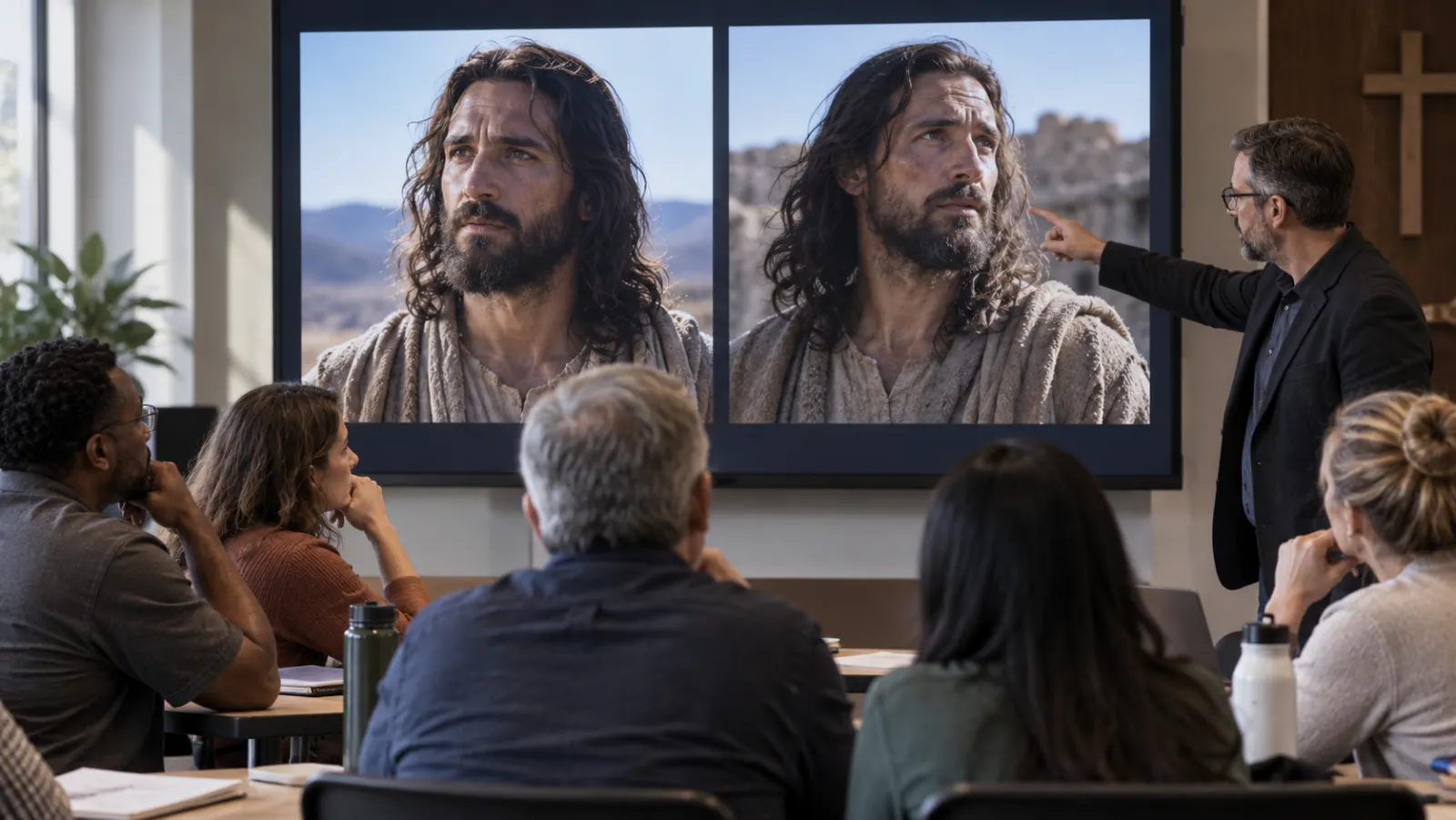
Digital images can now make Jesus say almost anything. The incarnation calls Christians to truth, restraint, and respect for the difference between representation and presence.
A photorealistic Jesus looks into the camera and delivers a new message. His accent, face, and gestures feel intimate. No actor performed the scene, no witness recorded it, and every word came from a prompt. For churches already fluent in illustrated Bibles and films, the leap can seem small. It is not.
The incarnation anchors Christian proclamation in a life that occurred: heard, touched, remembered, contested, crucified, and proclaimed risen. Synthetic media can serve imagination, but it can also blur illustration into fabricated evidence.
Every portrait is an interpretation
The Gospels do not supply a physical description from which to reconstruct Jesus’ face. Artists inevitably choose ethnicity, age, clothing, expression, and setting. A responsible image should not pretend neutrality or smuggle an American racial ideal into first-century Judea.
Photorealism changes the ethical stakes
A painting announces that it is a painting. A synthetic video may imitate the visual grammar of testimony. When viewers could reasonably believe an actor, scholar, pastor, or historical source produced something they did not, clear labeling becomes part of truthfulness.
Jesus is not a customizable spokesperson
Generative tools make it easy to recruit a sacred face for a political endorsement, product, prophecy, or private reassurance. The issue is not merely bad taste. It is the use of divine authority to bypass discernment and make the creator’s words feel unanswerable.
Representation is not presence
An AI companion may simulate endless patience and quote Scripture. It cannot consent, suffer, keep covenant, receive correction, or share responsibility. Christians can use tools for access and study while refusing to call statistical imitation a member of the body of Christ.
Churches need a disclosure habit
Media teams can label generated imagery, preserve source files, obtain consent for real likenesses, and prohibit fabricated testimony. Leaders should disclose when a voice or face has been synthesized, even if the law does not require it and the result seems harmless.
Teach slow seeing
Congregations need practical questions: Who made this? What is the original source? Is the claim corroborated? What emotion is the image trying to produce? The goal is not permanent suspicion. It is attention capable of protecting truth in an environment designed for instant reaction.
Questions for embodied practice
To bring this reading into an actual congregation, begin with a precise question: Could a reasonable viewer mistake this for real footage? Return to 1 John 1:1–4, separate what the passage states from what we infer, and listen first to people who will live with the consequences. Then choose one bounded action, name who owns it, and set a review date. The incarnation will not let a conclusion remain safely general when bodies, homes, and relationships will carry its cost.
The answer may land differently across American lives: What choices shape this depiction of Jesus? Income, race, region, age, disability, work schedule, gender, and family status can alter the experience without altering the gospel. A mature community asks for concrete cases, seeks relevant expertise, and permits disagreement without threatening belonging. Biblical application becomes more faithful when it can receive new evidence, repair harm, and explain what changed.
A pastoral way to work through “Deepfakes, AI Jesus, and the Reality of a Human Face” is to ask: Have we clearly labeled synthetic media? Sincerity is not enough. Care requires consent, resources, limits, and accountability. A church should say what it can offer, what lies outside its competence, and which qualified partners it will involve. Prayer and study sustain the process; neither replaces professional attention nor permits another person's vulnerability to become institutional publicity.
To bring this reading into an actual congregation, begin with a precise question: Are we assigning a tool the role of a person? Return to 1 John 1:1–4, separate what the passage states from what we infer, and listen first to people who will live with the consequences. Then choose one bounded action, name who owns it, and set a review date. The incarnation will not let a conclusion remain safely general when bodies, homes, and relationships will carry its cost.
The answer may land differently across American lives: Which source can verify the claim being made? Income, race, region, age, disability, work schedule, gender, and family status can alter the experience without altering the gospel. A mature community asks for concrete cases, seeks relevant expertise, and permits disagreement without threatening belonging. Biblical application becomes more faithful when it can receive new evidence, repair harm, and explain what changed.
When this practice is reviewed, the community can record what happened after asking: Could a reasonable viewer mistake this for real footage? The impression of those who designed the response is not enough. Receive voluntary testimony, notice unexpected costs, and identify who remained outside. If the practice did not produce truth, justice, care, and communion, changing it does not betray biblical conviction; it may be a humble way to obey more faithfully. Review 1 should end with a decision people can understand and see communicated.
When this practice is reviewed, the community can record what happened after asking: What choices shape this depiction of Jesus? The impression of those who designed the response is not enough. Receive voluntary testimony, notice unexpected costs, and identify who remained outside. If the practice did not produce truth, justice, care, and communion, changing it does not betray biblical conviction; it may be a humble way to obey more faithfully. Review 2 should end with a decision people can understand and see communicated.
When this practice is reviewed, the community can record what happened after asking: Have we clearly labeled synthetic media? The impression of those who designed the response is not enough. Receive voluntary testimony, notice unexpected costs, and identify who remained outside. If the practice did not produce truth, justice, care, and communion, changing it does not betray biblical conviction; it may be a humble way to obey more faithfully. Review 3 should end with a decision people can understand and see communicated.
When this practice is reviewed, the community can record what happened after asking: Are we assigning a tool the role of a person? The impression of those who designed the response is not enough. Receive voluntary testimony, notice unexpected costs, and identify who remained outside. If the practice did not produce truth, justice, care, and communion, changing it does not betray biblical conviction; it may be a humble way to obey more faithfully. Review 4 should end with a decision people can understand and see communicated.
When this practice is reviewed, the community can record what happened after asking: Which source can verify the claim being made? The impression of those who designed the response is not enough. Receive voluntary testimony, notice unexpected costs, and identify who remained outside. If the practice did not produce truth, justice, care, and communion, changing it does not betray biblical conviction; it may be a humble way to obey more faithfully. Review 5 should end with a decision people can understand and see communicated.
When this practice is reviewed, the community can record what happened after asking: Could a reasonable viewer mistake this for real footage? The impression of those who designed the response is not enough. Receive voluntary testimony, notice unexpected costs, and identify who remained outside. If the practice did not produce truth, justice, care, and communion, changing it does not betray biblical conviction; it may be a humble way to obey more faithfully. Review 6 should end with a decision people can understand and see communicated.
Christians need not fear every new image-making tool. They do need to remember that the faith rests on God’s real self-giving, not on our ability to generate a convincing face.
The Word became flesh once in history. Honoring that claim means refusing to make Jesus appear to say what our software—and our desire for authority—put in his mouth.