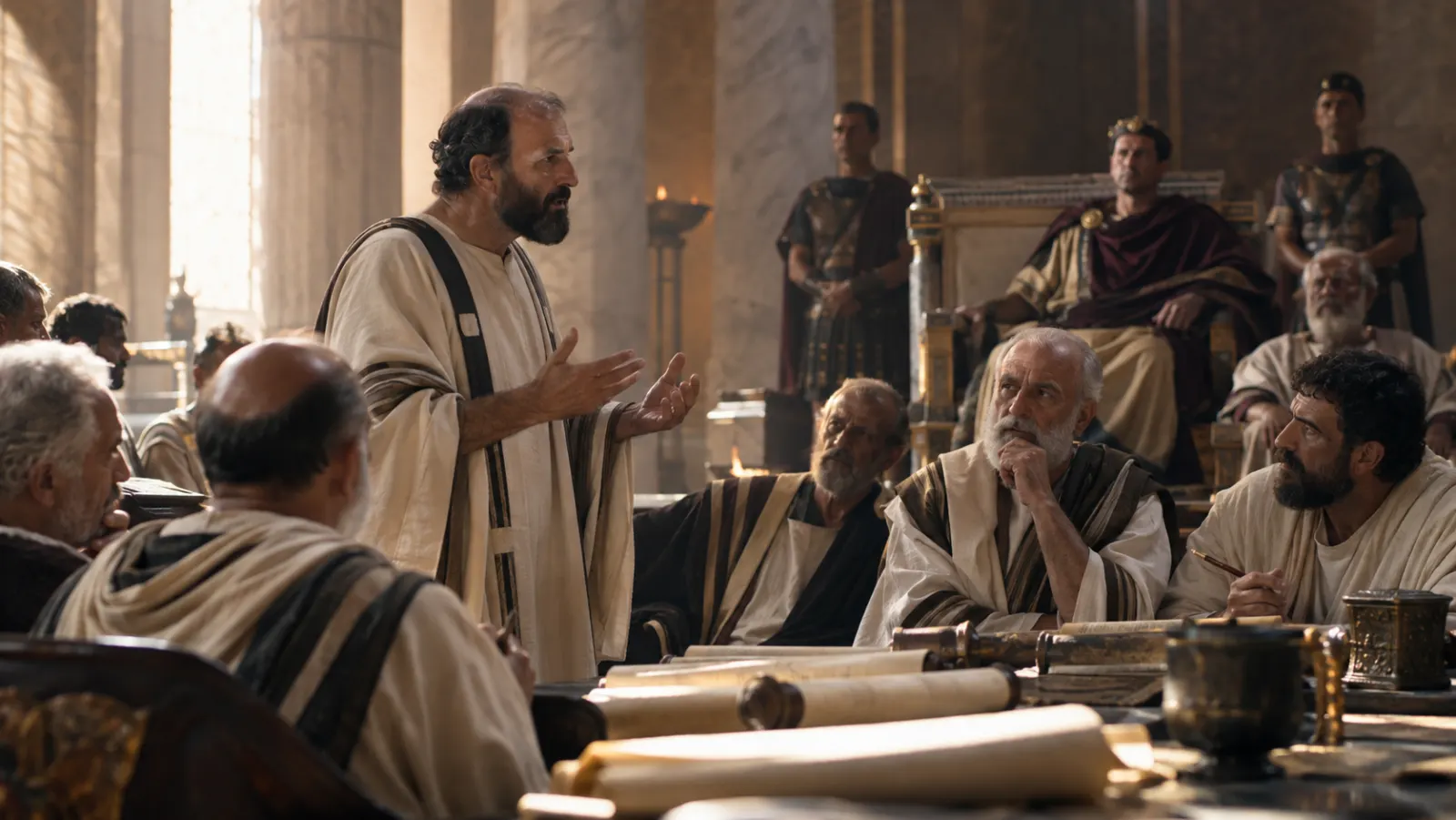
Nicaea was called amid a fierce dispute over whether the Son was a creature or truly shared the Father’s divine being. Its creed sharpened Christian language, but the history before and after the council is messier than popular myths suggest.
Few church councils attract as many internet myths as Nicaea. Constantine supposedly invented the Trinity there, turned Jesus into God by political decree, selected the books of the Bible, and imposed a brand-new religion on reluctant Christians. The actual council was certainly political as well as theological, but the surviving sources tell a different story.
By 325, Christians had been debating the relation of Jesus to the Father for years, and they had been worshiping Jesus, baptizing in Father-Son-Spirit language, and arguing about divine unity for generations. Constantine did convene the council and wanted religious peace in his empire. But he did not arrive with an empty theological slate on which he wrote the deity of Christ.
Arius Did Not Teach That Jesus Was Merely an Ordinary Man
The controversy is often simplified into “Jesus is God” versus “Jesus is human.” Arius was more complex. He regarded the Son as preeminent, heavenly, and prior to creation, but not eternal in the same way as the Father. The Son, in the Arian scheme, was ultimately a creature brought into being by God and therefore not of the same divine substance as the Father.
This explains why the conflict could become so intense among people who all used exalted language about Christ. The issue was not whether Jesus deserved respect. It was whether the Son belonged on the Creator side of the Creator-creature distinction.
Stanford’s history of trinitarian doctrines notes that Constantine first urged Arius and Alexander to stop quarreling and seek unity. When the dispute continued, he called a larger council at Nicaea. Modern estimates of attendance vary, and the traditional number 318 became symbolically important later. Most bishops came from the eastern half of the empire.
Constantine’s involvement matters. Christianity was no longer an illegal movement surviving at the margins. Imperial sponsorship changed the social setting of theological dispute and gave council decisions political consequences. Christians should not romanticize that shift. But political involvement is not the same as theological invention.
Why Homoousios Became the Flash Point
The creed says the Son is “begotten, not made” and of one substance with the Father. The Greek term homoousios was not a Bible word, and its history was complicated. Its force at Nicaea was largely exclusionary: the Son is not a creature of a different order from God. The creed also condemned slogans implying that there was a time when the Son did not exist.
The Council did not thereby solve every later question about divine personhood. In fact, the decades after Nicaea were filled with further controversy over terminology, rival creeds, imperial pressure, and competing parties. Nicene orthodoxy was not instantly uncontested.
Many churches today recite a creed commonly called the Nicene Creed that includes an expanded confession of the Holy Spirit as Lord and giver of life. The original 325 creed says much more about the Son than about the Spirit. The fuller form is associated with the later fourth-century settlement and the Council of Constantinople in 381, though the textual history of the expanded creed is more complicated than a simple one-meeting authorship story.
That development is historically important. It shows doctrine being refined through controversy rather than delivered all at once in finished vocabulary. It also cautions against treating “Nicaea” as shorthand for every later trinitarian formula.
What Nicaea Definitely Did Not Do
Nicaea did not vote to choose the books of the New Testament canon. Its surviving canons address church discipline, ordination, ecclesiastical jurisdiction, and related matters, while the creed addresses the Arian dispute. The popular story that bishops selected the Bible at Nicaea is a modern conflation of separate historical processes.
Nor did the council take a church that thought Jesus was merely human and suddenly divinize him. Pre-Nicene sources such as Ignatius, Justin, Irenaeus, and Tertullian already testify to remarkably high views of Christ, even though their terminology differs and development is real.
Constantine Convened the Council but Did Not Author the Theology
Councils do not become historically interesting only if they invent something. Nicaea mattered because an existing scriptural and worshiping tradition faced a question that demanded sharper boundaries. The resulting language became a standard by which later Christians judged competing accounts of the Son.
For readers today, that is both less sensational and more useful than conspiracy narratives. It invites a real historical question: did the council’s clarification faithfully express the Christian sources that came before it? That question can be investigated instead of assumed.
The decades after 325 also complicate the theory that Constantine simply imposed one settled theology. Imperial favor shifted. Bishops who opposed Nicaea sometimes gained influence, Athanasius was repeatedly exiled, and various formulas competed across the empire. Constantine himself eventually supported reconciliation with Arius before Arius died. None of this makes politics irrelevant; it shows politics did not move in one simple Nicene direction. The eventual dominance of Nicene theology came through a long fourth-century struggle involving emperors, bishops, councils, exile, preaching, and theological argument.
A Vote Did Not Turn a Man into God
One modern myth imagines a close political vote in which Jesus was promoted from human teacher to deity. The council’s actual dispute presupposed a much higher starting point. Arius and his allies already affirmed the Son’s heavenly preexistence and extraordinary rank. Their opponents argued that such exalted language was still insufficient if the Son remained a creature. The Nicene formula therefore did not move Jesus from ordinary humanity to divinity by decree; it defined the Son’s relation to the Father against a specific subordinationist account.
The bishops’ decision also drew on a preexisting Christian scriptural and worship tradition. The council could not have succeeded by simply ordering churches to begin honoring a figure they had never treated as divine. The controversy was so explosive precisely because Christians were already deeply invested in how Christ could be worshiped while God remained one. Nicaea supplied a doctrinal boundary to that inherited practice.
Nicaea Was a Major Chapter, Not the Beginning of the Story
The council’s creed also tells us what the bishops considered non-negotiable. It did not define every possible philosophical model of the Trinity. It targeted specific Arian claims by affirming that the Son comes from the Father’s own divine reality and is not made from nothing. The creed works like a boundary marker more than a complete metaphysical treatise. Later generations would spend enormous effort explaining the terms and extending the same logic to disputes about the Holy Spirit.
The council remains historically important precisely because it gave one answer institutional force. That fact should be studied honestly without confusing political enforcement with the origin of the beliefs being enforced.
The council’s authority also grew over time rather than functioning like a switch thrown in 325. Many bishops who opposed Arius remained uneasy about homoousios, partly because the term could be misunderstood, and subsequent emperors supported different theological parties. The long road to the settlement associated with Constantinople in 381 shows that Nicene language had to be defended, interpreted, and received. That reception history makes the council more historically credible, not less: the creed was not simply an imperial slogan that ended debate. It became dominant through decades of argument over how best to confess the scriptural God.
Nicaea was neither a pristine Bible study nor an imperial magic trick. It was a fourth-century council embedded in the politics, personalities, and theological arguments of its time.
Constantine convened it. Arius’s teaching supplied the immediate crisis. Bishops adopted language intended to say that the Son is truly divine and not made.
The Trinity’s history did not begin in 325, and it did not end there. Nicaea is a major chapter in a much longer Christian effort to speak consistently about the one God, Jesus Christ, and the Holy Spirit.