John 14:28 is often cited against Christ’s full deity. Historic trinitarian interpretation reads the verse in light of Jesus’ incarnate mission and John’s wider portrait rather than treating “greater” as a one-word definition of divine essence.
Some Bible verses feel as though they were written to disrupt a neat doctrinal summary. John 14:28 is one of them. Jesus tells his disciples that the Father is greater than he is. If Christianity later claims the Father and Son are equally divine, the question is unavoidable: did the creed contradict Jesus?
A serious answer cannot make the sentence disappear. Nor should it isolate the sentence from the Gospel in which it appears. John is the same book that opens by identifying the Word as God, depicts the Son receiving divine honor, records Jesus speaking of shared pre-creation glory, and ends its main resurrection narrative with Thomas addressing Jesus as Lord and God.
Start with the Farewell Discourse, Not an Isolated Sentence
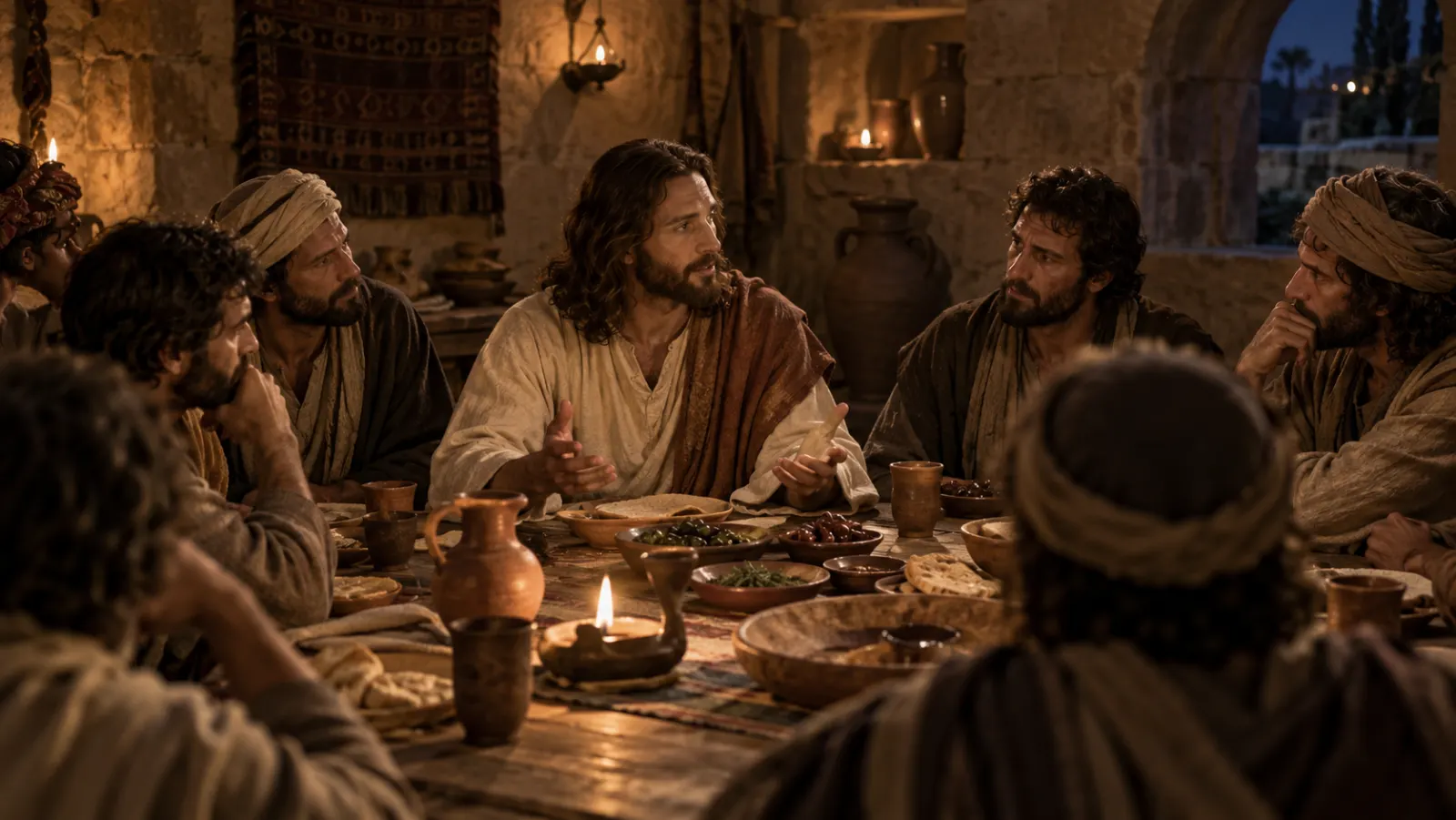
John 14 is not an abstract classroom discussion about ontology. Jesus is preparing frightened disciples for his departure. He speaks of going to the Father and tells them that if they loved him they would rejoice because he is going to the Father. “Greater” appears inside a movement from humiliation toward the Father’s presence and glory.
Historic trinitarian interpreters therefore often distinguish equality of divine nature from order and condition in the incarnate mission. The Son can truly humble himself, obey, be sent, suffer, and return to the Father without those roles proving that he is a created being.
Paul describes Christ as existing in divine form and then taking the form of a servant, humbling himself and becoming obedient to death. The movement is not from ordinary creature to temporary humility. It is from exalted status into chosen lowliness and then public exaltation. Christian theology later called this the incarnation and humiliation of the Son.
That framework helps explain why statements of obedience and dependence are not automatically denials of deity. They may be precisely what Christians expect if the divine Son has genuinely entered human life rather than merely appearing human.
John Distinguishes Father and Son Too Sharply for Modalism
The verse also guards against a different error. If Father and Son were simply two names for the same person, Jesus’ language about going to the Father, loving the Father, being sent by the Father, and asking the Father would become theatrical self-dialogue. John does not write that way. Relationship is real.
Trinitarian theology therefore does not answer John 14:28 by saying the Father and Son are interchangeable. It says the distinction belongs eternally to who God is, while the incarnation introduces a real economy of sending and obedience.
In ordinary language, greatness can refer to rank, position, role, visible glory, authority in a mission, or nature. Context determines which comparison is being made. The presence of the comparative word by itself does not settle the metaphysical question.
John’s wider Gospel makes a straightforward “the Father is divine and Jesus is a lesser creature” reading difficult because John assigns Jesus creation, life-giving authority, divine honor, and preexistent glory. Any interpretation of 14:28 has to account for both sets of passages.
The Early Church Did Not Ignore the Objection
Augustine discusses texts in which the Son appears less than the Father and distinguishes the Son’s divine equality from the humility of the incarnate mission. His exact philosophical framework is not the only way Christians have articulated the issue, but the existence of the discussion matters. The church did not preserve difficult verses by ignoring them; theologians had to integrate them.
That history is useful for skeptical readers because it shows the tension was not discovered by modern critics. The classical doctrine was formed in conversation with the same verses critics still cite.
Equality and Order Are Not the Same Question
Christian apologetics becomes fragile when it presents only verses that sound immediately supportive. John 14:28 belongs in the conversation because the Trinity claims to explain the whole biblical pattern: unity and distinction, divine status and genuine obedience, eternal Word and real humanity.
Readers may still decide the explanation is unpersuasive. But the fair comparison is between full interpretations, not between a creed and a single detached sentence.
Christian traditions have not always described the Father-Son relation in identical ways. Eastern theology often emphasizes the Father as the personal source within the Trinity, while Western theology developed other conceptual emphases. Those differences show why a short verse cannot be mapped onto one simplistic hierarchy. The creedal consensus is narrower: the Son is not a creature and shares the divine nature, while Father and Son are personally distinct. John 14:28 must be interpreted inside that larger scriptural and historical conversation rather than made to decide every later question by itself.
John 17 Complicates a Simple Hierarchy
Only a few chapters later, Jesus asks the Father to glorify him with the glory he had with the Father before the world existed. That statement does not erase John 14:28; it makes a flat interpretation harder. A creature may be exalted by God, but John’s language of shared pre-creation glory belongs to the same Gospel in which Jesus says the Father is greater. The reader is therefore pushed toward a distinction between the Son’s present humbled condition and his deeper identity and relation to the Father.
Trinitarian theology later expresses that distinction by talking about the Son according to his divine nature and according to his incarnate mission. Such language can sound technical, but it addresses a narrative problem already present in John: the one who is sent and obedient is also the one who came from the Father, shared glory before creation, and returns to the Father. The doctrine attempts to preserve that whole arc.
The verse also has pastoral weight in John’s narrative. Jesus is not protecting an abstract status claim; he is comforting disciples who fear abandonment. His going to the Father means the completion of his mission and the coming of the Spirit. Reading the sentence only as a metaphysical ranking can miss the emotional and narrative function of the farewell discourse. Theology should explain the verse without flattening the scene that gives it meaning.
The verse remains difficult only if a doctrine requires it to mean the opposite of what it says. Trinitarianism instead lets the Father be greater within the economy of the Son’s mission while denying that the Son is a creature by nature.
The Hard Text Belongs Inside the Whole Gospel
It is also worth noticing that the New Testament can speak of ordered relations without treating order as inferiority of nature. The Son is sent by the Father; the Spirit is sent in relation to Father and Son; the apostles are sent by Christ. These missions are not interchangeable, but role and source do not automatically answer the question of essence. Classical trinitarianism builds heavily on that distinction. Critics may reject the distinction, but they should recognize that it is not an ad hoc escape from one verse. It is a framework developed to explain a repeated biblical pattern of equality, relation, mission, and obedience.
So the verse should not be neutralized, but neither should it be made to carry more than John’s narrative allows. Jesus can truly speak from a position of humble mission and still be the preexistent Son whom the same Gospel places within divine glory, life, and honor.
“The Father is greater than I” is not a verse trinitarian Christians need to fear. It is a verse they need to interpret carefully.
John’s Jesus is genuinely sent, obedient, and returning to the Father. John’s Jesus is also preexistent, life-giving, honored, and confessed as divine.
The doctrine of the Trinity and incarnation developed in part because Christians believed both portraits belonged to the same Jesus and refused to discard either one.