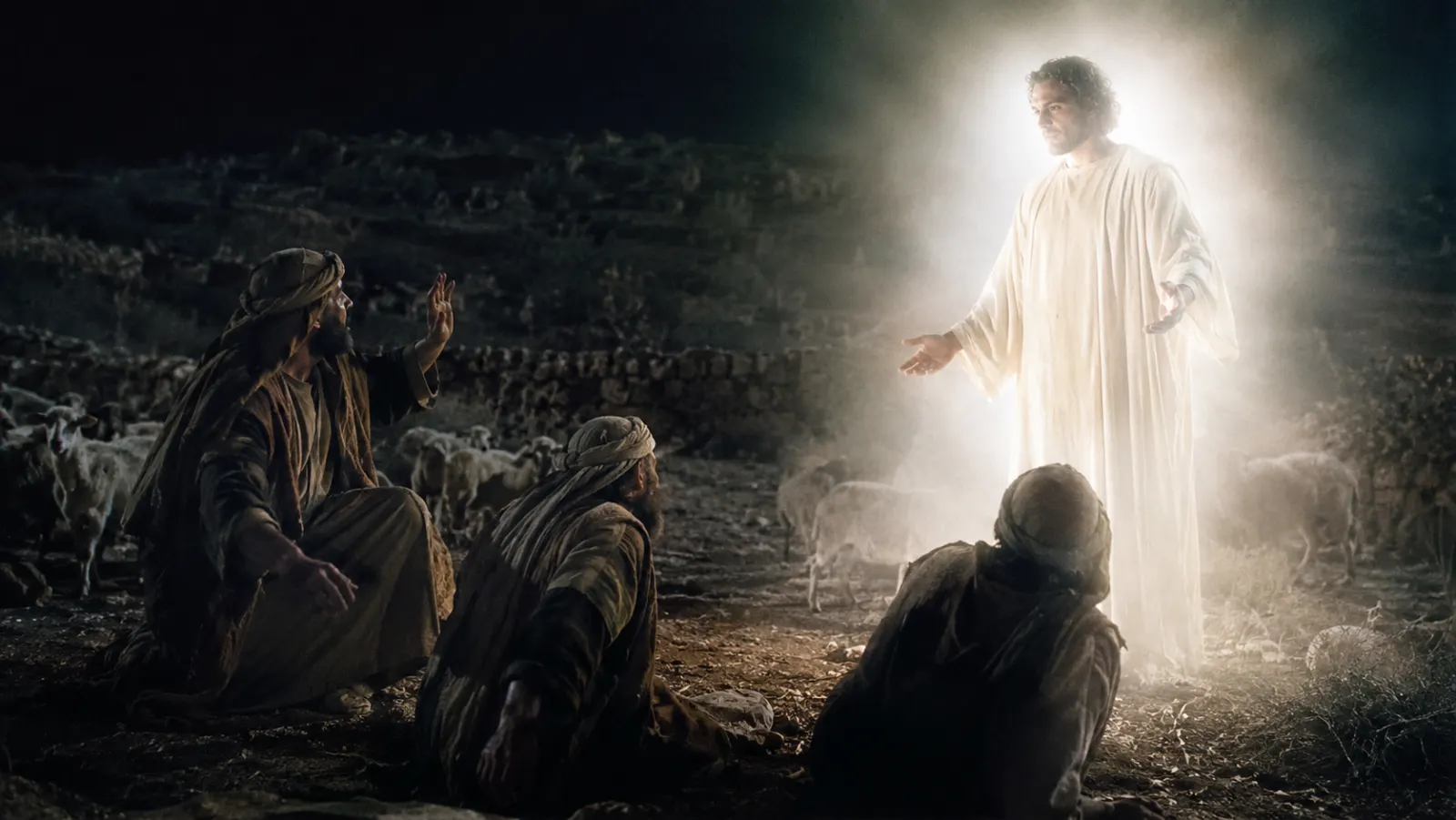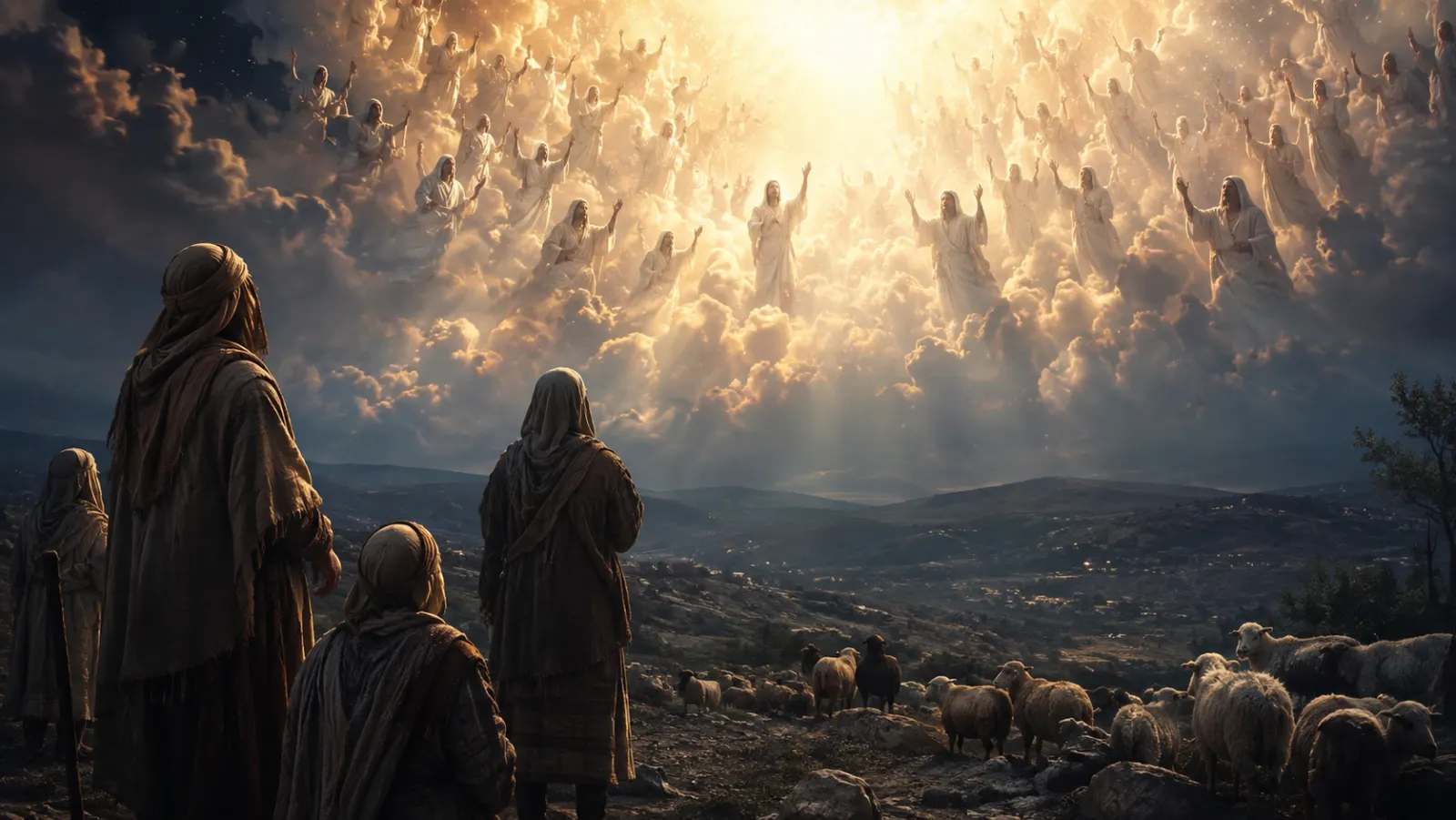
Luke says the heavenly host was praising God and “saying,” not explicitly singing. That small detail is a useful test case in how Christians distinguish Scripture from beloved Christmas tradition.
Few Christmas lines are more embedded in American memory than “Angels we have heard on high.” Church choirs swell, brass sections enter, children stretch out the Gloria, and nobody stops mid-carol to ask whether Luke ever says the angels sang. He does not—at least not explicitly.
Luke 2 says a multitude of the heavenly host appeared, praising God and saying words of glory and peace. That observation sometimes gets presented as a Christmas “gotcha”: the angels did not sing. But that conclusion goes too far in the opposite direction. Luke tells us what they said and that it was praise. He does not specify the musical form. The most accurate answer is less dramatic and more useful: singing is possible, but it is not stated.
The verb Luke uses is ordinary speech language
The Greek wording uses a verb commonly translated “saying.” That is a real textual detail, and it is worth preserving. When readers imagine the scene, they should know they are adding musical performance if they picture a choir. Luke’s narration itself does not mention melody, instruments, or song.
Yet biblical language does not always create a hard wall between saying and singing. Songs can be introduced with speech verbs, and praise can be spoken, chanted, or sung. Grammar alone cannot prove silence or melody. The text’s certainty is narrower: the heavenly host praises God and communicates a declaration.
Why Christmas tradition naturally turned the scene into music
Luke’s opening chapters are already saturated with poetic praise. Mary’s Magnificat, Zechariah’s prophecy, the heavenly declaration, and Simeon’s words have all been treated as songs in Christian worship. The church has sung these texts for centuries because their form and content invite musical expression.
That makes the caroling imagination understandable. A multitude of heavenly beings praising God practically begs composers to write music. The mistake is not creating a song. The mistake would be claiming the song arrangement is part of Luke’s eyewitness detail. Art can elaborate faithfully as long as it does not pretend to be quotation-level history.
This is a small example of a larger Christmas-reading problem
American Christians often encounter the nativity through a blend of Gospel text, carols, children’s books, movies, church pageants, Renaissance art, and family tradition. Over time the layers fuse. We remember a star over the manger, three kings at the stable, animals gathered around, an innkeeper turning the couple away, and angels singing in the sky as though one Gospel narrates the whole tableau.
Some of those elements may be reasonable artistic choices; others come from later tradition; some conflict with the most likely sequence of the texts. Learning to separate the layers is not an attack on Christmas. It is a way of letting Scripture surprise us again.
Precision does not require becoming a holiday scold
There is a certain kind of Bible trivia that enjoys ruining the room: “Actually, the Bible never says…” Sometimes that correction is needed. But if factual accuracy becomes a performance of superiority, we have missed the spirit of the text we are defending.
A healthy approach is generous and precise. Sing the carol. Enjoy the choir. Let children wear angel costumes. Then, when teaching Luke, say clearly that the Gospel describes praise and speech without specifying singing. Christians do not have to choose between biblical literacy and creative celebration.
What the heavenly praise actually emphasizes
The content matters more than the performance. The host directs glory upward to God and announces peace on earth among those who receive his favor. The angels are not showcasing angelic artistry. They interpret the birth.
That is why debates over singing should remain secondary. Whether the words were spoken, chanted, or sung, their theological function is the same: heaven responds to Jesus’ birth by glorifying God. The shepherds are given a frame for understanding what they are about to see in Bethlehem.
Music can help us receive the text without replacing it
Christian worship has always used music to carry biblical language into memory. Many Americans can recall Luke 2 phrases because they first heard them in a carol. Music can deepen attention, join doctrine to emotion, and make communal praise possible in a way ordinary speech often does not.
The danger comes only when the song becomes more authoritative than the passage. The best Christmas music sends listeners back to Scripture with sharper ears. It helps us feel the scale of the praise while allowing Luke’s own wording to set the boundaries of what we claim happened.
A better question than “Did they sing?”
The more important question is why heaven praises at all. Luke’s answer is the birth of a Savior, Messiah, and Lord. The angelic multitude does not celebrate generic seasonal goodwill. It responds to a specific act of God in history.
That focus can rescue Christmas music from sentimentality. The point of the Gloria is not that December is magical. It is that God has acted in Christ. If our songs preserve that center, they are doing exactly what Christian art should do: interpreting the event without replacing it.
The history of Christian worship explains why the “song” language became natural
Long before modern Christmas albums, Christians used Luke’s words in liturgy. The Gloria became part of worship in major Christian traditions, and composers repeatedly set the angelic declaration to music. Over centuries, the difference between “the angels praised and said” and “the angels sang” naturally faded in devotional memory.
That history should make us more patient with the tradition. People were not necessarily trying to falsify Luke; they were worshiping with Luke. The important scholarly task is simply to keep categories clear: liturgical reception tells us how Christians used the text, while exegesis asks what the text itself explicitly reports.
Carols often preserve theology even when they add imagery
A carol is not a police report. Poetry condenses, expands, personifies, and imagines. “Hark! The Herald Angels Sing” does not become worthless because Luke says “praising God and saying.” Its theological center—the birth of Christ provoking heavenly praise—fits the narrative even if the musical form is an artistic choice.
The better question for Christians is whether our artistic additions illuminate the biblical claim or distract from it. A beautiful song that directs worship toward Christ can be faithful art. A memorable lyric that teaches a false historical claim should be corrected. Discernment is more useful than either gullibility or cynicism.
What we can say with confidence
We can say the heavenly multitude praised God. We can say it communicated words that Luke records. We can say the scene has inspired Christian music from ancient worship to contemporary Christmas albums. We cannot say Luke explicitly reports singing, and we cannot say his wording rules singing out.
That may sound like an unsatisfying middle answer, but it models a mature way to read Scripture. Confidence should match evidence. Where the text is clear, speak clearly. Where it leaves room, leave room. That discipline matters far beyond one Christmas question.
A precise reading can deepen, not flatten, the carols
Once we know Luke’s exact wording, familiar music can become more interesting. We notice which phrases come directly from the text and which are poetic expansions. We hear how composers have interpreted the scene rather than unconsciously treating every lyric as a Gospel quotation.
That kind of listening is richer than simple debunking. Scripture becomes the score beneath the score. The carol remains art, but the biblical text becomes audible again inside it.
The point survives either way
Whether the heavenly praise was spoken or sung, Luke’s theological claim does not move. Heaven recognizes the significance of Jesus’ birth and responds by glorifying God. The shepherds hear a declaration they can carry with them into Bethlehem.
That shared center is more important than winning a trivia question. Good interpretation preserves the distinction without allowing the distinction to swallow the message.
So, did the angels sing? Luke does not tell us. He says they praised God and said the words that follow. Singing remains possible, but it should not be advertised as a detail the text explicitly supplies.
That modest conclusion leaves almost everything we love intact. Keep the carols. Keep the choir. But let the distinction sharpen our habits: tradition can be beautiful without becoming Scripture, and Scripture can be honored without making us afraid of imagination.