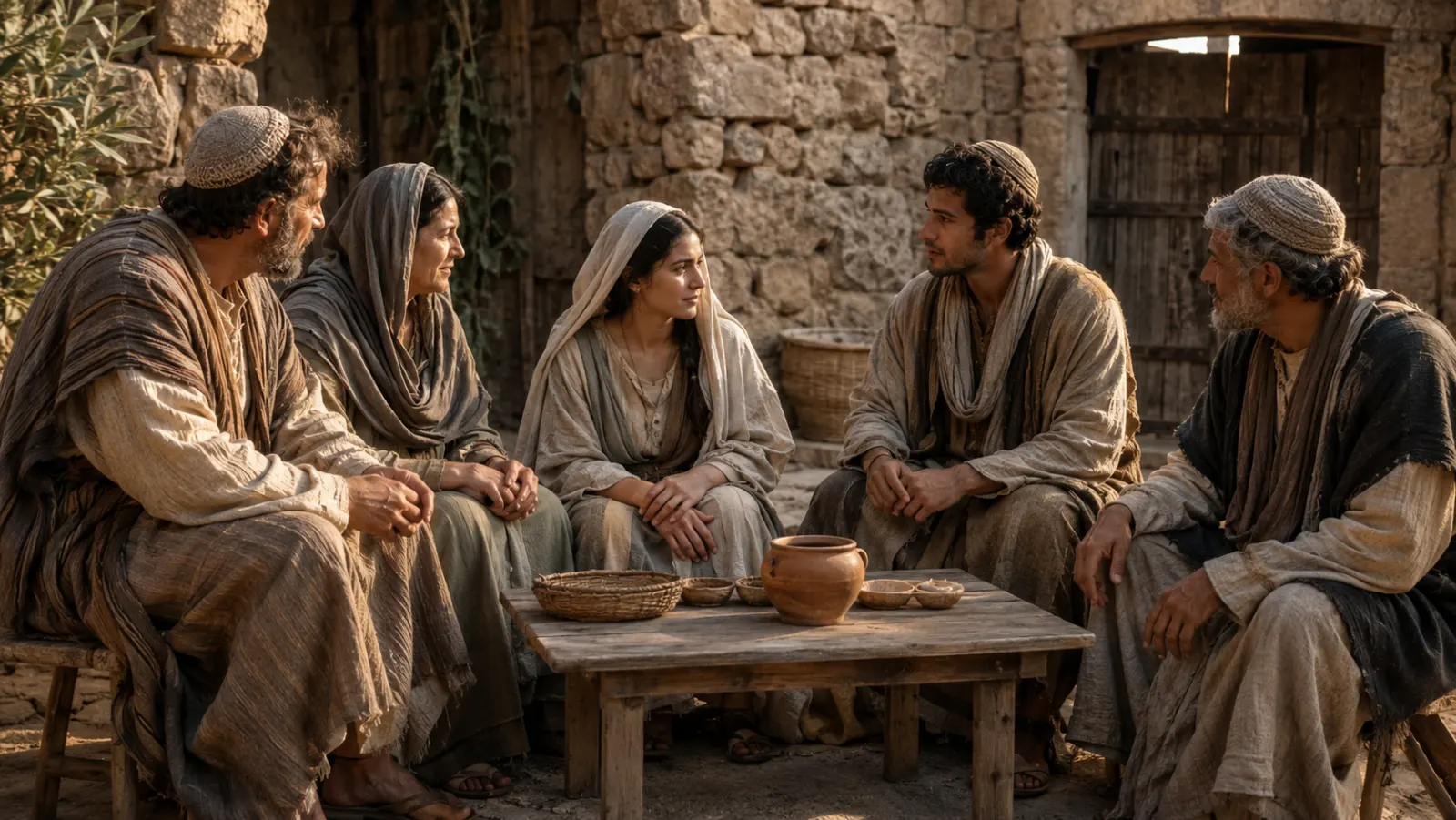
Joseph is usually pictured at a woodworking bench. The Gospel's occupational word is broader: he was a builder or craftsman, part of the skilled working world that formed Jesus' ordinary life.
Imagine the sounds before the sermon: stone struck and shaped, timber cut, a tool sharpened, a customer explaining that a beam has shifted. The Gospels preserve almost nothing about Joseph's daily schedule, but they give his household an occupation. Matthew's neighbors identify Jesus as the craftsman's son; Mark calls Jesus Himself a tekton. The word commonly translated carpenter can include a wider range of building work.
That small linguistic fact matters in an American economy that constantly ranks labor. We admire the finished house while ignoring the crew, praise entrepreneurship while mocking calloused hands, and tell young people that success requires leaving manual work behind. Joseph's presence in Jesus' home does not settle wages or workforce policy. It does dismantle the assumption that holy significance belongs mainly to people with titles, platforms, and clean cuffs.
Tekton names a craft, not a complete résumé
Greek tekton can refer to an artisan or builder who works with materials such as wood and stone. In a small Galilean setting, rigid modern job classifications may not apply. Joseph may have made agricultural implements, repaired roofs and doors, shaped structural timber, worked stone, or joined larger building projects. The evidence does not permit us to choose one workshop scene with certainty.
Carpenter remains a reasonable traditional translation, especially if we hear it broadly. The problem comes when a familiar image becomes precise history: a solitary furniture maker producing polished tables in a modern-style shop. The Gospels tell us enough to place Joseph in skilled manual labor and too little to reconstruct his product line, income, or commute.
Nazareth was close to larger construction
Nazareth was a modest Galilean settlement. Several miles away, Sepphoris grew as an important regional center during the period associated with Jesus' youth. Historians sometimes suggest that local craftspeople could have found work there. The proposal is plausible, but the New Testament never says Joseph or Jesus worked on a particular building in Sepphoris.
The distinction between possibility and fact is worth keeping. It helps us imagine economic networks without pretending to possess Joseph's timecard. A village artisan might combine local repairs, seasonal agriculture, family obligations, and work where demand appeared. Like many American tradespeople, he may have been known less by one employer than by competence, relationships, and the next needed job.
Skill is a form of knowledge
Manual work is sometimes described as the alternative for people who are not academic. Anyone who has framed a wall, wired a panel, repaired an engine, set tile, or diagnosed a leak knows how false that division is. Craft requires measurement, memory, spatial reasoning, material judgment, patience, and adaptation when the existing structure refuses to match the plan.
Scripture treats skill as morally and intellectually meaningful. The artisans who construct the tabernacle are described as equipped with wisdom for their work. Proverbs notices competent labor. The New Testament honors quiet work that serves others. Christian theology should never make intelligence synonymous with one kind of classroom achievement or regard the body as merely the vehicle that carries a brain to meetings.
Work in Jesus' home was ordinary and economically exposed
A craftsman's household was not necessarily destitute, and we should avoid turning poverty into scenery. At the same time, ordinary labor in an agrarian economy carried vulnerability. Illness, injury, harvest conditions, political demands, and a client's ability to pay could affect the household. Tools represented investment; reputation brought work; family members contributed to survival.
The incarnation enters that economic texture. Jesus grows not as a royal child insulated from material tasks but within a household where things must be made and repaired. Christian confession does not say work becomes painless or that honest labor guarantees prosperity. It says God the Son knew a human life formed by schedules, tired muscles, limited resources, and dependence on the work of others.
America honors work in speech and underprices it in practice
Public language celebrates essential workers, skilled trades, small business, and the dignity of labor. Actual arrangements can tell another story. Contractors delay payment down the chain. Workers lack predictable schedules or safe equipment. Customers demand speed while resenting the cost of expertise. Immigrant labor is welcomed at the jobsite and distrusted in the neighborhood.
Joseph cannot be recruited as a mascot for one economic platform. His story can still test Christian habits. Do we pay promptly? Do churches hire the lowest bid while expecting donated extras? Do we learn the names of people maintaining our buildings? Do parents speak of vocational education as a meaningful calling or as failure to reach a four-year college? Honor becomes credible when it changes treatment.
Work can shape a child without defining his worth
Mark's audience knows Jesus by the trade itself. That suggests His public identity carried the memory of work. We do not need invented childhood scenes to recognize that households transmit habits: how to keep a promise, handle frustration, treat a customer, share a task, or rest when work is unfinished. Joseph's example likely belonged to the ordinary human formation Christians confess Jesus truly received.
Yet Jesus' worth is not created by productivity. At His baptism, divine delight precedes His public miracles and teaching. In ministry He withdraws to pray, receives hospitality, and refuses demands designed to control Him. The working household of Nazareth can teach both diligence and limits. A person's labor matters deeply; a person is never only the amount of labor an employer can extract.
The church needs more than platform-shaped honor
Christian communities can unintentionally treat visible speech as the highest gift. The people preaching, singing, leading, and publishing receive names; those repairing the furnace, cooking meals, building ramps, cleaning after events, or driving neighbors to appointments become invisible. That hierarchy does not resemble a Gospel that remembers a tekton's household.
A healthier church recognizes competence, pays specialized work fairly, and invites tradespeople into decisions that concern buildings and safety. It also refuses to reduce them to free labor. Vocation is larger than occupation, but occupation is one real place where love of neighbor takes material form. A stable railing, safe circuit, sound roof, and honest estimate can all be acts of service.
Trade work creates moral dependence
A society built by skilled labor is a society of dependence, though professional culture often hides that fact. The surgeon needs sterile ventilation, the software office needs electrical service, the pastor needs a sound roof, and the homeowner needs somebody who understands why water is appearing where it should not. Competence holds other people's lives together.
That dependence creates moral obligations beyond admiration. Safety standards protect workers and customers. Apprenticeships require patience rather than cheap labor disguised as training. Customers should expect honest work and tradespeople should receive timely payment. Christian ethics belongs in estimates, contracts, scheduling, and the decision to admit a mistake before it becomes dangerous.
Joseph's trade cannot answer every labor dispute, but it places workmanship near the incarnation. The hands that supported Jesus' household belonged to an economy of materials and neighbors. Our faith becomes abstract when it praises a builder at Christmas and then treats contemporary builders as interchangeable costs.
Work also passes through generations in complicated ways. A parent may hope a child joins the trade, while the child longs for another path. A family business can provide belonging and become a burden. The Gospels remember occupational continuity without telling every young person to reproduce a parent's job. Vocation can honor inherited skill and still take a different form.
Churches can bless this discernment by inviting tradespeople to speak about both satisfaction and strain, connecting young adults with honest apprenticeships, and refusing the hierarchy that treats college as the only intelligent future. The goal is not to steer every student toward tools. It is to widen the forms of work the community is able to recognize as skilled and worthy.
We cannot tour Joseph's shop or identify the objects he made. The Gospels give no speech from him and almost no biography. They do give us enough to see working hands near the beginning of Jesus' human story. Before crowds called Jesus teacher, neighbors knew the household by a craft.
That memory is good news for people whose work rarely earns applause. Skill, reliability, and bodily effort are not spiritually second-class. The son raised in a builder's home would later speak of foundations, stones, yokes, gates, towers, wages, vineyards, and houses. Christianity's central claim did not arrive above ordinary work. It took flesh in a home where somebody knew how to build.