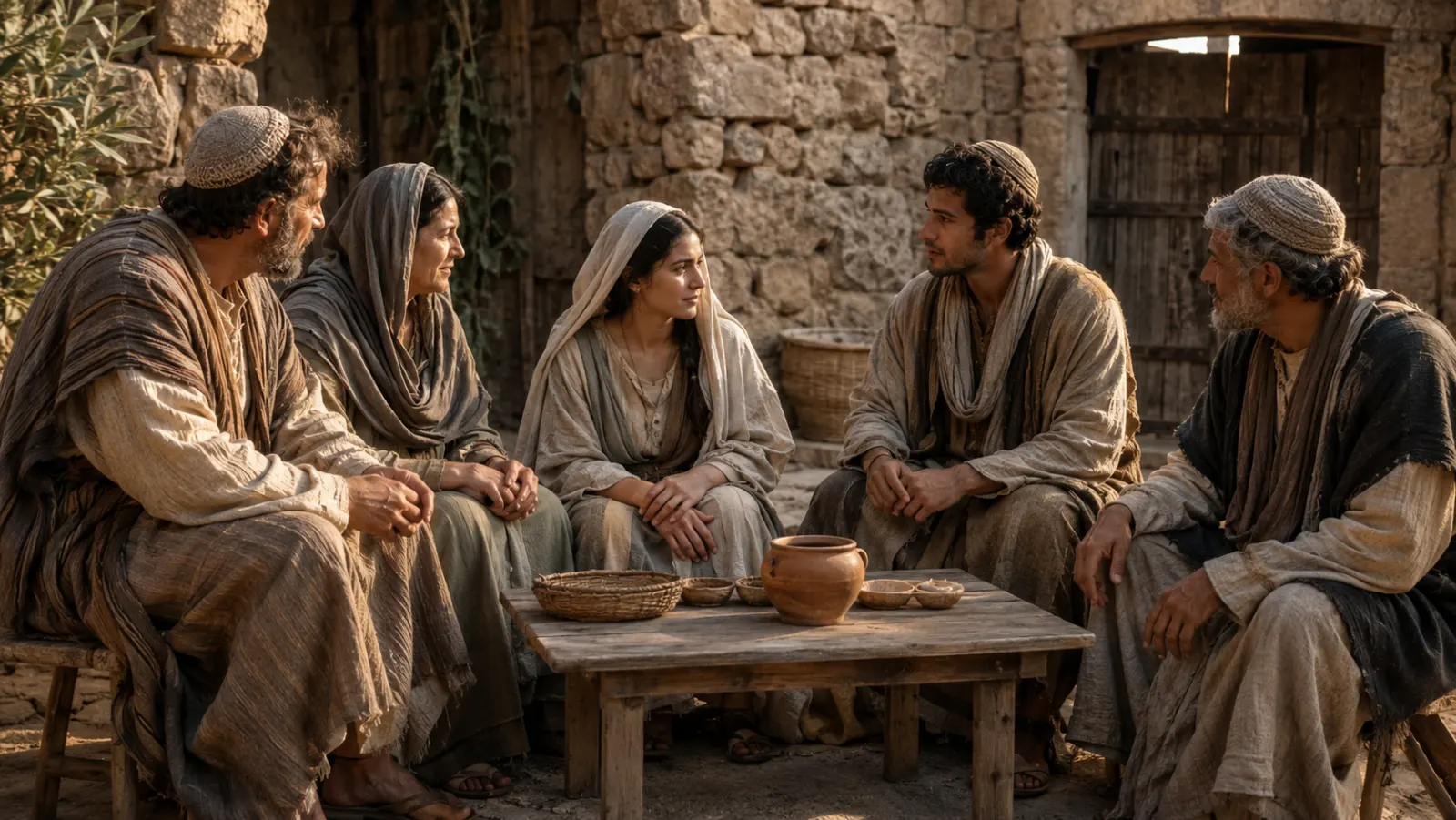
Joseph wakes Mary, takes the child, and leaves under threat from Herod. The Gospel gives Christians a family forced from home—and asks for more than a slogan in America's immigration arguments.
The departure happens at night. Joseph receives a warning, takes the child and His mother, and crosses toward Egypt because Herod intends to kill. Matthew does not tell us what they packed, how long the road took, who offered work, or where they slept. He tells us enough: political violence makes home unsafe, and a family survives by leaving.
American Christians regularly invoke the Holy Family in arguments about refugees and immigration. One side places them on protest signs; another objects that ancient borders and modern legal categories are not the same. The objection is historically correct and morally incomplete. Matthew is not a policy memo. It is a story capable of training the imagination that citizens bring to policy—and of exposing what happens when categories make us forget families.
Herod turns political fear into family danger
The Magi's question about a newborn king alarms Herod. He seeks information, disguises violence as worship, and eventually orders the killing of children in Bethlehem's vicinity. Historians debate what can be independently verified about the massacre, but the portrait coheres with the insecurity and brutality associated with Herod's rule. Matthew places imperial-scale fear inside ordinary homes.
Forced displacement often begins that way. A decision made by rulers reaches a kitchen, school route, pharmacy, or bedroom. People leave not because migration was their preferred lifestyle but because staying has become unlivable. Political language speaks of flows and encounters; families experience a locked door, a missing document, a hurried bag, and the calculation of which road is less dangerous.
Egypt is both old memory and present refuge
In Israel's Scriptures, Egypt carries the memory of slavery and exodus. Matthew deliberately echoes that story: a threatened child, a murderous ruler, and a son called out of Egypt. Yet in this episode Egypt is also the place beyond Herod's reach. Biblical geography is not morally one-dimensional. A former house of bondage can become temporary shelter.
Jewish communities had lived in Egypt for centuries, including a major population in Alexandria. The Gospel does not identify the family's destination or host network, but they would not have entered an entirely unknown Jewish world. Displaced people often survive through relatives, co-religionists, language communities, and previous migrants whose local knowledge turns arrival into something more than exposure.
Modern labels do not map neatly onto the text
Refugee has a specific meaning in modern international law, and asylum, parole, temporary protection, and immigration status are distinct mechanisms. Mary and Joseph did not pass through a twenty-first-century adjudication system. Ancient political boundaries, travel controls, and imperial administration operated differently. Historical honesty forbids claiming that Matthew endorses one contemporary bill by name.
It also forbids using technical difference to avoid the passage's human claim. The family flees a credible threat and needs safety outside its home territory. Whatever legal category a modern person occupies, Christians should ask whether the process recognizes danger accurately, preserves family unity, protects children, and allows meaningful access to counsel and basic care. Those are moral questions, not sentimental evasions.
Compassion and public order are not enemies
Nations maintain borders, screen claims, and make difficult decisions about capacity. Pretending those tasks do not exist produces shallow advocacy. But order is not morally neutral simply because it is administrative. A system can be orderly and still expose families to needless danger, delay, fraud, exploitation, or years of uncertainty. Efficiency must be judged by what it efficiently does to people.
Christian political disagreement will continue. Believers may propose different admission levels, enforcement priorities, or international strategies. They should not lie about immigrants, delight in suffering, treat every official as malicious, or make compassion sound naive. Matthew's story does not eliminate prudence. It insists that prudence keep a threatened child and exhausted parents within view.
Church hospitality must become competent
A welcoming sign is not enough for a newly arrived family. Real help may include temporary housing, school enrollment, transportation, language interpretation, trauma-informed care, job navigation, childcare, and reliable legal referral. Churches should partner with qualified organizations rather than improvise immigration advice or promise outcomes they cannot secure.
Competence also protects against paternalism. Displaced adults are not props for a congregation's generosity. They possess skills, preferences, faith, grief, and the right to make decisions. Help should increase agency, preserve confidentiality, and invite mutual relationship without making worship attendance the price of groceries. The vulnerable should never become a captive audience.
The return home is not simple
After Herod dies, Joseph is told to return, but danger has not disappeared. He hears that Archelaus rules Judea, fears going there, receives further direction, and settles in Galilee. The homeward movement includes new assessment and a changed destination. Return does not mean restoration of the old life exactly as it was.
Modern displaced families face similar complexity without repeating the same history. Houses may be destroyed, governments unstable, children rooted in a new language, and relatives scattered. Voluntary return, local integration, or resettlement each carries loss and possibility. Churches should resist treating return as the morally obvious ending merely because it closes the story for the host community.
The passage asks who gets to be seen as a family
Political rhetoric often divides migrants into the innocent and the threatening, the deserving and the fraudulent. Screening is necessary, but public imagination can become addicted to suspicion. A father becomes a male of military age; a mother becomes a dependent; a child becomes a number in a facility. The administrative description may serve a function while erasing a relationship.
Matthew keeps the relationship visible: the child and His mother, taken by Joseph into safety. Christians need not pretend to know every stranger's story. They can refuse language that makes cruelty easier. The family at the center of their faith once depended on a place beyond home, a road away from violence, and the courage to believe that leaving could be an act of protection.
Stories should not be used to demand political gratitude
Refugees and immigrants are often expected to prove worth through exceptional success. The acceptable story features the grateful newcomer who starts a business, earns degrees, loves the nation without criticism, and never needs long-term help. Ordinary struggle is treated as a moral failure. This standard asks displaced people to purchase dignity through usefulness.
The Holy Family is significant because of Jesus' identity, not because every displaced family is secretly extraordinary. Christian concern rests on human worth before achievement. A sick parent, traumatized teenager, elderly grandparent, or worker whose credentials are not recognized deserves lawful and humane treatment without becoming an inspirational profile.
Church storytelling should obtain consent and protect identifying details when publicity could create risk. It should allow newcomers to describe both gratitude and disappointment. Hospitality that controls the guest's public voice is another form of possession. Welcome matures when the received family can participate, disagree, contribute, and eventually help shape the community that first helped them.
Language learning illustrates the difference between help and control. Adults may need interpretation immediately and time to gain fluency; children often learn faster and become unofficial translators for medical, legal, or financial matters. Churches should not place adult burdens on children when qualified language access is available. Protecting family roles is part of welcome.
Long-term friendship also matters after emergency assistance ends. The first apartment and donated furniture make a good photograph. The harder seasons arrive when transportation fails, credentials are rejected, trauma surfaces, or teenagers navigate two cultures. Hospitality becomes covenantal when the community remains reachable after the dramatic beginning.
Congregations can also support the public systems that make humane order possible: qualified caseworkers, interpreters, teachers, medical staff, and judges. Charity should not become an excuse to underfund competence. The neighbor at the border and the neighbor working a crushing caseload both deserve institutions designed for truth rather than chaos.
The flight to Egypt is not a shortcut around policy. It is a refusal to discuss policy without moral memory. The passage will not tell Congress how many cases an asylum officer should carry. It will tell the church that forced departure belongs inside the story of Jesus before He can speak a word.
Christians can debate law while telling the truth, protecting due process, supporting public servants, and seeing displaced people as neighbors rather than symbols. The Holy Family does not need to be converted into a partisan mascot. Let them remain what Matthew makes them: a threatened child, a courageous mother, and a father who treats escape as faithful care.