
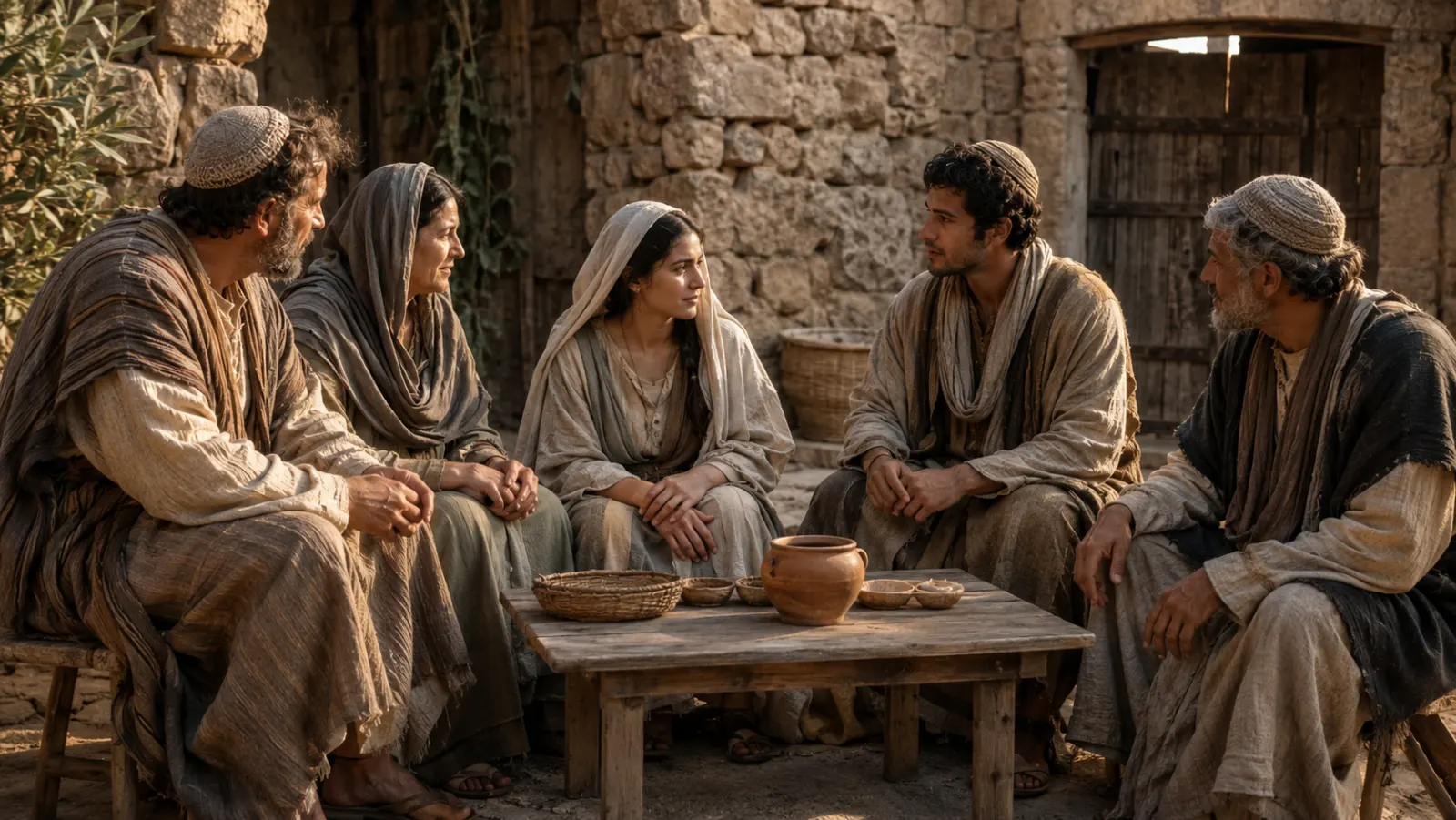
Mary and Joseph were pledged to one another in a social and legal world unlike ours. Understanding betrothal makes the crisis in Matthew sharper—and prevents us from treating an ancient household as a modern romance with biblical costumes.
An American engagement can be ended with a difficult conversation, a returned ring, and perhaps a fight over deposits. Painful as that may be, no court usually needs to dissolve it. Matthew's readers heard something more binding when he described Mary as betrothed to Joseph. The couple had not begun ordinary married life, yet their pledge already carried legal and communal weight.
That difference explains why Matthew can call Joseph Mary's husband, speak of divorce, and still say that they had not come together. It also explains why the pregnancy creates more than romantic disappointment. Two households, a public covenant, inheritance, reputation, and Mary's safety are implicated. The story becomes clearer when we stop squeezing it into either a modern engagement or a fully completed marriage.
Betrothal occupied a real middle space
Marriage practices varied across centuries and Jewish communities, so reconstruction requires humility. In the broad legal pattern known from ancient Jewish sources, betrothal established a recognized bond before the bride joined the husband's household and the marriage was consummated. The interval could involve preparations, negotiated obligations, and waiting. It was not a casual promise to consider marrying later.
Matthew's compressed wording assumes that social world. Mary is bound to Joseph, but they do not yet share the ordinary life of husband and wife. A formal ending is therefore required when Joseph believes the covenant has been broken. English translations that use engaged are understandable, but contemporary readers should hear a commitment stronger than the word often carries in American life.
Marriage joined households as well as two people
Americans usually imagine marriage beginning with two individuals who fall in love and then invite their families into the celebration. Ancient Mediterranean marriage more visibly joined kinship networks, labor, property, honor, and future children. Affection could be real, but it was not the only purpose or decision-making force. Parents and extended households had interests in the union.
This does not mean every marriage followed one script, or that ancient people lacked agency. It does mean Mary and Joseph's crisis could not remain a purely private matter. A pregnancy would affect how both families were perceived and how the child's place was understood. When Joseph receives Mary, he is not making a romantic gesture in isolation. He is accepting consequences that will reach through a network of relationships.
The text gives us commitment, not a courtship memoir
The Gospels never describe how Mary and Joseph met, what they admired in one another, or how their families arranged the match. Pageants, films, and novels naturally fill the silence because human beings want a love story. Those imagined scenes may be beautiful, but they should not be confused with historical reporting or required Christian belief.
Matthew is interested in something else: Joseph's righteous response and Jesus' identity. Luke foregrounds Mary's encounter with Gabriel, her visit to Elizabeth, and the birth. Neither writer offers a model dating history. That absence can disappoint readers, but it also prevents one couple's undocumented romance from becoming the measure of faithful relationships everywhere.
Ancient context does not automatically endorse ancient power
Historical explanation is not moral approval. Ancient marriage systems often gave men, fathers, and households more public power than young women possessed. Economic dependence and concern for family honor could narrow a woman's choices. Readers should not turn the vulnerability of that world into a Christian command to recreate every feature of it.
Scripture speaks within cultures and also forms moral judgment about them. Matthew draws attention to Joseph's refusal to disgrace Mary; Luke gives Mary speech, theological intelligence, and direct response to God's messenger. Christian marriage is ultimately interpreted through the self-giving love, truthfulness, mutual honor, and rejection of domination taught across the New Testament—not through nostalgia for any one social arrangement.
The in-between season carried genuine uncertainty
Betrothal was a promise aimed toward a household that did not yet fully exist. Mary and Joseph lived inside that unfinished future when the annunciation and pregnancy disrupted it. They could not simply return to the original plan. Their obedience would preserve the covenant while radically changing the story they thought they were entering.
American couples know different versions of an in-between season: immigration paperwork, military deployment, medical uncertainty, job relocation, caring for aging parents, or a wedding delayed by debt. The ancient details should not be flattened into those experiences, but the moral pressure is recognizable. Commitments become real not only in ceremonies, but in the choices made when preparation stops feeling predictable.
Our wedding culture can obscure the meaning of covenant
The American wedding industry trains couples to manage a production: venue, photographs, attire, music, seating chart, and a hundred purchased details. None of those is inherently shallow. Celebration matters. Yet a flawless event can coexist with little preparation for the moral life of marriage, while a courthouse ceremony can begin a durable covenant of patience and truth.
Mary and Joseph's story does not condemn beautiful weddings; Scripture includes feasts and joy. It does relocate seriousness. Their faithfulness appears when the anticipated social script collapses. The question is not whether every detail looked right to their neighbors. It is whether they would receive one another and obey God when doing so carried more risk than applause.
Context makes Joseph's obedience heavier
Once the angel tells Joseph to take Mary as his wife, obedience has a public form. He completes the union and names the child. Whatever explanation the couple offered, the household must now live with a story many neighbors would not believe. Joseph cannot obey invisibly. His decision locates his name, labor, and future beside Mary and Jesus.
Knowing the strength of betrothal also clarifies why quiet divorce had seemed merciful. Joseph was not ending an informal relationship with a private text message; he was seeking to dissolve a recognized bond without maximizing harm. When God redirects him, the same seriousness becomes covenant courage. He does not merely feel differently. He changes what he is prepared to carry.
Covenant language still needs consent
Because ancient marriages involved households and obligations, some modern Christians use covenant language to minimize individual consent. The logic is backwards. A covenant is morally weighty precisely because it is not casual access to another person. Promises require truthful knowledge, freedom, public accountability, and the ability to recognize when coercion has made a supposed agreement unjust.
Church preparation can honor that seriousness by discussing money, sexuality, conflict, family expectations, faith, addiction, children, work, and safety before the wedding. It should ask whether either person is afraid to disagree. It should also make clear that postponing a ceremony can be wise when new facts emerge; protecting the event calendar is not more sacred than protecting the people.
Mary and Joseph's betrothal carried obligations different from ours, but it never makes another person's will irrelevant. Matthew honors Joseph's deliberate choice, and Luke honors Mary's direct response. Any Christian account of marriage that needs one partner to become voiceless has failed to learn from both narratives.
The language we use for engaged couples should reflect both promise and freedom. Treating them as already married can pressure a person to proceed after discovering deception, danger, or profound incompatibility. Treating the promise as disposable can excuse carelessness. A church can hold both truths: this commitment deserves honesty, and the wedding itself requires a willing covenant rather than momentum.
Joseph's story is extraordinary, so it cannot decide every modern relationship. It can teach a posture for discernment: take promises seriously, do not maximize another person's shame, seek truth, and accept that faithful action may cost the future everyone expected. That is more durable than copying the surface of an ancient custom.
Mary and Joseph were neither a contemporary dating couple nor flat symbols in a religious tableau. They were participants in a form of marriage that joined law, kinship, reputation, and household economy. The distance between their world and ours should make us slower, not colder: slower to assume, slower to romanticize, and slower to make one reconstructed custom into a timeless rule.
Betrothal helps us feel the cost of Matthew's story. A binding promise stood under strain before the household had properly begun. Joseph's obedience and Mary's courage did not restore the original wedding plan. They carried the promise into a future neither had designed—and made room within it for the child Christians confess as Emmanuel.


