John preached a baptism tied to repentance. Christian theology confesses Jesus as sinless. So why does Jesus step into the Jordan? The Gospel accounts answer not with one slogan but with themes of solidarity, righteousness, commissioning, Spirit, and Sonship.
John’s baptism creates an immediate theological problem. He calls people to repent. They confess sins. Then Jesus arrives and asks to be baptized. If Christian faith confesses Jesus as the sinless Son of God, what exactly is he doing in a line of repentant people?
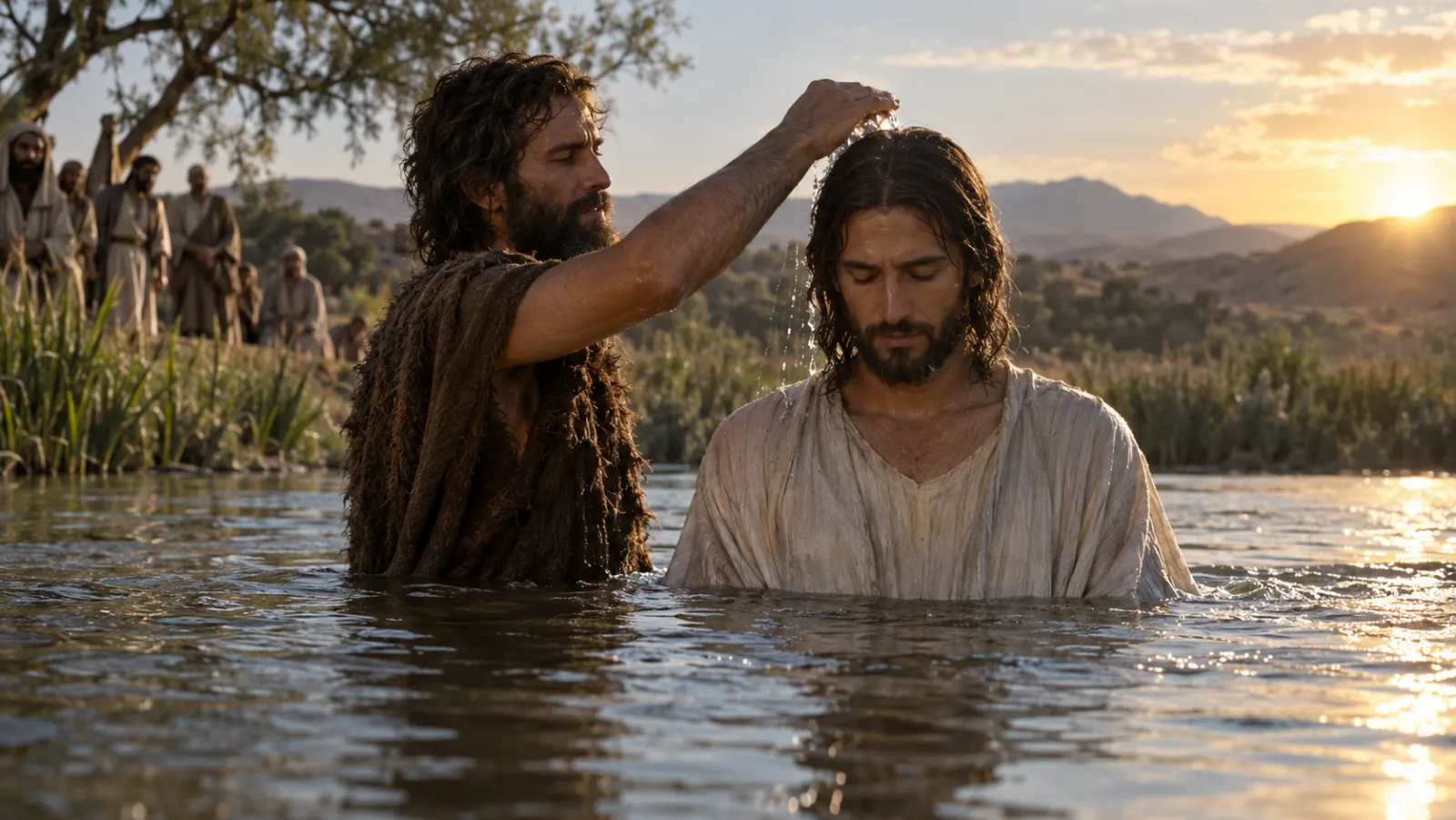
Matthew knows the question. In his account, John resists and says the roles should be reversed. Jesus answers that it is fitting to “fulfill all righteousness.” The scene therefore does not accidentally stumble into the problem; it places the problem in the dialogue and invites readers to see the baptism as something more than a confession of personal wrongdoing.
The Gospels do not say Jesus confessed sins
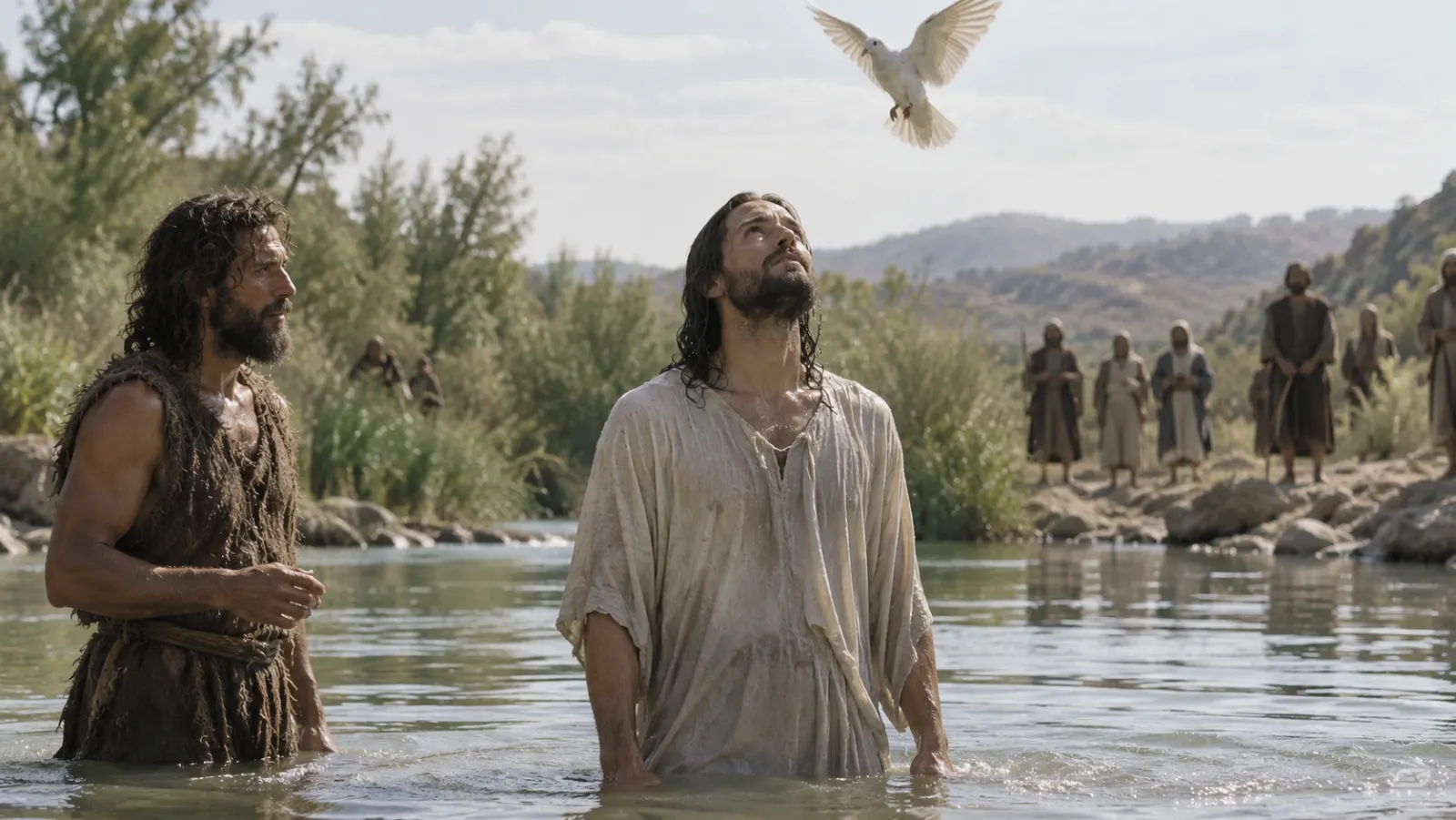
That simple observation is important. Mark describes people from Judea and Jerusalem confessing sins as they are baptized, but when Jesus appears the narrative changes focus. The heavens open, the Spirit descends, and the heavenly voice identifies him as Son.
Luke makes the distinction even clearer by describing Jesus’ baptism after mentioning the people generally and then emphasizing Jesus at prayer. None of the accounts depicts him listing personal sins. The act belongs to John’s movement, but Jesus’ participation carries its own meaning.
“Fulfill all righteousness” points toward obedient mission
Matthew’s phrase is broad. Righteousness in Matthew concerns faithful alignment with God’s will. Jesus’ response to John therefore suggests that receiving baptism is the fitting obedient step within God’s plan.
This is not Jesus submitting to a requirement because he has moral guilt. It is Jesus embracing the path the Father has set before him. His public mission begins not with self-exaltation but with an act of humility in the same water where Israel is being called to return to God.
Jesus identifies with the people he comes to save
Christian interpreters have long seen solidarity here. Jesus stands among people who need repentance even though the Gospel does not portray him as sharing their sin. He enters their place rather than remaining at a symbolic distance.
That pattern becomes central to the New Testament’s larger theology. Jesus eats with sinners, bears suffering, and finally goes to a cross associated with shame and condemnation. The Jordan is not the cross, but it already shows the direction of his mission: identification without moral complicity.
The baptism is also an anointing and commissioning
The descent of the Spirit evokes Old Testament patterns of prophetic and royal empowerment. Isaiah’s servant is marked by God’s Spirit. Kings are anointed for vocation. At the Jordan, the Spirit rests on Jesus as the voice declares his identity.
The baptism therefore functions as a public transition. Jesus’ hidden years give way to Spirit-led mission. Immediately afterward the Synoptic Gospels move toward wilderness testing and proclamation. The water is part of a larger commissioning scene.
The heavenly voice combines biblical themes
The words from heaven echo Scripture associated with royal sonship and the beloved servant. Christian theology later articulates this scene in trinitarian terms: the Son is baptized, the Spirit descends, and the Father speaks.
We should be careful not to imagine the baptism as the moment Jesus becomes Son, as though he lacked that identity before. Matthew and Luke have already made claims about his identity in their infancy narratives. The baptism reveals and commissions; it does not manufacture Jesus’ sonship.
Why humility matters
For American readers, public launches usually involve credentials, announcements, and platforms. Jesus’ ministry begins differently. He travels to a wilderness preacher and receives a rite John is giving to people responding to a message of repentance.
That does not mean Jesus is pretending to be sinful. It means his messianic authority is expressed through obedient humility. The kingdom does not begin with self-protection from association with morally needy people. Jesus steps into their water.
The scene does not erase the later meaning of Christian baptism
Christians are baptized for reasons connected with Jesus that cannot apply to Jesus himself in the same way. Believers confess sin, identify with Christ’s death and resurrection, receive the church’s sign of discipleship, and enter a community shaped by his name.
Jesus’ baptism is therefore foundational without being mechanically identical to ours. He is not simply the first Christian convert. He is the Messiah whose baptism inaugurates the mission that later gives Christian baptism its center.
The servant theme gives the scene deeper biblical texture
The heavenly declaration at the baptism has often been heard alongside Isaiah’s servant language: God’s chosen one, beloved and upheld by the Spirit. If that echo is intended, the baptism points toward a mission characterized not only by kingship but by obedient service.
That is significant for the sinlessness question. Jesus enters the water not as someone seeking a private spiritual reset, but as the servant-Son accepting the vocation that will eventually lead through suffering, rejection, and vindication.
Each Gospel emphasizes the event differently
Mark gives the scene urgent simplicity. Matthew adds John’s objection and Jesus’ statement about fulfilling righteousness. Luke emphasizes prayer and places the baptism within a broader account of the people. John’s Gospel reports the Baptist’s testimony about seeing the Spirit descend and remain.
Reading the four together enriches interpretation, but we should also let each voice retain its emphasis. The baptism was important enough that early Christians remembered and narrated it from several angles rather than reducing it to one doctrinal formula.
The Jordan anticipates Jesus’ habit of standing with the morally needy
Throughout the Gospels, Jesus repeatedly enters spaces respectable people avoid. He eats with tax collectors, touches people considered unclean, allows compromised people near him, and refuses to protect holiness by social distance.
The baptism fits that pattern at the beginning. He does not endorse sin, and his presence never makes repentance unnecessary. Instead, holiness moves toward people who need restoration. The Jordan is an early sign that Jesus’ mission will be defined by redemptive proximity.
John’s hesitation protects the reader from a wrong conclusion
Matthew’s decision to narrate John’s resistance is the clearest sign that early Christian readers were not expected to infer Jesus’ personal guilt from the baptism. John recognizes an apparent mismatch and voices it inside the story.
Jesus does not answer by confessing hidden wrongdoing. He reframes the act as what is fitting for God’s righteousness to be fulfilled. The Gospel therefore guides interpretation before later theology ever enters the discussion.
The baptism also reveals what kind of Messiah Jesus will be
The scene combines humility and exaltation. Jesus stands in the same river as ordinary people, yet heaven opens over him. He submits to baptism, yet the Spirit descends and the divine voice names him Son.
That combination becomes characteristic of the Gospel story. Jesus’ glory is not opposed to humility; it is revealed through obedient humility. The Jordan prepares readers for a Messiah whose authority will repeatedly look different from ordinary displays of status.
The scene also validates John’s call
By entering John’s baptism, Jesus does not distance himself from the prophetic demand that Israel turn back to God. His participation gives the moment extraordinary seriousness even as the heavenly signs distinguish his role from everyone else’s.
The result is a scene of both continuity and difference: Jesus stands with the people hearing John’s call, yet the Father’s voice and the Spirit identify him uniquely.
The question remains useful because it forces careful reading
If the baptism were simply routine, readers would not need to ask why Jesus receives it. The tension pushes us toward the Gospel’s own explanation: obedience, solidarity, revelation, and mission. The apparent problem becomes one of the scene’s theological strengths.
Jesus is baptized not because the Gospels quietly assume he is personally guilty, but because the Jordan is the fitting place for his obedient, representative, Spirit-anointed mission to begin.
The paradox is part of the Christian claim. The sinless one does not keep his distance from sinners. He enters the waters of repentance with them, and from that place the Father’s voice and the Spirit direct our attention to who he is.