Americans instinctively ask where Jesus went to school and how educated he was. The question is modern, but the evidence opens a useful window on family instruction, synagogue life, Scripture, oral learning, and literacy in first-century Judaism.
Ask an American parent how a child is educated and the answer usually begins with an institution: public school, private school, homeschool, college prep. Ask the same question about Jesus and the categories begin to wobble. First-century Jewish education was not organized like a modern school district, and our sources do not preserve a classroom schedule for Nazareth.
Still, the question is worth asking because the adult Jesus is saturated in Scripture. He debates interpretation, teaches in synagogues, quotes biblical texts, and responds to questions with a command of Israel’s story. How did that formation happen? The evidence points not to one neat institution but to a culture of household teaching, communal worship, oral memory, reading, and religious practice.
The family was the first classroom
Deuteronomy 6 imagines teaching as something woven into ordinary life: at home, on the road, morning and evening. Jewish identity was transmitted through words, practices, festivals, food, prayer, and story. A child learned not only information but belonging.
Luke portrays Jesus within exactly that kind of world. His family travels to Jerusalem for Passover. He grows in Nazareth. The household participates in Israel’s religious rhythms. Whatever formal instruction existed, it would have rested on this broader foundation of family memory and communal practice.
Synagogue mattered, but we should avoid a modern school picture
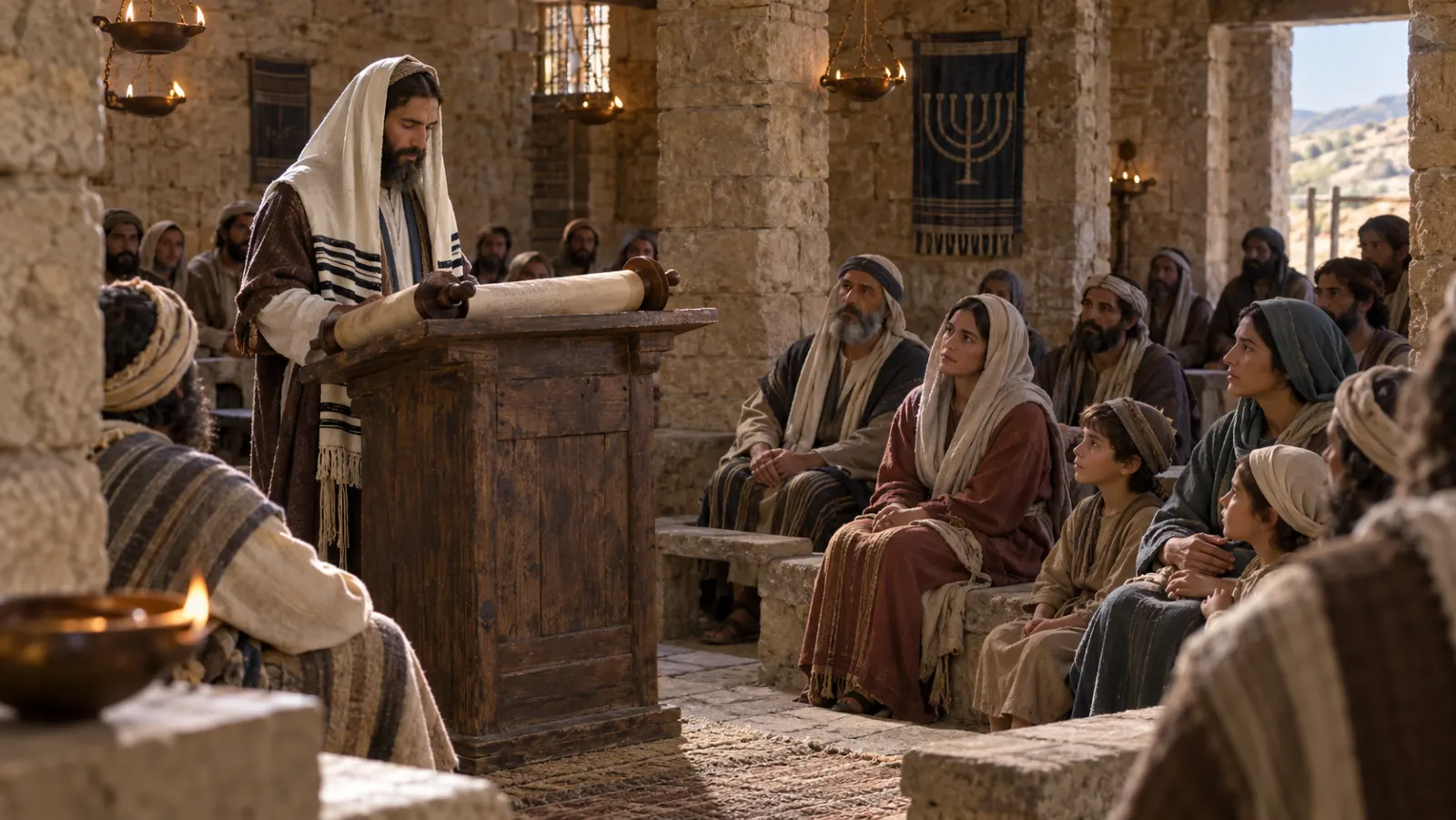
By the first century, synagogues functioned as important local places for assembly, prayer, Scripture reading, and teaching. The adult Jesus regularly appears in synagogues, and Luke describes his return to the Nazareth synagogue as customary. That makes the synagogue a natural part of his formation.
What we should not do is imagine a standardized elementary school identical in every village, complete with grade levels and universal attendance. Evidence for organized Jewish schooling in this period is debated. Local arrangements varied. The safest conclusion is that synagogue and community supported learning without assuming a modern educational bureaucracy.
Oral culture could produce remarkable knowledge
Modern Americans often equate education with silent reading and written assignments. Ancient Mediterranean societies relied much more heavily on hearing, recitation, memorization, and public reading. A person could know texts deeply without owning books or reading privately every day.
Scrolls were expensive. Copies were not lying around every household. Scripture was encountered through public reading and memory as well as direct reading. This matters because arguments about Jesus’ literacy can become too binary. The real question is not simply “could he read?” but how textual knowledge functioned in a culture where oral and written learning reinforced each other.
Luke depicts Jesus reading
Luke 4 explicitly portrays Jesus taking the scroll of Isaiah, finding a passage, reading it, and then interpreting it. Within Luke’s narrative, that is a clear picture of literacy. John 7 also records surprise at Jesus’ learning despite the absence of recognized elite training.
Historians debate how directly individual Gospel scenes can be used to reconstruct every detail of Jesus’ education, but the textual portrait is consistent: Jesus is not presented as someone unfamiliar with written Scripture. He handles Israel’s texts with confidence while standing outside the credentialed elite institutions associated with some scribes.
The Temple scene is about identity more than precocious genius
The twelve-year-old Jesus in Luke 2 listens to teachers, asks questions, and gives answers that amaze those present. Christian art can turn the scene into a miniature professor lecturing elderly scholars. Luke’s wording is subtler. Jesus participates in questioning and dialogue.
The center of the episode is not a school competition. It is Jesus’ relationship to his Father and his place within Israel’s sacred story. He returns to Nazareth afterward and continues to grow. The scene shows unusual understanding without denying ordinary development.
No evidence supports a secret elite education
Because Jesus later teaches with authority, some theories place him in an Essene academy, Greek philosophical school, or foreign religious institution. None of those proposals is required by the evidence. Galilee itself provided a rich Jewish environment, and Jewish scriptural culture offered more than enough context for the kinds of debates preserved in the Gospels.
This does not mean Galilee was sealed off from Greek language or broader Mediterranean influence. It was not. But cultural contact is different from enrollment in a hidden school. We should resist upgrading possibility into biography.
Why the question still matters
American Christianity often swings between two mistaken pictures: Jesus as an uneducated rustic whose wisdom dropped from heaven without human formation, or Jesus as a credentialed intellectual who must have attended some lost academy. The incarnation allows a more integrated picture.
Jesus can grow, learn, listen, memorize, work, read, and mature while Christians also confess him as the Son of God. Human formation is not a threat to divine identity. Luke’s language of growth insists on taking both seriously.
Literacy was uneven, not simply present or absent
Scholars disagree over literacy rates in Roman Palestine, partly because the word literacy can mean many things. A person might recognize common written forms, read Scripture slowly, copy a short text, or possess advanced scribal competence. Those are different abilities.
The safest historical picture avoids extremes. We should not imagine every Galilean peasant casually reading books, but neither should we assume rural Jews had no meaningful contact with texts. Inscriptions, documents, synagogue reading, and scriptural culture existed inside a society where full scribal education remained specialized.
Jesus’ debates show interpretive formation, not merely quotation skill
The adult Jesus does more than recite isolated verses. He compares commandments, interprets narratives, argues about Sabbath, discusses resurrection, and asks how passages fit together. Whether every remembered exchange preserves exact wording or not, the Gospel portrait assumes a teacher formed inside Jewish argument about Scripture.
That kind of formation could arise through years of listening, memorization, discussion, and participation long before someone possessed elite credentials. Education in the ancient world was relational. A village could transmit a sophisticated scriptural imagination without looking anything like a modern seminary.
The question of language belongs here too
Jesus likely grew up in an environment where Aramaic was central to ordinary speech, Hebrew remained important in Scripture and worship, and Greek circulated in wider regional life. How much Greek Jesus personally used is debated, but Galilee was not linguistically sealed.
Education therefore involved more than alphabetic skill. It meant moving between spoken language, sacred text, and the cultural registers of a politically connected region. American readers accustomed to monolingual schooling can miss how normal such layered language environments have been across history.
A Torah-shaped imagination is more important than a diploma
The strongest evidence of Jesus’ formation is not a reconstructed schoolhouse but the texture of his teaching. He reasons from Torah, prophets, and psalms; he knows Israel’s stories; he assumes listeners understand Sabbath, purity, Temple, covenant, and commandment.
That kind of scriptural imagination grows through a community’s repeated practices as much as through formal lessons. For modern readers, it is a reminder that education is larger than credentialing. The Gospels present Jesus as deeply formed by Israel’s Scriptures even while opponents question where his recognized learning came from.
Questions we should leave open
We cannot responsibly name Jesus’ teachers, calculate the number of years he studied, or prove exactly how much Greek he could read and write. Those questions remain legitimate research topics, but our evidence does not support a school transcript.
The best historical method is therefore layered: affirm what the Gospels actually depict, use archaeology and comparative evidence to describe the educational environment, and mark debated conclusions as debated. That approach is less dramatic than certainty, but far more useful.
We do not know the name of Jesus’ childhood teacher, the length of his formal instruction, or whether Nazareth had anything we would call a school. We do know that he grew within a Jewish household and community shaped by Scripture, synagogue, pilgrimage, and memory.
That is enough to replace both romantic ignorance and invented academic credentials. Jesus’ formation belongs to the real educational world of first-century Judaism—a world where learning happened through family, community, hearing, reading, repetition, and practice.