American Christians know John as the man who baptized Jesus, but that familiarity can flatten him into a supporting character. In his own historical setting he was a powerful Jewish prophetic figure with disciples, public influence, and a message that threatened a ruler.
John the Baptist can become strangely harmless in Christian memory. He appears for a few minutes in an Advent reading, points toward Jesus, performs a baptism, and exits. The camel-hair clothing becomes costume. The wilderness becomes scenery.
His contemporaries did not treat him as scenery. Crowds traveled to hear him. He formed disciples. Religious leaders investigated him. Herod Antipas imprisoned and eventually executed him. The Jewish historian Josephus also remembers John as a morally serious teacher who attracted large numbers. To understand Jesus’ baptism, we need to meet John as a historical Jewish prophet before we reduce him to “the guy who went first.”
John speaks like Israel’s prophets
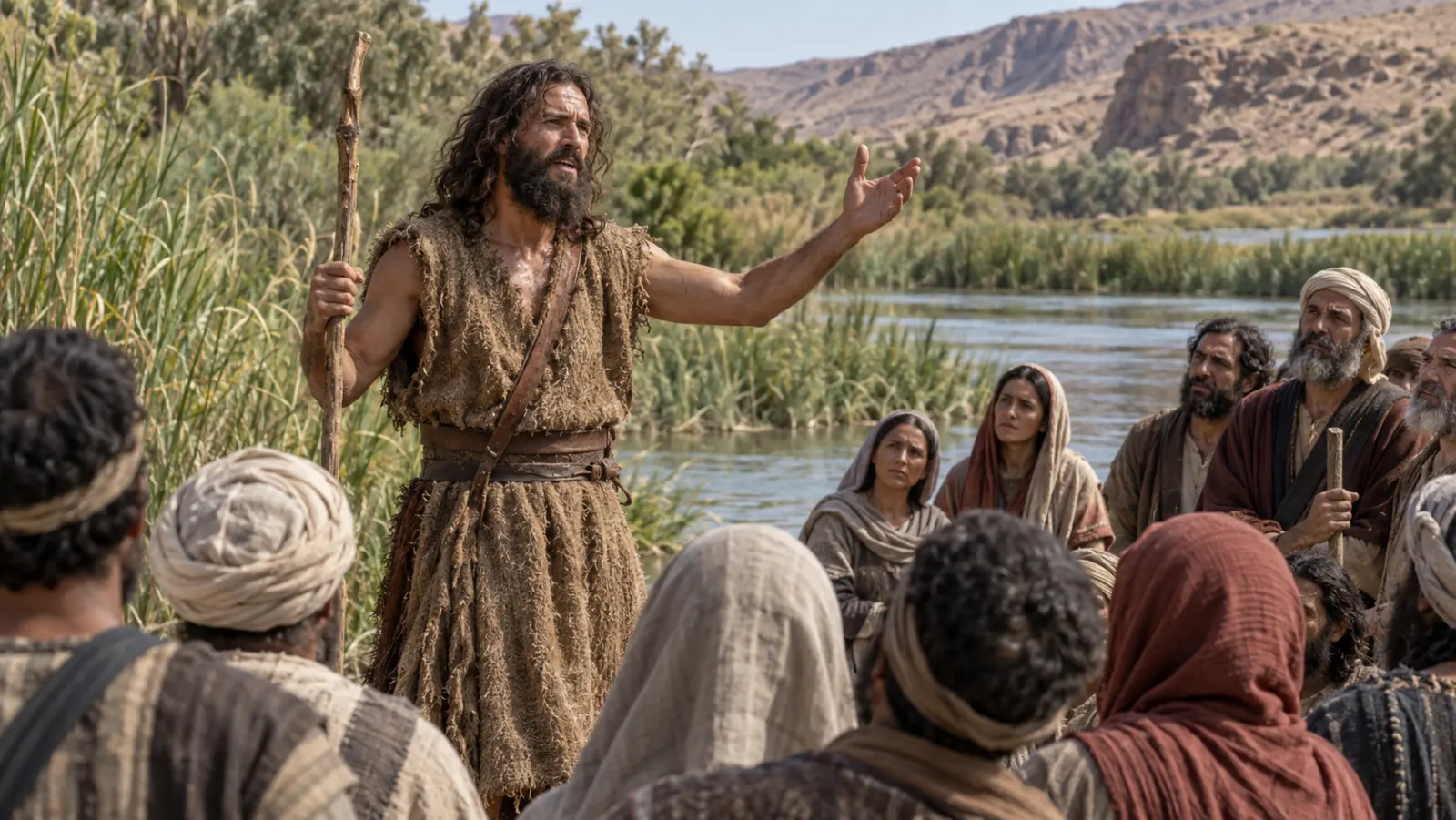
The Synoptic Gospels introduce John with Isaiah’s voice in the wilderness. His message combines warning, repentance, ethical change, and expectation that God is about to act. He addresses crowds, tax collectors, soldiers, and religious leaders with concrete demands.
This is prophetic speech in the biblical tradition. John is not offering generic spirituality. He confronts complacency and insists that ancestry alone cannot substitute for repentance. The axe at the root and the winnowing fork are images of judgment, not motivational branding.
The wilderness is part of the message
The Judean wilderness and Jordan River carry biblical memory. Israel crossed the Jordan into the land; prophets operated in wilderness spaces; Elijah traditions linger around the region. John’s location therefore has symbolic force as well as practical importance.
He calls people away from centers of ordinary life to a boundary landscape where repentance becomes physical movement. Yet we should not over-script every geography. The texts do not say John staged a reenactment of one specific Old Testament episode. They create a network of wilderness, Jordan, prophecy, and new beginning.
Camel hair does not make John a cartoon
Matthew and Mark describe John’s rough clothing and simple diet. Christian art sometimes exaggerates this into a barely civilized hermit. The biblical imagery points instead toward prophetic identity, especially Elijah, who is remembered with distinctive hairy clothing and a leather belt.
Locusts were real food, not a euphemism required to save John from eating insects. Honey could be gathered in the wild. The point is ascetic simplicity and prophetic symbolism, not that John lacked human dignity or basic social intelligence.
John had a movement of his own
The Gospels mention John’s disciples, and Acts later encounters people who know John’s baptism. That persistence is historically important. John was not simply a literary invention designed to introduce Jesus. He had a recognizable movement and lasting influence.
This also explains why the Gospels carefully define the relationship between John and Jesus. John is honored but subordinated. He prepares the way but is not the Messiah. He baptizes, yet speaks of one stronger who is coming. The early Christian tradition is not erasing John’s importance; it is locating that importance within its claim about Jesus.
Josephus confirms John’s public significance
Josephus, writing outside the New Testament, describes John as a good man who urged virtue, righteousness, piety, and a baptism connected with a life already turned toward what is right. He also says Herod feared John’s influence over the crowds.
Josephus and the Gospels explain John’s death differently in emphasis: Josephus highlights political fear, while the Gospels emphasize John’s rebuke of Herod’s marriage. Those perspectives are not mutually exclusive. A ruler can fear a popular prophet precisely because moral criticism gathers public power.
John’s message is not identical to later Christian baptism
John’s baptism belongs to his announcement of repentance and approaching divine action. Christian baptism after Jesus’ resurrection develops within a different narrative context—union with Christ, discipleship, the triune name, and incorporation into the church.
The continuity matters, but so does the difference. Reading later denominational debates backward into John can distort the scene. He is not a Baptist pastor, Catholic priest, Orthodox presbyter, or nondenominational church planter. He is a first-century Jewish prophet at the Jordan.
Jesus enters John’s public moment—and transforms the horizon
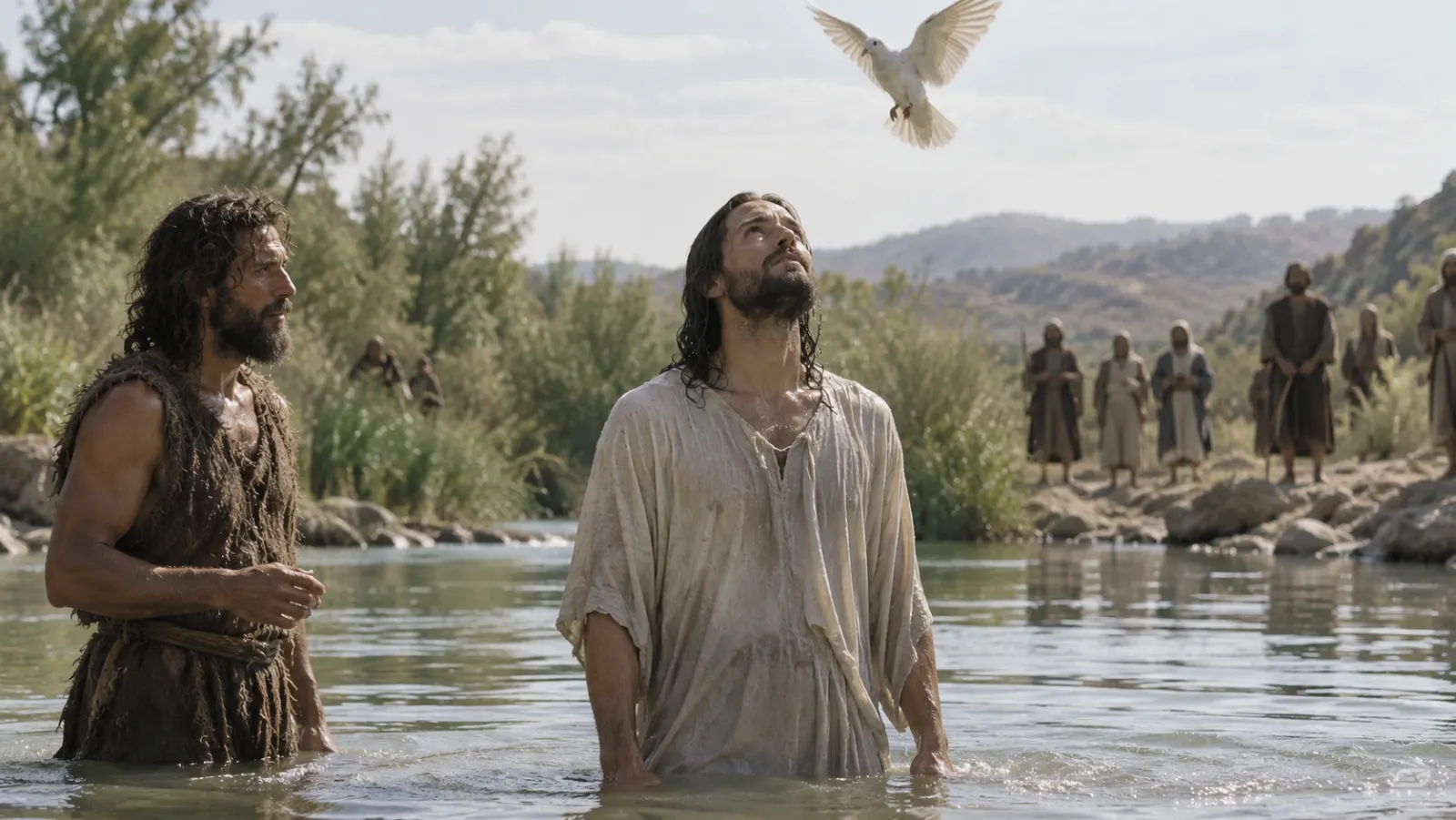
When Jesus comes to be baptized, he does not invent the setting. He enters a movement already calling Israel to repentance. Yet the baptism narratives then shift attention. The Spirit descends, the heavenly voice identifies Jesus, and John’s preparatory role points beyond itself.
That movement from John to Jesus is theological without requiring us to belittle John. Jesus himself speaks of John with extraordinary respect. The forerunner matters because the one for whom he prepares the way matters.
John’s ethics were concrete, not merely apocalyptic
Luke gives John unusually practical answers when people ask what repentance requires. Share clothing and food. Tax collectors should not overcharge. Soldiers should not extort and should be content with their pay. Apocalyptic urgency therefore produces ordinary ethics.
That combination is important. John is not a doomsday preacher who escapes responsibility for the present because the future is near. The coming judgment makes present conduct more serious. Repentance becomes visible in money, possessions, and the use of power.
John and Herod show the political edge of prophecy
John’s confrontation with Herod Antipas reminds us that biblical morality could collide directly with political authority. The Gospels connect his imprisonment with criticism of Herod’s marriage, while Josephus emphasizes Herod’s fear of John’s influence over large crowds.
A prophet who commands moral credibility can become politically dangerous without leading an army. John’s execution therefore belongs to the long biblical pattern in which rulers discover that religious speech is not always domesticated by power.
Jesus honors John without copying him exactly
Jesus receives John’s baptism and later praises John, yet his own ministry develops a different public style. John is associated with wilderness asceticism; Jesus becomes known for meals, villages, homes, and traveling among diverse people. Their missions overlap without being identical.
This difference helps prevent a simplistic picture in which Jesus merely takes over John’s program. The Gospels portray continuity, fulfillment, and transformation. John prepares; Jesus announces and embodies the kingdom in a broader pattern of teaching, healing, table fellowship, and confrontation.
John’s popularity helps explain why Jesus’ baptism mattered publicly
Receiving baptism from an obscure private mystic would carry one kind of meaning. Receiving it from a prophet whose movement drew crowds and attracted political attention carried another. Jesus enters a public field of expectation that people already recognize.
That does not mean John “authorizes” Jesus in a modern institutional sense. The Gospels ultimately ground Jesus’ authority in God. But historically, the encounter connects Jesus’ ministry with a visible reform movement already stirring Judea and the Jordan Valley.
John remains important after he leaves the narrative
The New Testament continues to mention John after his death because questions about his status did not disappear. Jesus compares responses to John and to himself. Religious leaders are challenged over whether John’s baptism came from heaven. Acts still encounters people shaped by John’s message.
Those echoes are evidence of lasting memory. John was not merely the opening act of a story whose audience forgot him. His movement remained a reference point as early Christians explained what was new about Jesus.
John’s question from prison keeps him human
Later in the Gospel tradition, John sends disciples to ask Jesus whether he is truly the coming one. The scene prevents us from flattening John into a character who always sees everything perfectly.
Prophetic conviction and human uncertainty can coexist. That makes John historically and spiritually more compelling: he is a real participant in the story, not a mechanical signpost.
John the Baptist is easier to understand when we stop dressing him in later Christian categories. He is a Jewish prophet announcing that Israel must get ready for God’s decisive action.
That historical location sharpens the Gospel claim. Jesus does not begin his ministry in a vacuum. He steps into a charged prophetic movement at the Jordan, receives baptism from a respected public figure, and then emerges as the one John’s message had taught people to expect.