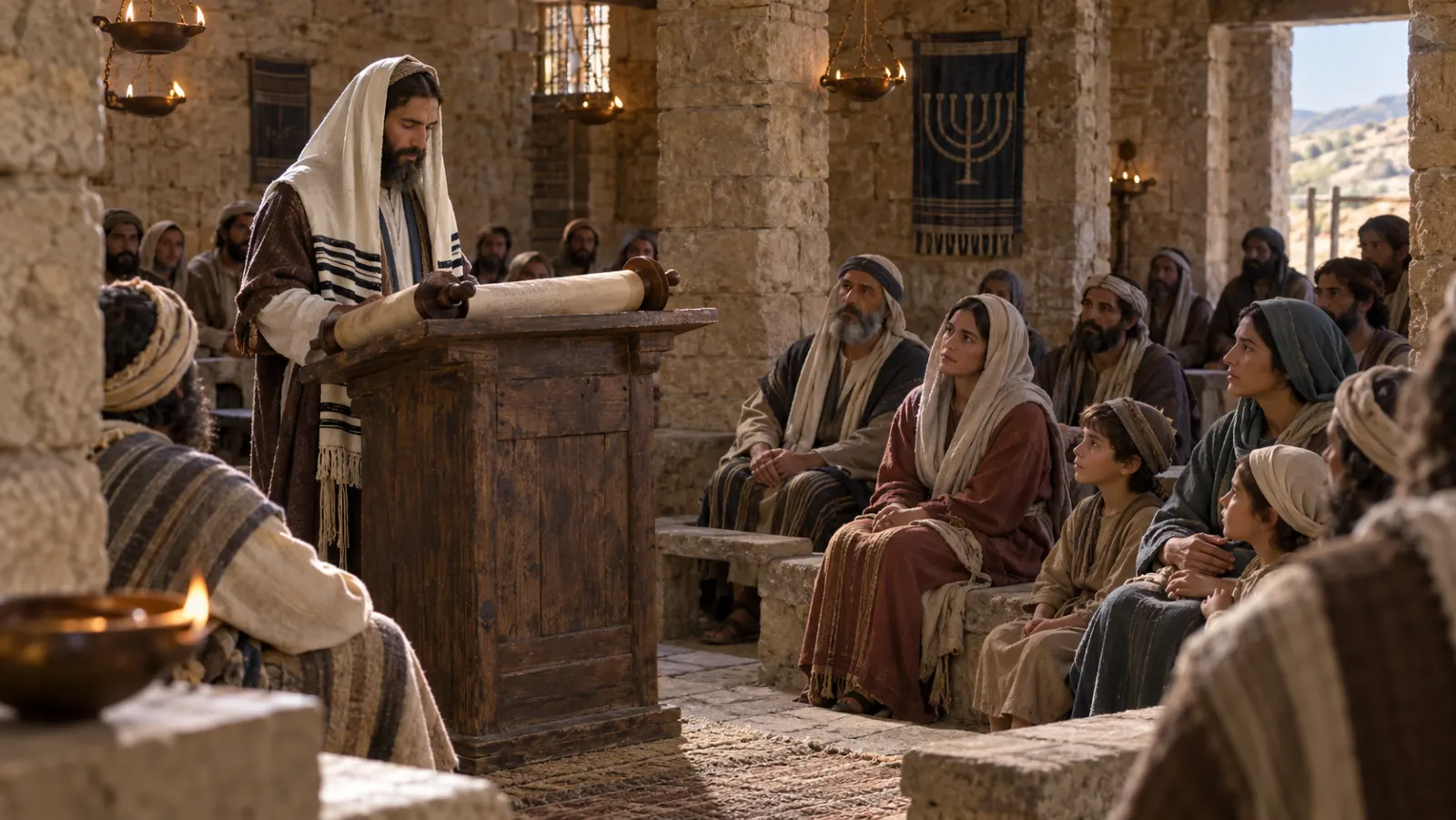
Luke says Jesus was “about thirty” when his public ministry began. Americans often turn that line into an exact age, a rule about leadership, or a supposed priestly requirement. The text is more modest—and more interesting.
Thirty is a culturally satisfying number. In American life it sounds like a threshold: old enough to be established, young enough to begin something large. So when Luke says Jesus was “about thirty years old” as he began his work, readers often turn an approximation into a biography.
Some sermons go further. Jesus had to wait until thirty because priests began service at thirty, or because biblical leaders cannot minister before that age, or because thirty marks a universal divine timetable. The connections can sound persuasive until we slow down and notice Luke’s wording. He says “about.” That small word should govern the whole discussion.
Luke gives a rounded marker, not a birth certificate
The Greek expression Luke uses communicates approximation. It situates Jesus at roughly thirty when the public ministry begins. It does not tell us his birthday or require a precise interval between the baptism and that birthday.
That matters because the calendar of Jesus’ life is reconstructed from several pieces: Herod the Great’s reign, the beginning of John’s ministry under Tiberius, Passover references, and the possible dates of the crucifixion. Scholars disagree on some of those anchors. Luke’s “about” leaves room for the ordinary looseness of ancient chronological description.
Jesus may have been somewhat older than a modern nativity timeline suggests
If Jesus was born before Herod the Great’s death, as Matthew indicates, and began public ministry in the late twenties CE, then he may have been in his early thirties rather than exactly thirty. Different reconstructions produce slightly different results.
That is not a contradiction in Luke. “About thirty” functions precisely as an approximate age. Modern readers often demand date-of-birth precision from an ancient text that is not trying to provide it.
What about priests beginning at thirty?
Numbers 4 sets thirty as the starting age for certain Levitical service associated with the tabernacle, which is why some interpreters connect Jesus’ age with priesthood. But the comparison has limits. Jesus is not introduced as a Levite reporting for tabernacle duty, and later biblical passages reflect different age arrangements for Levites.
A theological echo can be explored without turning it into a legal requirement. Luke does not say, “Jesus waited because the law required him to be thirty.” If that were Luke’s point, he had an easy way to tell us.
David also became king at thirty
Second Samuel says David was thirty when he began to reign. Because Luke’s genealogy soon emphasizes Jesus’ Davidic line, some readers hear a royal echo. That connection fits Luke’s broader interest in Jesus as Davidic Messiah more naturally than a strict priestly rule does.
Again, echo is not the same as proof. Ancient readers could recognize meaningful biblical patterns without assuming every shared number had only one explanation. Luke’s narrative gives us identity through a network of themes: Son, Spirit, David, Adam, kingdom, obedience.
Why wait so long at all?
The bigger emotional question for many Americans is not “Why thirty instead of twenty-nine?” but “Why did Jesus spend so many years in obscurity?” Our culture prizes early achievement. We celebrate teenage founders, twenty-something influencers, and compressed career timelines.
The Gospel story refuses that urgency. Most of Jesus’ earthly life, as far as our sources show, passes outside public ministry. The Son of God is not in a hurry to build a platform. The theological significance is not that thirty is magical but that hidden faithfulness and ordinary maturation are not wasted time.
The baptism marks commission, not adulthood itself
Jesus’ baptism sits at the transition between hidden life and public mission. The Spirit descends, the heavenly voice identifies the beloved Son, and the next scenes move toward testing and proclamation. The event functions as commissioning and revelation.
That is different from saying Jesus becomes spiritually mature at thirty. Luke has already described him growing in wisdom and favor. Baptism does not transform an immature man into an adult. It marks the public beginning of the mission the narrative is about to follow.
Do not build a rule for everyone from one approximate number
Christian communities sometimes use Jesus’ age to argue that younger adults should wait for leadership or that a person who has not “launched” by thirty is behind. Neither conclusion follows from the text. Scripture contains young leaders, older callings, and many forms of service before public recognition.
Jesus’ timeline is unique because his mission is unique. The imitation of Christ does not mean copying every chronological detail. It means receiving his teaching, character, cross, and resurrection as the pattern of discipleship.
Ancient age statements often function rhetorically
Biblical narratives sometimes use age to situate a person at a meaningful transition: Joseph enters Pharaoh’s service at thirty, David becomes king at thirty, priests and Levites have age thresholds in different legal settings. Readers trained in Scripture could hear resonance in such numbers.
But resonance does not erase ordinary chronology. Luke is still telling us roughly how old Jesus was. The wisest reading lets the number be both historical orientation and possible literary echo without insisting that one symbolic pattern explains everything.
The ministry’s length affects every age calculation
The Gospels do not give a sentence saying, “Jesus’ ministry lasted exactly three years.” John mentions multiple Passovers, which is why many reconstructions extend the public ministry across more than two years, while other chronologies differ.
Because both birth dating and ministry dating involve debated evidence, claims that Jesus was exactly thirty at baptism and exactly thirty-three at death are more traditional than demonstrable. Those numbers may be close, but Luke’s own “about” should keep the arithmetic modest.
“Starting late” is a modern anxiety the text can unsettle
For readers who feel behind in career, vocation, ministry, or family life, Jesus’ long hidden period can become pastorally significant without turning into a formula. The Gospel does not portray the first three decades as delay caused by failure.
Neither does it promise that everyone receives a public calling at thirty. The deeper challenge is to resist measuring faithfulness by visibility. Scripture gives most of Jesus’ earthly years almost no public record, yet Christian theology does not regard them as wasted.
Why Luke places the genealogy here
Immediately after stating Jesus’ approximate age, Luke traces his genealogy backward through David and Abraham to Adam. The placement links the beginning of ministry with identity. Jesus steps onto the public stage not as an isolated adult but as a son within Israel’s story and, ultimately, within humanity’s story.
That literary move suggests Luke cares about more than a birthday calculation. The age notice helps mark a threshold, while the genealogy widens the horizon. Public mission begins in a particular historical moment and carries a significance Luke wants to trace all the way back to creation.
Age thirty was maturity, not retirement from ordinary life
In a society with different life expectancy patterns and family structures from modern America, age categories did not map neatly onto ours. By roughly thirty, a man could have years of work and household responsibility behind him. Jesus was not an adolescent finally permitted to speak.
That makes the transition at the Jordan more concrete. The public ministry begins after substantial adult life in Nazareth. The narrative change is vocational and revelatory, not simply biological.
Approximation is not carelessness
Modern readers sometimes assume an approximate age means the writer did not care about history. Ancient historical writing often used rounded ages when exact dates were unavailable or unnecessary.
Luke’s phrasing is therefore responsible rather than evasive. He gives enough chronological orientation to place the beginning of Jesus’ ministry while signaling that he is not claiming birthday-level precision.
Luke’s “about thirty” is valuable precisely because it is modest. It locates Jesus historically and narratively without pretending to solve every chronological question.
The phrase should make us less dogmatic, not more. Jesus’ public ministry begins in mature adulthood after years of largely unrecorded life. That fact can challenge American impatience without turning age thirty into a spiritual law.