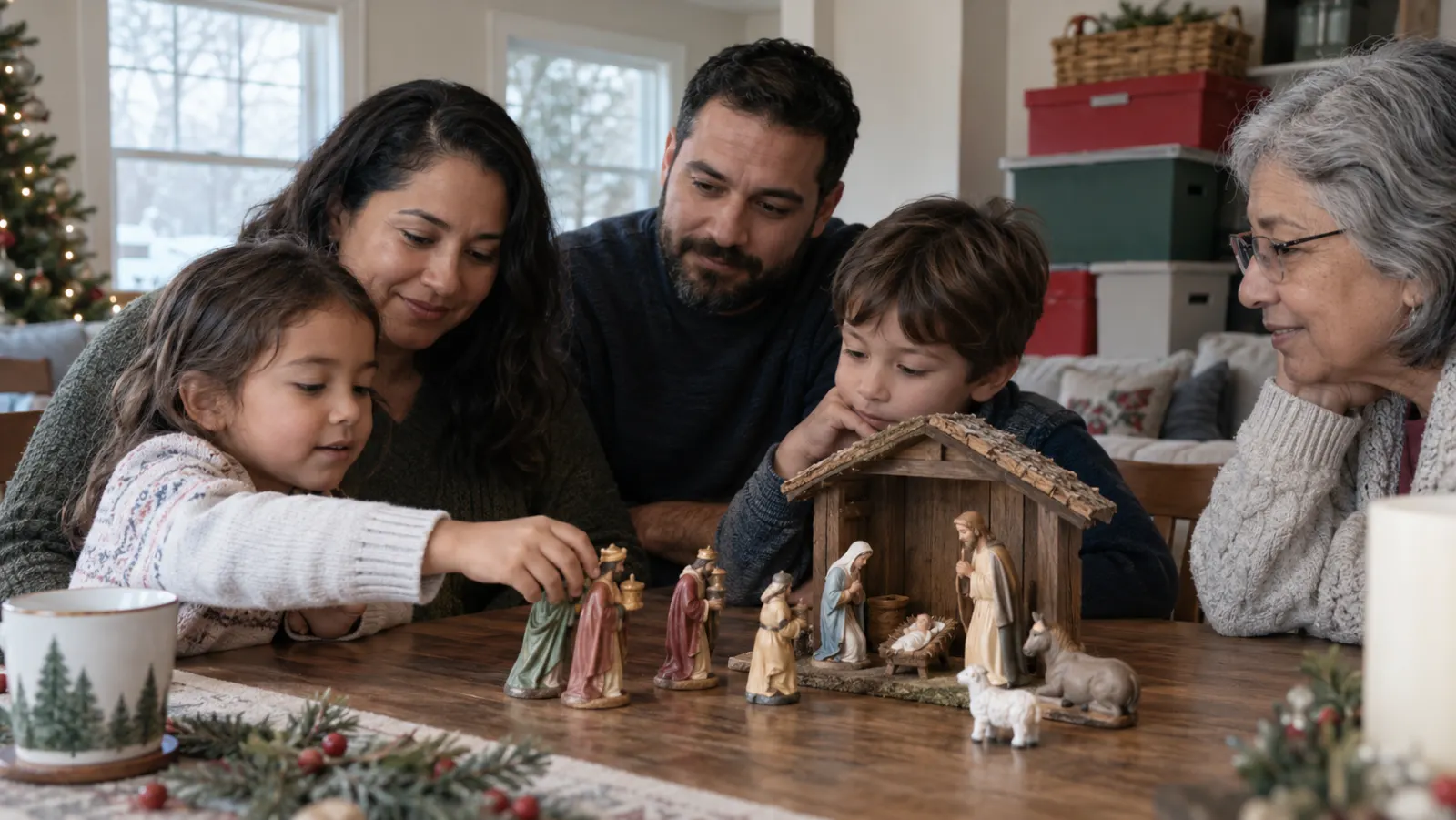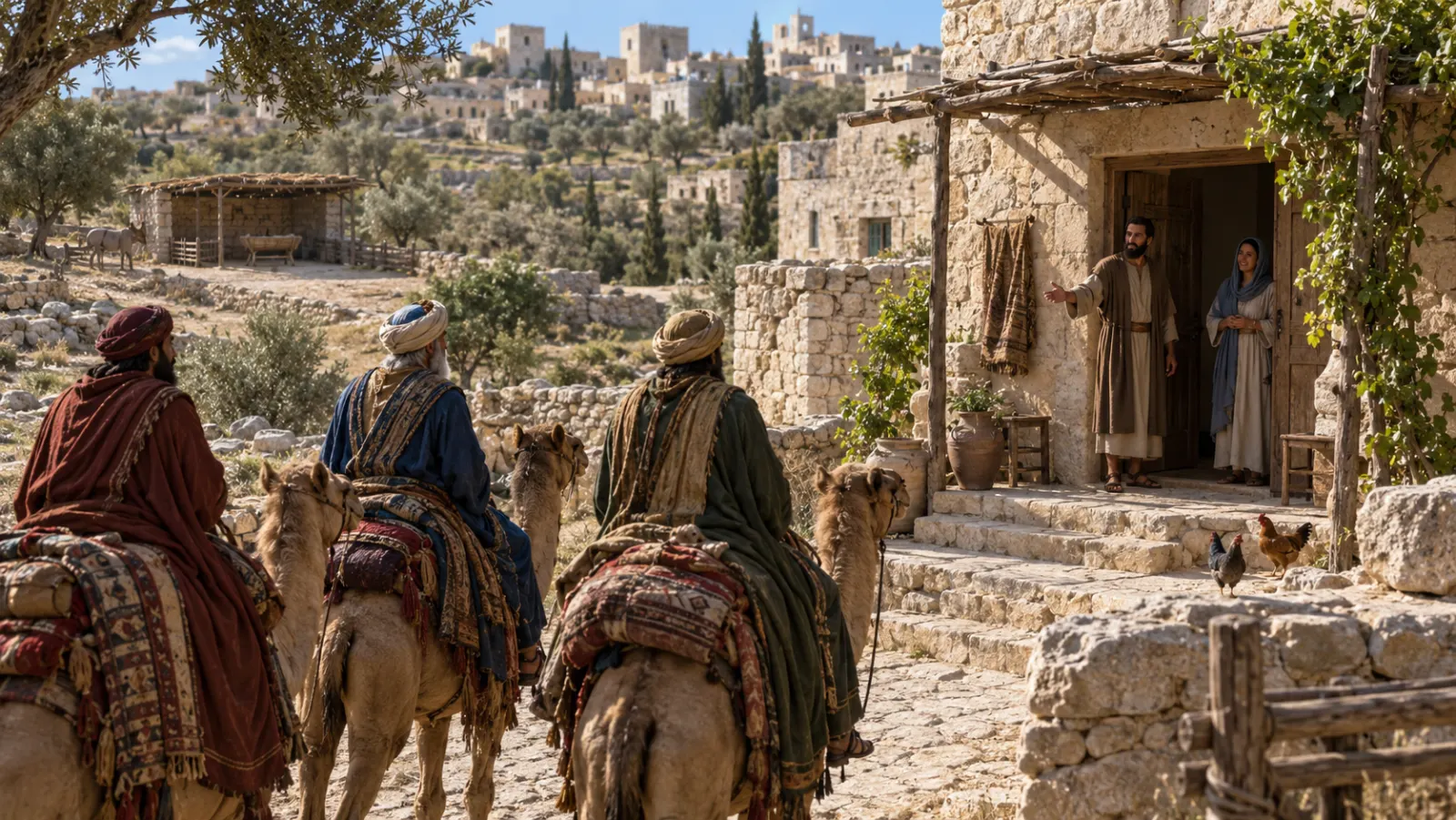
Luke places shepherds beside a newborn in a feeding trough. Matthew brings the Magi into a house and calls Jesus a child. Our nativity scenes combine the accounts, but the combination should be labeled.
Most church nativity sets run on a crowded schedule. Mary, Joseph, the infant, shepherds, sheep, angels, Magi, camels, and perhaps a drummer occupy the same patch of straw. The arrangement is efficient, beautiful, and almost impossible to derive from one Gospel. Luke brings shepherds to the manger on the night of the birth. Matthew brings eastern visitors to a house at a time he describes less precisely.
Saying that the Magi were probably not at the manger can sound like a person correcting children for enjoying Christmas. That is not the point. Art may combine scenes. Pageants must fit a story into forty minutes. The important distinction is between a visual summary and the wording of the texts. Once the figures are gently separated, Matthew and Luke each become more vivid.
Luke gives us the manger and the shepherds
Luke narrates the journey to Bethlehem, the birth, the wrapping of the baby, and the use of a feeding place because suitable guest space is unavailable. Shepherds in nearby fields receive the angelic announcement and go with haste. They find Mary, Joseph, and the baby lying in the manger. The scene has urgency: announcement, movement, recognition, report.
Luke never mentions a star, Magi, Herod's inquiry, royal gifts, or a flight to Egypt. His birth narrative attends to imperial registration, humble conditions, songs of praise, shepherd witnesses, and later presentation in the temple. Those omissions are not defects. A writer selects material to make a truthful account with a particular emphasis.
Matthew gives us a house and a child
Matthew begins the Magi episode after stating that Jesus had been born in Bethlehem. When the travelers arrive, they enter a house and see the child with Mary. The ordinary Greek terms can cover a range of age and setting, so they do not produce an exact birthday. They do, however, sound different from Luke's explicit newborn-and-manger scene.
Herod asks when the star appeared and later targets boys two years old and under according to the time learned from the Magi. His brutal margin may be deliberately broad; it does not prove Jesus was almost two. It does show that Matthew's chronology allows more elapsed time than a single crowded night requires.
The Gospels are not security-camera footage
Modern readers often expect parallel biographies to answer the same questions in the same order. Ancient narrative did not operate under that contract, and the evangelists tell the birth from different vantage points. Matthew follows Joseph's dreams and threats from rulers. Luke follows Mary's experience, songs, shepherds, and temple worship.
Harmonization asks how both accounts might fit within one history. That can be responsible when it respects what each text states and admits where reconstruction is uncertain. It becomes misleading when a possible sequence is presented as a verse-by-verse fact. We can say the Magi likely arrived later without pretending to know the exact week or month.
Christians combined the figures for understandable reasons
A nativity display is a theological portrait, not a calendar. It gathers the people who recognize Jesus near the beginning of His life: Jewish parents, low-status shepherds, heavenly messengers, and Gentile visitors with treasures. Together they announce humility and universality in one glance. Art often compresses time to reveal meaning.
Church festivals also shaped the visual tradition. Christmas and Epiphany developed related celebrations, and worshipers remembered the birth and manifestation of Christ across a season. When later homes placed all the figures in one stable, they made a compact devotional world. Appreciating that history is better than either policing every creche or calling the arrangement biblical reportage.
The combined scene can hide Matthew's danger
When Magi stand harmlessly beside shepherds, Herod's shadow usually disappears. Matthew's episode is not merely another visit. The travelers' question alarms a ruler, Scripture points toward Bethlehem, worship occurs under threat, a dream changes the route, and violence follows. The gifts arrive inside a political crisis.
Separating the scenes restores narrative tension. The family has moved into a house, ordinary life may be beginning, and then foreigners appear with news that has already reached the palace. Joy and danger exist beside each other. Matthew's Christmas is not frozen in a peaceful stable; it is moving toward exile.
The separation also protects Luke's poor witnesses
The Magi's costly gifts and traditional royal clothing can dominate a tableau. Shepherds become rustic extras behind a caravan. Luke gives them a different dignity. They receive the announcement directly, visit the baby, spread the news, and return praising God. Their social importance does not depend on sharing a stage with wealthy visitors.
Letting Luke's scene stand on its own clarifies the Gospel's attention to people without status. Letting Matthew's stand on its own clarifies the arrival of the nations and the conflict between kings. The Bible does not need one visitor group to validate the other. Each carries a distinct witness.
Good teaching labels imagination without shaming it
A teacher can point to a nativity set and ask children or adults which details come from Matthew, which from Luke, and which from later tradition. The exercise need not end with pieces being thrown away. Instead, the group learns how biblical knowledge works. A camel may be plausible even though Matthew names no animal; three Magi may be traditional even though the number comes from gifts.
This practice builds trust. People will eventually discover differences between beloved images and the text. If churches have been candid, discovery becomes an invitation to read more closely. If every decorative detail was defended as revelation, a small correction may feel like a larger betrayal. Intellectual honesty is pastoral care.
A revised pageant can let both Gospels breathe
Churches do not need to abandon the familiar production. A simple time transition can move from Luke's manger to Matthew's house. Shepherds can leave rejoicing; lights change; the family settles; travelers arrive later. The staging gains drama and teaches chronology without a lecture. Another option is to place the Magi at a distance, still on their road.
The point is not historical perfection in costume and blocking. It is attention. When Scripture shapes the art, familiar characters recover agency and surprise. The Magi stop being late-arriving ornaments and become foreigners whose search destabilizes a capital. Mary and Joseph stop posing and become parents whose circumstances keep changing.
Chronology changes how we imagine the family's resources
If the Magi arrive after some time has passed, the Holy Family is no longer frozen in the emergency of childbirth. They have found a house, however modest, and begun a stretch of ordinary care. The visitors enter not a permanent tableau but a household trying to live. Soon Matthew will move that household again through danger and flight.
This sequence protects Mary and Joseph from being treated as decorative figures beside a feeding trough. They make arrangements, receive unexpected guests, interpret warnings, and relocate. A later visit lets their parental labor become visible between miracles.
Christmas preaching can respect unresolved sequence
Matthew and Luke provide enough material for several plausible harmonies and not enough to answer every question. Where did the family stay after the birth? How long before the Magi came? When did the temple visit occur in relation to the flight? Confident timelines often outrun the evidence.
A sermon can name the broad distinction without solving every interval. Honest uncertainty invites congregants into serious reading and prevents secondary chronology from becoming a test of faith. The evangelists' central claims remain clear even where our composite calendar remains penciled.
The distinction gives artists more scenes, not fewer
Once the timeline opens, Christian imagination gains a family receiving guests in a house, travelers asking dangerous questions in Jerusalem, scholars consulting texts, a warning at night, and a quiet departure by another road. The single stable tableau has hidden an entire sequence of visual and dramatic possibilities.
Accuracy need not make art sterile. It can make art more inventive by recovering details the familiar composition crowded out. The text supplies tension, place, movement, and character without requiring invented spectacle.
The Magi were probably not at the manger. That conclusion rests on Matthew's house and child, Luke's explicit birth-night scene, and Herod's chronology. It remains a responsible reconstruction rather than a date stamped by the text.
Keep the family nativity if it helps you worship. Let it be what it is: a small artistic harmony. Then open Matthew and Luke separately. The reward for moving one set of figures down the timeline is not a colder Christmas, but two warmer, stranger, more demanding Gospel stories.