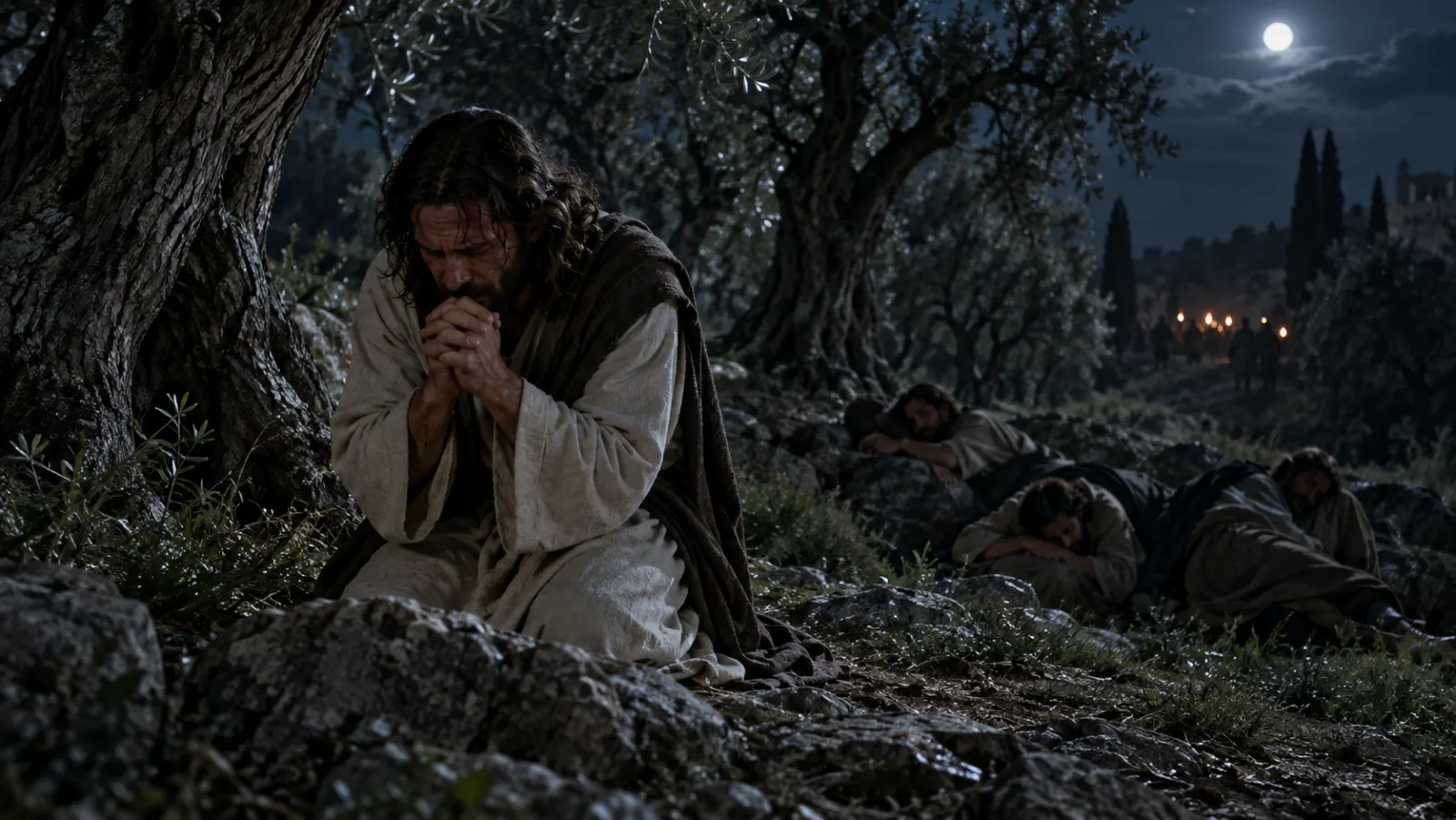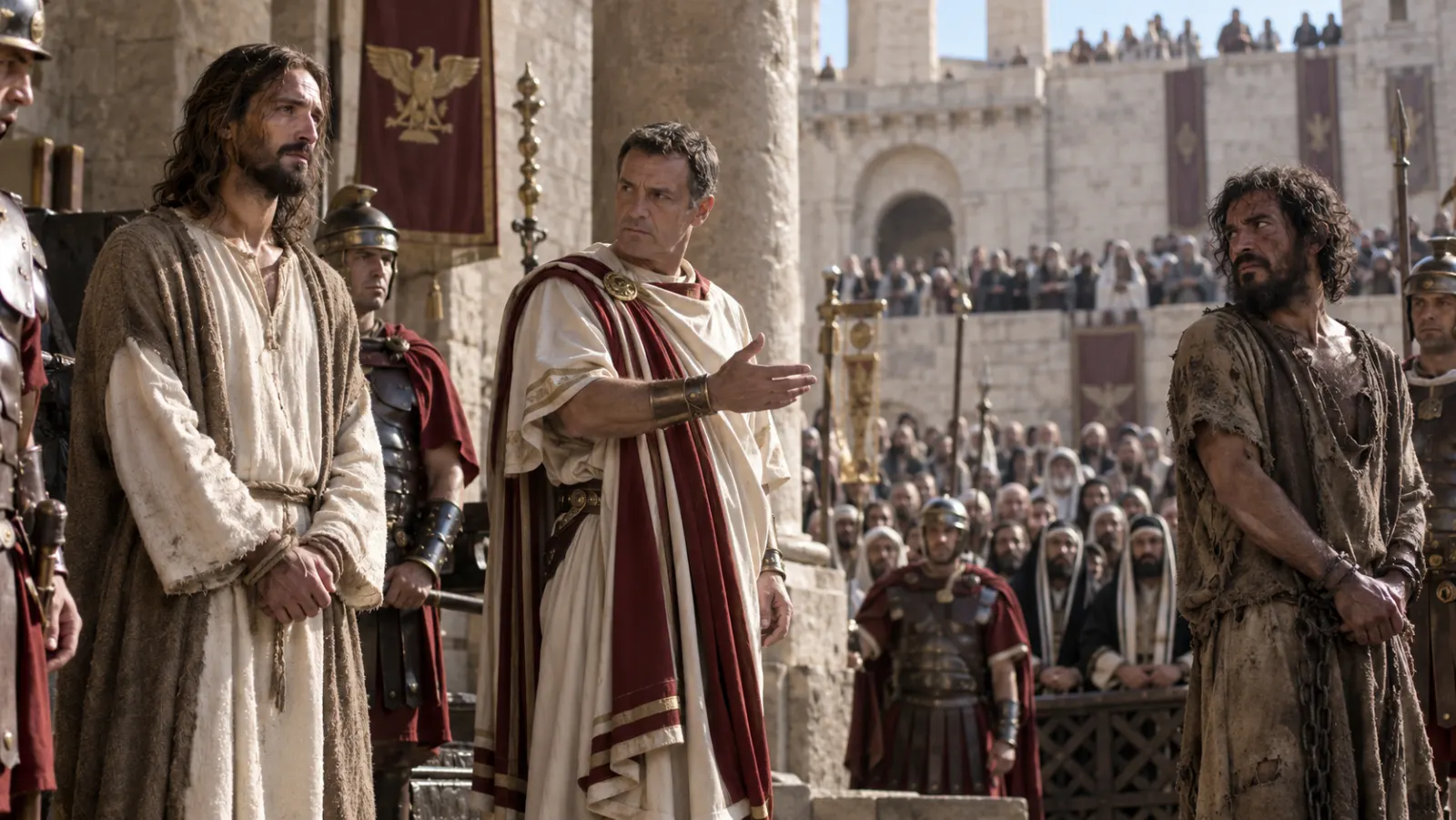
Barabbas often appears in sermons as a symbolic stand-in for sinners. Historically, the scene also reflects political unrest, Roman authority, and the charged atmosphere of Passover.
Barabbas enters the Passion narrative suddenly and disappears almost as quickly. He is a prisoner, associated in the Gospels with insurrection, robbery, or murder, depending on the account and translation. Pilate presents him alongside Jesus, and the crowd asks for Barabbas’s release. Christian preaching has often treated the scene symbolically: the guilty man goes free while the innocent Jesus is condemned. That symbolism is powerful, but the historical setting adds another layer.
Passover in Jerusalem was a season when Roman officials had reason to be alert. The festival remembered liberation from foreign oppression. Large crowds filled the city. National hopes were easily stirred. A prisoner connected with uprising therefore represents more than private criminality. Barabbas belongs to the politics of resistance, while Jesus stands accused under the language of kingship. The Roman governor is dealing with two figures who can be placed, however differently, inside the category of public threat.
The Gospels portray Barabbas as connected with violent unrest
Mark says Barabbas was imprisoned with rebels who had committed murder in an insurrection. Luke likewise connects him to insurrection and murder. John calls him a robber or bandit, a term that could carry political overtones in some contexts. The exact event behind his imprisonment is unknown, but the general picture is clear: Barabbas is not simply a pickpocket or anonymous inmate. He is associated with violent resistance to order.
That matters because Roman authorities treated sedition seriously. Crucifixion itself was one of the empire’s tools for humiliating and deterring those judged dangerous. Barabbas has been caught in the machinery of imperial punishment. His release, whether part of a local Passover custom or a particular political decision, occurs inside that atmosphere of unrest and control.
The Passover release custom remains historically debated
All four Gospels refer in some way to a custom of releasing a prisoner at the festival, but external evidence for a regular annual Passover amnesty exactly like the Gospel description is limited. Scholars have therefore debated whether the practice was local, occasional, informal, or narratively shaped. Responsible historical reading should acknowledge that debate rather than pretending the evidence is stronger than it is.
At the same time, governors in the Roman world did possess discretionary powers and could use clemency for political purposes. The absence of a neat parallel does not make release impossible. The Gospel scene is historically intelligible as a governor managing a volatile crowd and using prisoner release as a tool. What cannot be confidently reconstructed is a detailed bureaucratic policy manual behind it.
Pilate’s choice is political, not merely personal
The Passion narratives often portray Pilate as recognizing that Jesus does not fit an ordinary criminal profile, yet still sending him to crucifixion. Whether he acts from fear of unrest, political expediency, pressure, or a mix of motives, his decision reflects the cold logic of governance: preserve order, avoid escalation, sacrifice the expendable person if necessary.
Barabbas makes that logic visible. A known violent prisoner can be released while Jesus, whose kingship does not operate through armed revolt, is condemned as “King of the Jews.” Rome can tolerate one danger if doing so neutralizes another immediate crisis. The governor’s task is not to discover theological truth; it is to maintain control. The scene exposes how justice bends when political stability becomes the highest good.
Two visions of deliverance stand side by side
Christian interpreters have often noticed the irony that Barabbas represents violent insurrection while Jesus has refused the sword. Both can be associated with freedom in radically different senses. One participates in revolt against imperial power; the other announces God’s kingdom and enters the Passion without armed resistance. The crowd’s preference therefore becomes, at least narratively, a choice between two kinds of deliverance.
We should be careful not to turn Barabbas into a cartoon nationalist or pretend we know his ideology in detail. The Gospels tell us too little for that. But the contrast they create is real. Holy Week asks what kind of Messiah people want when oppression is tangible. Jesus does not offer the familiar route of violent overthrow. That makes him harder to recognize as a deliverer on ordinary political terms.
The symbolic reading still matters—if it does not erase history
Christian preaching is right to see substitutional irony in the scene: Barabbas goes free while Jesus is condemned. The Gospel narratives place a guilty prisoner and the innocent Jesus in stark relation. But the symbolism becomes richer, not poorer, when history is allowed to remain visible. The prisoner is not an abstract “sinner.” He is a man shaped by a world of occupation, violence, and political fear.
That combination is one reason the scene endures. The Passion is theological without becoming unreal. Grace appears inside a courtroom governed by expediency. A prisoner walks away because another man is sentenced. For Christians, the exchange becomes a vivid image of salvation, while historically it remains a disturbing picture of how empire, crowd pressure, and fear can converge around a human life.
Barabbas’s name creates a striking narrative irony
The name Barabbas likely reflects the Aramaic “bar-Abba,” meaning “son of the father.” Some manuscript traditions of Matthew even preserve the form “Jesus Barabbas,” though the textual history is debated. If that reading is original, the scene becomes especially striking: Pilate sets before the crowd Jesus Barabbas and Jesus called the Messiah. Even without the longer name, the irony remains suggestive.
Christian interpreters have long noticed the contrast between the prisoner called “son of the father” and Jesus, whom the Gospels identify in a unique sense as the Son of the Father. This is literary and theological resonance, not proof that Barabbas was invented. The name deepens an already dramatic exchange between two prisoners whose paths suddenly diverge.
The crowd scene should not be turned into collective Jewish guilt
As with the rest of the Passion, the Barabbas episode has been used irresponsibly against Jewish communities. The crowd before Pilate is a particular crowd in a particular scene, not a referendum of every Jew in Jerusalem, much less of Jews across history. Jesus’ own supporters are Jewish, and the conflict unfolds within a diverse population under Roman rule.
This caution actually improves the historical reading. Crowds can be local, organized, pressured, or simply limited by who is present at a governor’s residence early in the morning. We do not know the exact composition. What the Gospels emphasize is the tragic choice within the scene, not an ethnic verdict on a whole people.
Barabbas is easy to overlook because the Gospel story quickly moves on. Yet his brief appearance reveals the charged political world of Holy Week. Passover remembers liberation, Rome guards order, a rebel is in custody, and Jesus stands accused as a king. The governor chooses what seems expedient.
For Christian readers, the scene carries both historical and theological weight. Barabbas represents a real world of resistance and imperial punishment, while his release becomes an unforgettable picture of an exchange: the prisoner goes free, and Jesus goes toward the cross. The Passion story is never only abstract doctrine. It unfolds in the hard decisions of power.
Seen in that light, Barabbas is not a disposable side character. He makes visible the world Jesus is entering: a world of occupation, revolt, prison, political calculation, and competing hopes for liberation. The Gospel places Jesus in the middle of that world and shows that his path to kingship will not look like anyone’s expected route to freedom.
That contrast is one reason the scene belongs inside Holy Week rather than at its margins. The prisoner linked with violent revolt is released, while the unarmed claimant to kingship is condemned. The irony is political before it becomes devotional.