Few church questions become personal as quickly as ‘May I take Communion here?’ The answer can touch baptism, membership, conversion, age, church discipline, denominational identity and conscience. Visitors may discover…
Few church questions become personal as quickly as ‘May I take Communion here?’ The answer can touch baptism, membership, conversion, age, church discipline, denominational identity and conscience. Visitors may discover the rules only when the tray reaches their row. Someone returning to faith after years away may hear a warning and assume the table is only for people who have finally become good enough.
In Who Can Take Communion? Baptism, Faith, and the Church’s Table, the aim is not to manufacture consensus but to clarify the ground on which disagreement happens. 1 Corinthians 11:27–29 is read in context, early Christian sources are treated as historical witnesses, and later confessions are used to represent positions that remain alive today. That combination makes room for an evangelical conclusion without pretending that history is simpler, or that another tradition’s strongest argument can be replaced by its weakest caricature.
The New Testament assumes faith and belonging
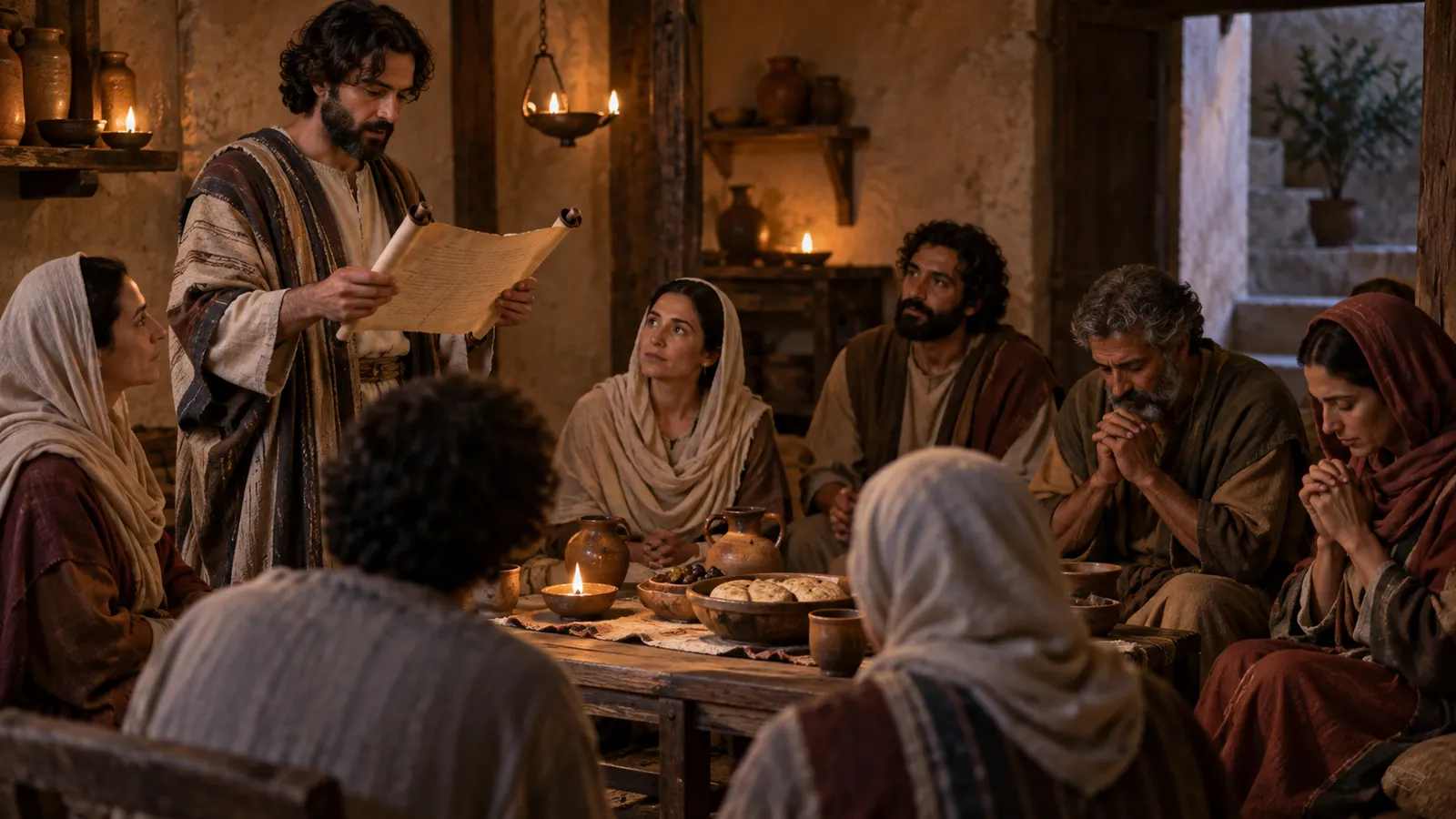
The disagreement around The New Testament assumes faith and belonging is real, but 1 Corinthians 11:27–29 still provides common ground from which the competing readings can be compared fairly. Communion appears as a practice of gathered believers who have received the apostolic message and entered the community. Acts places breaking bread alongside baptism, teaching, prayer and fellowship. Baptism, Faith, and the Church’s Table: Communion cannot be explained faithfully while the people at the table disappear from view.
The New Testament assumes faith and belonging is where doctrine becomes visible in ordinary church decisions, and 1 Corinthians 11:27–29 keeps those decisions tied to the gospel rather than preference alone. That pattern explains why churches commonly connect participation to a credible profession of faith and some account of Christian initiation. For Who Can Take Communion? Baptism, Faith, and the Church’s Table, that means the section should be read as part of one argument rather than as a detachable proof-text.
Early churches drew boundaries
The pastoral force of Early churches drew boundaries appears when 1 Corinthians 11:27–29 is heard as an address to an actual congregation rather than a detached religious slogan. The Didache restricts its Eucharistic meal to the baptized, and Justin describes participation in relation to belief, baptism and a life ordered by Christ’s teaching. Seen this way, Early churches drew boundaries contributes evidence to Who Can Take Communion? Baptism, Faith, and the Church’s Table without pretending to settle every later controversy by itself.
The first issue in Early churches drew boundaries is textual: 1 Corinthians 11:27–29 has to be allowed to set the terms before later labels take over. Those texts do not settle every modern policy, but they show that an entirely boundaryless table is not the only ancient model. A meal in such a world could display hierarchy or overturn it. Baptism, Faith, and the Church’s Table: the table has doctrinal meaning precisely because it also shapes conduct.
Open, close and closed communion
Read through the lens of Open, close and closed communion, 1 Corinthians 11:27–29 puts a specific claim on the table that cannot be reduced to a denominational catchphrase. Modern Protestant churches use several approaches. Some invite all baptized believers; some require believer’s baptism; some limit participation to members of the local congregation; others use broader language of faith in Christ and self-examination. Baptism, Faith, and the Church’s Table, the point is not antiquarian detail but the way historical setting changes what faithful application requires.
The evidence for Open, close and closed communion begins with a concrete practice rather than an abstract definition, especially when 1 Corinthians 11:27–29 is read in context. Because practices differ, churches should explain their invitation before distribution rather than embarrass visitors in the moment. This is why Open, close and closed communion matters to Who Can Take Communion? Baptism, Faith, and the Church’s Table: it locates the Christian claim in a community that must actually live what it confesses.
Children and developing faith
Children and developing faith becomes clearer once the argument is located inside the social and worship setting implied by 1 Corinthians 11:27–29. Families and churches need a theology, not merely an age cutoff. Questions include whether the child professes faith, understands the meal at an age-appropriate level, has been baptized, and belongs under the church’s pastoral care. Baptism, Faith, and the Church’s Table, this makes Children and developing faith a test of proportion: central claims remain central while secondary questions are kept secondary.
A close reading of 1 Corinthians 11:27–29 gives Children and developing faith a sharper edge than the language Christians often inherit from later debates. A serious approach avoids both automatic participation and needless fear. Churches should be able to explain which boundaries they believe Scripture requires, which customs are prudential, and which choices simply reflect local history. Baptism, Faith, and the Church’s Table: Communion cannot be explained faithfully while the people at the table disappear from view.
Discipline and restoration
The historical question behind Discipline and restoration is limited but answerable: the sources show patterns without giving us a complete transcript of early Christian life. Paul’s warnings and broader New Testament teaching make persistent, unrepentant rebellion relevant to the church’s table, but discipline should aim at restoration rather than public humiliation. Some believers were eating ahead, others were left hungry, and the gathering reproduced divisions that denied the meaning of the Lord’s Supper. Baptism, Faith, and the Church’s Table.
For Discipline and restoration, practice matters because theology was enacted in meals, gatherings, exclusions, and acts of welcome before it was summarized in later formulas. The table is not a trophy for the morally elite; it is a gospel practice for repentant believers who know they need grace. The meal calls believers to discern Christ’s body in a way that includes the church gathered around the table. Baptism, Faith, and the Church’s Table without pretending to settle every later controversy by itself.
Pastoral clarity is part of hospitality
The disagreement around Pastoral clarity is part of hospitality is real, but 1 Corinthians 11:27–29 still provides common ground from which the competing readings can be compared fairly. A congregation can hold convictions without turning Communion into a social trap. Clear explanations, private conversation and a gracious way to abstain protect both conscience and dignity. Baptism, Faith, and the Church’s Table, where interpretation and practice cannot finally be separated.
Pastoral clarity is part of hospitality is where doctrine becomes visible in ordinary church decisions, and 1 Corinthians 11:27–29 keeps those decisions tied to the gospel rather than preference alone. The goal is not to make boundaries disappear but to make their biblical and pastoral logic visible. For the argument of Who Can Take Communion? Baptism, Faith, and the Church’s Table, the point is not antiquarian detail but the way historical setting changes what faithful application requires.
Communion is neither an all-purpose hospitality snack nor a reward for people who have no sins left to confess. Churches should connect the table to faith, baptism, belonging and repentance in ways they can explain from Scripture—and then communicate those convictions with enough grace that a visitor is not made into a spectacle.
The table described in Who Can Take Communion? Baptism, Faith, and the Church’s Table holds past, present, and future together. 1 Corinthians 11:27–29 recalls Christ’s death, addresses a living congregation, and refuses to let the present age become the final horizon. That is why Communion can carry both sobriety and joy. It tells the truth about sin and fracture while also telling the truth about grace, belonging, and the kingdom Christians believe is still coming.