Ask five Christians what happens in Communion and you may hear five answers that sound similar until the conversation reaches the word ‘presence.’ Roman Catholics speak of transubstantiation; Eastern Orthodox Christians…
Ask five Christians what happens in Communion and you may hear five answers that sound similar until the conversation reaches the word ‘presence.’ Roman Catholics speak of transubstantiation; Eastern Orthodox Christians speak of mystery and real participation; Lutherans confess Christ’s body and blood as truly present; Reformed churches often stress a real spiritual feeding on Christ; many Baptists emphasize memorial symbolism. The disagreement is old, serious and often badly summarized.
The question behind Bread and Cup: Why Christians Disagree About Christ’s Presence is narrower than a complete theology of Communion, so this essay stays close to 1 Corinthians 10:16 and the evidence most relevant to that question. Early Christian witnesses are used to show how practice developed, while later confessions are brought in only where they clarify a real disagreement. That keeps biblical claims, historical reconstruction, and denominational interpretation from being treated as though they were the same kind of evidence.
Start with the shared texts
The first issue in Start with the shared texts is textual: 1 Corinthians 10:16 has to be allowed to set the terms before later labels take over. The institution narratives say ‘this is my body’ and ‘this is my blood,’ while Paul calls the cup and bread a participation in Christ. For Bread and Cup: Why Christians Disagree About Christ’s Presence, that means the section should be read as part of one argument rather than as a detachable proof-text.
Read through the lens of Start with the shared texts, 1 Corinthians 10:16 puts a specific claim on the table that cannot be reduced to a denominational catchphrase. The dispute concerns how the biblical language works, not whether the language exists. That observation narrows the claim without weakening it, which is important for the larger question posed by Bread and Cup: Why Christians Disagree About Christ’s Presence.
Catholic and Orthodox accounts
The evidence for Catholic and Orthodox accounts begins with a concrete practice rather than an abstract definition, especially when 1 Corinthians 10:16 is read in context. Catholic teaching uses the term transubstantiation to describe a real change while retaining the appearances of bread and wine. The result is a more demanding reading of Bread and Cup: Why Christians Disagree About Christ’s Presence: the table has doctrinal meaning precisely because it also shapes conduct.
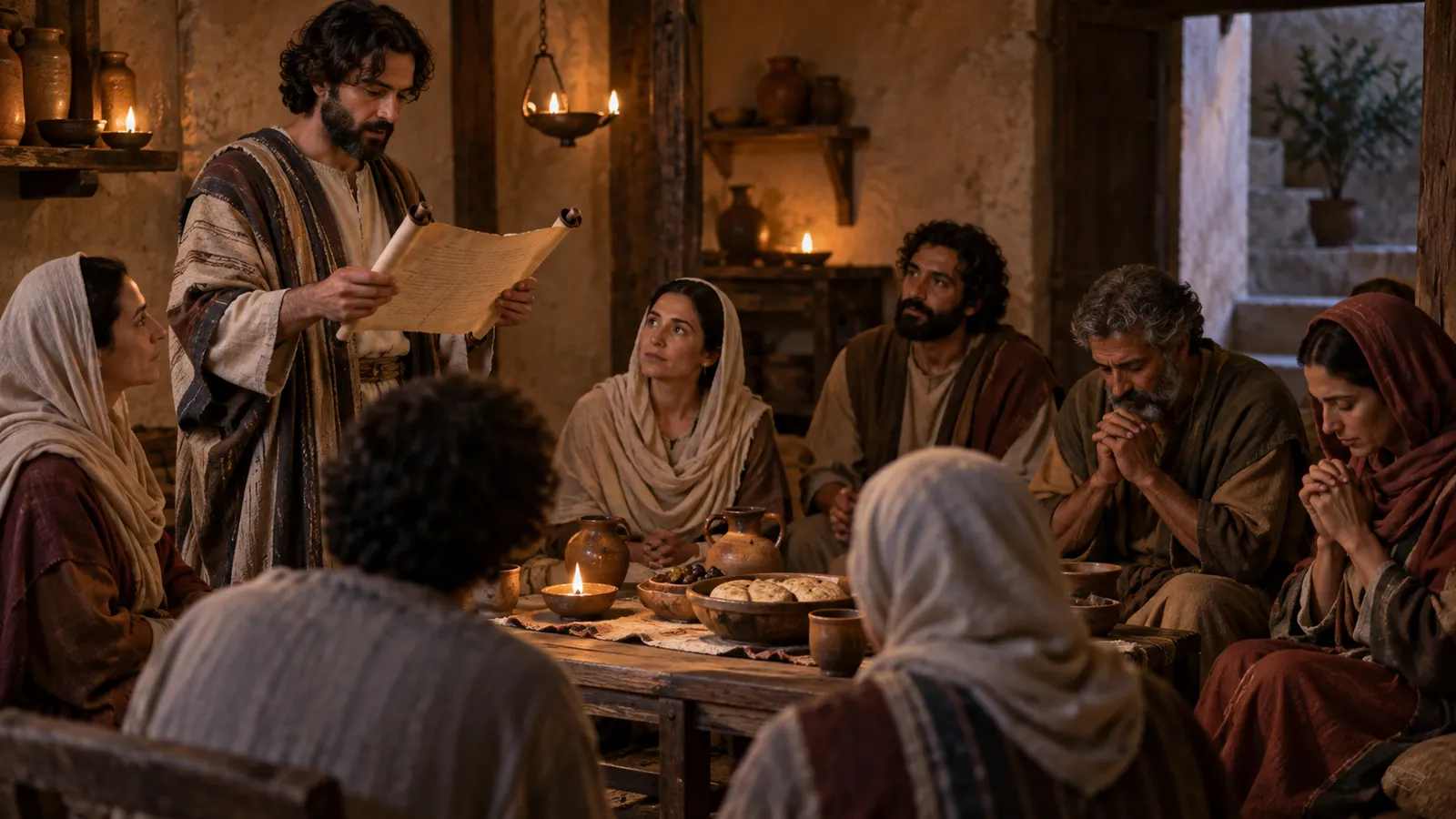
Catholic and Orthodox accounts becomes clearer once the argument is located inside the social and worship setting implied by 1 Corinthians 10:16. Those positions should be reported in their own terms rather than collapsed into ‘literalism.’ Early Christians often met in houses before purpose-built basilicas became common, and Roman dining rooms carried visible signals of status. That connection gives Catholic and Orthodox accounts its weight within Bread and Cup: Why Christians Disagree About Christ’s Presence, where interpretation and practice cannot finally be separated.
Lutheran confession
A close reading of 1 Corinthians 10:16 gives Lutheran confession a sharper edge than the language Christians often inherit from later debates. The Augsburg Confession states that Christ’s body and blood are truly present and distributed to communicants. Lutheran theology therefore rejects a merely symbolic reading. This is why Lutheran confession matters to Bread and Cup: Why Christians Disagree About Christ’s Presence: it locates the Christian claim in a community that must actually live what it confesses.
The historical question behind Lutheran confession is limited but answerable: the sources show patterns without giving us a complete transcript of early Christian life. Popular summaries sometimes call this ‘consubstantiation,’ but confessional Lutherans themselves often avoid that label because it can misstate their account. The distinction protects Bread and Cup: Why Christians Disagree About Christ’s Presence from two opposite errors—treating history as irrelevant and treating later history as though it were Scripture.
Reformed spiritual presence
For Reformed spiritual presence, practice matters because theology was enacted in meals, gatherings, exclusions, and acts of welcome before it was summarized in later formulas. The Westminster tradition rejects a physical change of the elements while still speaking of real spiritual nourishment and communion with Christ for believers. That is the pressure 1 Corinthians 10:16 places on Bread and Cup: Why Christians Disagree About Christ’s Presence: Communion cannot be explained faithfully while the people at the table disappear from view.
The disagreement around Reformed spiritual presence is real, but 1 Corinthians 10:16 still provides common ground from which the competing readings can be compared fairly. This makes classic Reformed theology distinct from the idea that the supper is nothing more than an acted reminder. Confusing those categories produces unnecessary fear or superiority. For Bread and Cup: Why Christians Disagree About Christ’s Presence, that means the section should be read as part of one argument rather than as a detachable proof-text.
Baptist memorial emphasis
Baptist memorial emphasis is where doctrine becomes visible in ordinary church decisions, and 1 Corinthians 10:16 keeps those decisions tied to the gospel rather than preference alone. The Baptist Faith and Message calls the Lord’s Supper a symbolic act of obedience that memorializes Christ’s death and anticipates his return. Seen this way, Baptist memorial emphasis contributes evidence to Bread and Cup: Why Christians Disagree About Christ’s Presence without pretending to settle every later controversy by itself.
The pastoral force of Baptist memorial emphasis appears when 1 Corinthians 10:16 is heard as an address to an actual congregation rather than a detached religious slogan. Even here, the symbolism is not supposed to mean insignificance: the ordinance is commanded, corporate and gospel-centered. The result is a more demanding reading of Bread and Cup: Why Christians Disagree About Christ’s Presence: the table has doctrinal meaning precisely because it also shapes conduct.
What evangelicals can say with confidence
The first issue in What evangelicals can say with confidence is textual: 1 Corinthians 10:16 has to be allowed to set the terms before later labels take over. A non-denominational evangelical article should not pretend to erase these differences. For the argument of Bread and Cup: Why Christians Disagree About Christ’s Presence, the point is not antiquarian detail but the way historical setting changes what faithful application requires.
Read through the lens of What evangelicals can say with confidence, 1 Corinthians 10:16 puts a specific claim on the table that cannot be reduced to a denominational catchphrase. Honesty about unresolved questions can coexist with strong conviction about that biblical center. This is why What evangelicals can say with confidence matters to Bread and Cup: Why Christians Disagree About Christ’s Presence: it locates the Christian claim in a community that must actually live what it confesses.
The presence debate matters because Christians are asking how the risen Christ gives himself to his people. The best first step is neither to mock sacramental language nor to dismiss memorial language, but to read Scripture carefully, hear historic traditions accurately, and keep the meal tethered to the gospel it was given to proclaim.
The practical measure of Bread and Cup: Why Christians Disagree About Christ’s Presence is therefore not how elaborate the ceremony becomes but whether the meal tells the truth about Christ and the people he gathers. 1 Corinthians 10:16 keeps remembrance, participation, repentance, and hope connected. A church can disagree with another church about important details and still be called to explain its own practice with humility, biblical seriousness, and visible love for the people who share the table.