Some Christians have skipped Communion because they were afraid of taking it ‘unworthily.’ They imagined Paul was saying that only people who had reached an acceptable spiritual level should approach the table. Read in c…
Some Christians have skipped Communion because they were afraid of taking it ‘unworthily.’ They imagined Paul was saying that only people who had reached an acceptable spiritual level should approach the table. Read in context, however, 1 Corinthians 11 confronts something more concrete and more demanding: a church meal where social division and humiliating treatment of the poor contradicted the body the meal was supposed to display.
Self-Examination and a Worthy Manner: What Paul Really Meant asks a practical question with a long theological history. The discussion therefore starts with 1 Corinthians 11:27–34, checks that reading against the earliest available Christian evidence, and only then turns to later doctrinal formulations. The sequence is deliberate: it allows readers to see where the evidence is firm, where interpretation begins, and why Christians who share the same New Testament can nevertheless organize and explain the meal differently.
The abuse comes before the warning
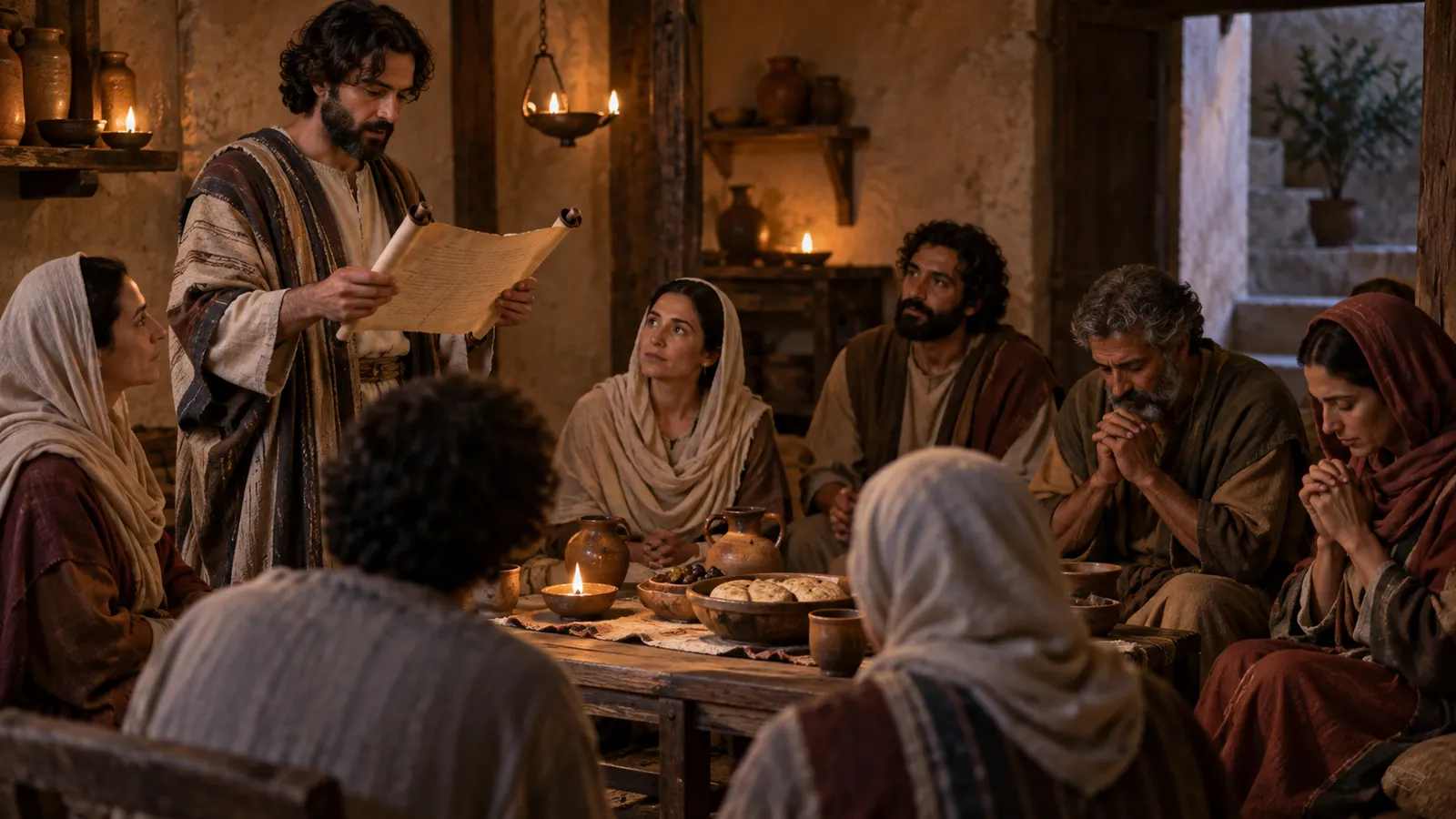
A close reading of 1 Corinthians 11:27–34 gives The abuse comes before the warning a sharper edge than the language Christians often inherit from later debates. Paul begins by saying the Corinthians’ gatherings do more harm than good. Some eat their private food, one goes hungry and another gets drunk. Within Self-Examination and a Worthy Manner: What Paul Really Meant, this makes The abuse comes before the warning a test of proportion: central claims remain central while secondary questions are kept secondary.
The historical question behind The abuse comes before the warning is limited but answerable: the sources show patterns without giving us a complete transcript of early Christian life. The warning about an unworthy manner cannot be detached from that communal failure without changing the problem Paul addresses. That is the pressure 1 Corinthians 11:27–34 places on Self-Examination and a Worthy Manner: What Paul Really Meant: Communion cannot be explained faithfully while the people at the table disappear from view.
‘Unworthy’ describes the manner
For ‘Unworthy’ describes the manner, practice matters because theology was enacted in meals, gatherings, exclusions, and acts of welcome before it was summarized in later formulas. The grammar concerns eating and drinking in an unworthy way, not proving that the recipient is a worthy human being. That observation narrows the claim without weakening it, which is important for the larger question posed by Self-Examination and a Worthy Manner: What Paul Really Meant.
The disagreement around ‘Unworthy’ describes the manner is real, but 1 Corinthians 11:27–34 still provides common ground from which the competing readings can be compared fairly. That distinction matters pastorally because the gospel assumes believers come as people who need mercy, not as people who have made themselves deserving. Seen this way, ‘Unworthy’ describes the manner contributes evidence to Self-Examination and a Worthy Manner: What Paul Really Meant without pretending to settle every later controversy by itself.
Self-examination is not spiritual paralysis
Self-examination is not spiritual paralysis is where doctrine becomes visible in ordinary church decisions, and 1 Corinthians 11:27–34 keeps those decisions tied to the gospel rather than preference alone. Paul tells believers to examine themselves and then to eat and drink; the goal is corrected participation, not permanent withdrawal. That connection gives Self-examination is not spiritual paralysis its weight within Self-Examination and a Worthy Manner: What Paul Really Meant, where interpretation and practice cannot finally be separated.
The pastoral force of Self-examination is not spiritual paralysis appears when 1 Corinthians 11:27–34 is heard as an address to an actual congregation rather than a detached religious slogan. Healthy examination names sin truthfully, seeks reconciliation and receives grace rather than circling endlessly around anxiety. For the argument of Self-Examination and a Worthy Manner: What Paul Really Meant, the point is not antiquarian detail but the way historical setting changes what faithful application requires.
Discerning the body
The first issue in Discerning the body is textual: 1 Corinthians 11:27–34 has to be allowed to set the terms before later labels take over. Christians debate whether ‘the body’ in verse 29 points primarily to Christ’s sacramental body, the church as Christ’s body, or both dimensions together. The distinction protects Self-Examination and a Worthy Manner: What Paul Really Meant from two opposite errors—treating history as irrelevant and treating later history as though it were Scripture.
Read through the lens of Discerning the body, 1 Corinthians 11:27–34 puts a specific claim on the table that cannot be reduced to a denominational catchphrase. The surrounding emphasis on divided treatment makes the communal dimension impossible to ignore even where a tradition also stresses sacramental presence. Confusing those categories produces unnecessary fear or superiority. Within Self-Examination and a Worthy Manner: What Paul Really Meant, this makes Discerning the body a test of proportion: central claims remain central while secondary questions are kept secondary.
Waiting for one another
The evidence for Waiting for one another begins with a concrete practice rather than an abstract definition, especially when 1 Corinthians 11:27–34 is read in context. Paul’s practical conclusion is wonderfully ordinary: when you gather to eat, wait for one another. Theology comes down to patience at the table. For Self-Examination and a Worthy Manner: What Paul Really Meant, that means the section should be read as part of one argument rather than as a detachable proof-text.
Waiting for one another becomes clearer once the argument is located inside the social and worship setting implied by 1 Corinthians 11:27–34. A congregation that takes self-examination seriously should ask who is being overlooked, rushed, shamed or excluded by its habits. That observation narrows the claim without weakening it, which is important for the larger question posed by Self-Examination and a Worthy Manner: What Paul Really Meant.
A warning that leads back to grace
A close reading of 1 Corinthians 11:27–34 gives A warning that leads back to grace a sharper edge than the language Christians often inherit from later debates. Divine judgment in the passage is sobering, but Paul frames the Lord’s discipline as distinct from final condemnation with the world. The result is a more demanding reading of Self-Examination and a Worthy Manner: What Paul Really Meant: the table has doctrinal meaning precisely because it also shapes conduct.
The historical question behind A warning that leads back to grace is limited but answerable: the sources show patterns without giving us a complete transcript of early Christian life. The warning is meant to reform the church’s gathering, not to teach tender consciences that one imperfect thought makes Communion forbidden. That connection gives A warning that leads back to grace its weight within Self-Examination and a Worthy Manner: What Paul Really Meant, where interpretation and practice cannot finally be separated.
Paul’s words should make Communion serious, not inaccessible. The table asks for repentance, attention and reconciled community because it proclaims a costly death. The right response to conviction is not to become worthy enough on our own; it is to turn from the behavior that denies the gospel and then to eat and drink as people who depend on Christ.
Self-Examination and a Worthy Manner: What Paul Really Meant is ultimately a question about formation. 1 Corinthians 11:27–34 gives the church an action to repeat until memory becomes gratitude, gratitude becomes fellowship, and fellowship is tested by how people treat one another. The ceremony cannot guarantee those outcomes, but it can keep calling the community back to them. That is a better measure of faithfulness than novelty, aesthetic polish, or confidence that one’s inherited custom needs no explanation.