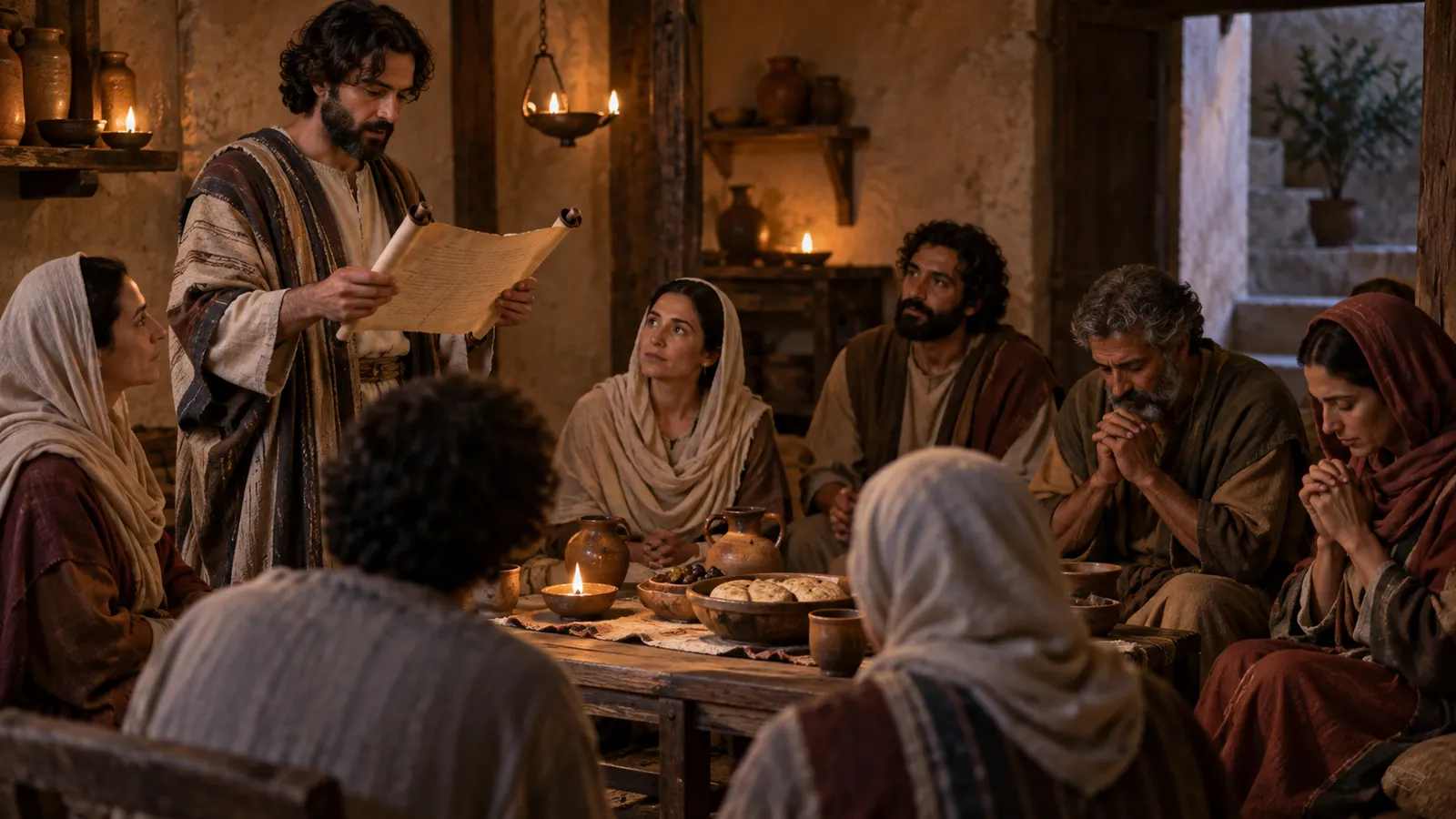
The Last Supper has been painted so often that the painting can replace the meal. In the Gospels, however, Jesus does not sit behind a Renaissance table in a European hall. He eats as a first-century Jew in Jerusalem, on…
The Last Supper has been painted so often that the painting can replace the meal. In the Gospels, however, Jesus does not sit behind a Renaissance table in a European hall. He eats as a first-century Jew in Jerusalem, on the eve of his death, during Passover season, surrounded by disciples whose Scriptures already connected bread, blessing, covenant, deliverance and sacrifice with Israel’s story.
Because The Last Supper in Context: What Jesus Was Really Doing touches both doctrine and ordinary church practice, this essay refuses a shortcut through either one. Luke 22:14–20 supplies the biblical center; early sources show how Christians embodied that center; later confessions reveal where interpretation diverged. The evangelical perspective remains clear, but it does not convert historical description into proof-texting or present a contested theological conclusion as though all Christians have always spoken with one voice.
A Jewish meal, not a Christian stage set
A Jewish meal, not a Christian stage set is where doctrine becomes visible in ordinary church decisions, and Luke 22:14–20 keeps those decisions tied to the gospel rather than preference alone. This is why A Jewish meal, not a Christian stage set matters to The Last Supper in Context: What Jesus Was Really Doing: it locates the Christian claim in a community that must actually live what it confesses.
The pastoral force of A Jewish meal, not a Christian stage set appears when Luke 22:14–20 is heard as an address to an actual congregation rather than a detached religious slogan. Respecting Jewish context keeps Christians from treating Israel’s story as disposable scenery for a new religion. The distinction protects The Last Supper in Context: What Jesus Was Really Doing from two opposite errors—treating history as irrelevant and treating later history as though it were Scripture.
How ancient people actually ate
The first issue in How ancient people actually ate is textual: Luke 22:14–20 has to be allowed to set the terms before later labels take over. Roman-era banquets often used reclining arrangements, shared dishes and household dining rooms. That is the pressure Luke 22:14–20 places on The Last Supper in Context: What Jesus Was Really Doing: Communion cannot be explained faithfully while the people at the table disappear from view.
Read through the lens of How ancient people actually ate, Luke 22:14–20 puts a specific claim on the table that cannot be reduced to a denominational catchphrase. That world makes the later Corinthian abuse understandable: meals could reinforce status, and the Lord’s Supper challenged the church to become a different kind of table. For The Last Supper in Context: What Jesus Was Really Doing, that means the section should be read as part of one argument rather than as a detachable proof-text.
Bread, cup and interpretation
The evidence for Bread, cup and interpretation begins with a concrete practice rather than an abstract definition, especially when Luke 22:14–20 is read in context. Jesus takes familiar meal elements and speaks about them in relation to his body and blood. The action interprets his approaching death before the disciples understand the crucifixion or resurrection. Seen this way, Bread, cup and interpretation contributes evidence to The Last Supper in Context: What Jesus Was Really Doing without pretending to settle every later controversy by itself.
Bread, cup and interpretation becomes clearer once the argument is located inside the social and worship setting implied by Luke 22:14–20. The meal is therefore not an ornamental farewell. It becomes a lens through which his death will be remembered as purposeful self-giving and covenantal promise. The result is a more demanding reading of The Last Supper in Context: What Jesus Was Really Doing: the table has doctrinal meaning precisely because it also shapes conduct.
The new covenant language
A close reading of Luke 22:14–20 gives The new covenant language a sharper edge than the language Christians often inherit from later debates. Luke and Paul associate the cup with the new covenant in Jesus’s blood, echoing Israel’s covenant vocabulary while announcing a decisive act of God through Jesus. For the argument of The Last Supper in Context: What Jesus Was Really Doing, the point is not antiquarian detail but the way historical setting changes what faithful application requires.
The historical question behind The new covenant language is limited but answerable: the sources show patterns without giving us a complete transcript of early Christian life. Christians should resist the idea that ‘new’ means God discarded the Jewish Scriptures; Jesus’s words draw their force from them. This is why The new covenant language matters to The Last Supper in Context: What Jesus Was Really Doing: it locates the Christian claim in a community that must actually live what it confesses.
A meal facing betrayal and death
For A meal facing betrayal and death, practice matters because theology was enacted in meals, gatherings, exclusions, and acts of welcome before it was summarized in later formulas. The narrative does not separate sacred symbolism from human failure. Within The Last Supper in Context: What Jesus Was Really Doing, this makes A meal facing betrayal and death a test of proportion: central claims remain central while secondary questions are kept secondary.
The disagreement around A meal facing betrayal and death is real, but Luke 22:14–20 still provides common ground from which the competing readings can be compared fairly. The meal calls believers to discern Christ’s body in a way that includes the church gathered around the table. That is the pressure Luke 22:14–20 places on The Last Supper in Context: What Jesus Was Really Doing: Communion cannot be explained faithfully while the people at the table disappear from view.
From one night to a repeated practice
From one night to a repeated practice is where doctrine becomes visible in ordinary church decisions, and Luke 22:14–20 keeps those decisions tied to the gospel rather than preference alone. Paul’s tradition in 1 Corinthians shows that Jesus’s actions were already being repeated in Christian assemblies within the first decades of the movement. That observation narrows the claim without weakening it, which is important for the larger question posed by The Last Supper in Context: What Jesus Was Really Doing.
The pastoral force of From one night to a repeated practice appears when Luke 22:14–20 is heard as an address to an actual congregation rather than a detached religious slogan. Bread is broken in a world where bodies still hunger, communities still fracture, and death still wounds. Seen this way, From one night to a repeated practice contributes evidence to The Last Supper in Context: What Jesus Was Really Doing without pretending to settle every later controversy by itself.
The historical setting does not explain away the theology; it sharpens it. Jesus’s final meal stands inside Israel’s story, inside the social world of ancient dining, and immediately before the cross. Communion inherits that density every time Christians break bread and lift the cup in his name.
The history surrounding The Last Supper in Context: What Jesus Was Really Doing is complicated, but the Christian act itself remains strikingly simple. In Luke 22:14–20, ordinary food is made to serve an extraordinary proclamation. The church receives the meal as a gift, not as proof of its own superiority. That posture gives room for reverence without superstition, doctrinal clarity without contempt, and a common table that keeps pointing beyond itself to Christ.