
The Light in Apartment 4B
A widower who has made solitude a habit meets a neighbor who knows exactly what kind of help she wants. A damp package and a hallway light open a careful new friendship.
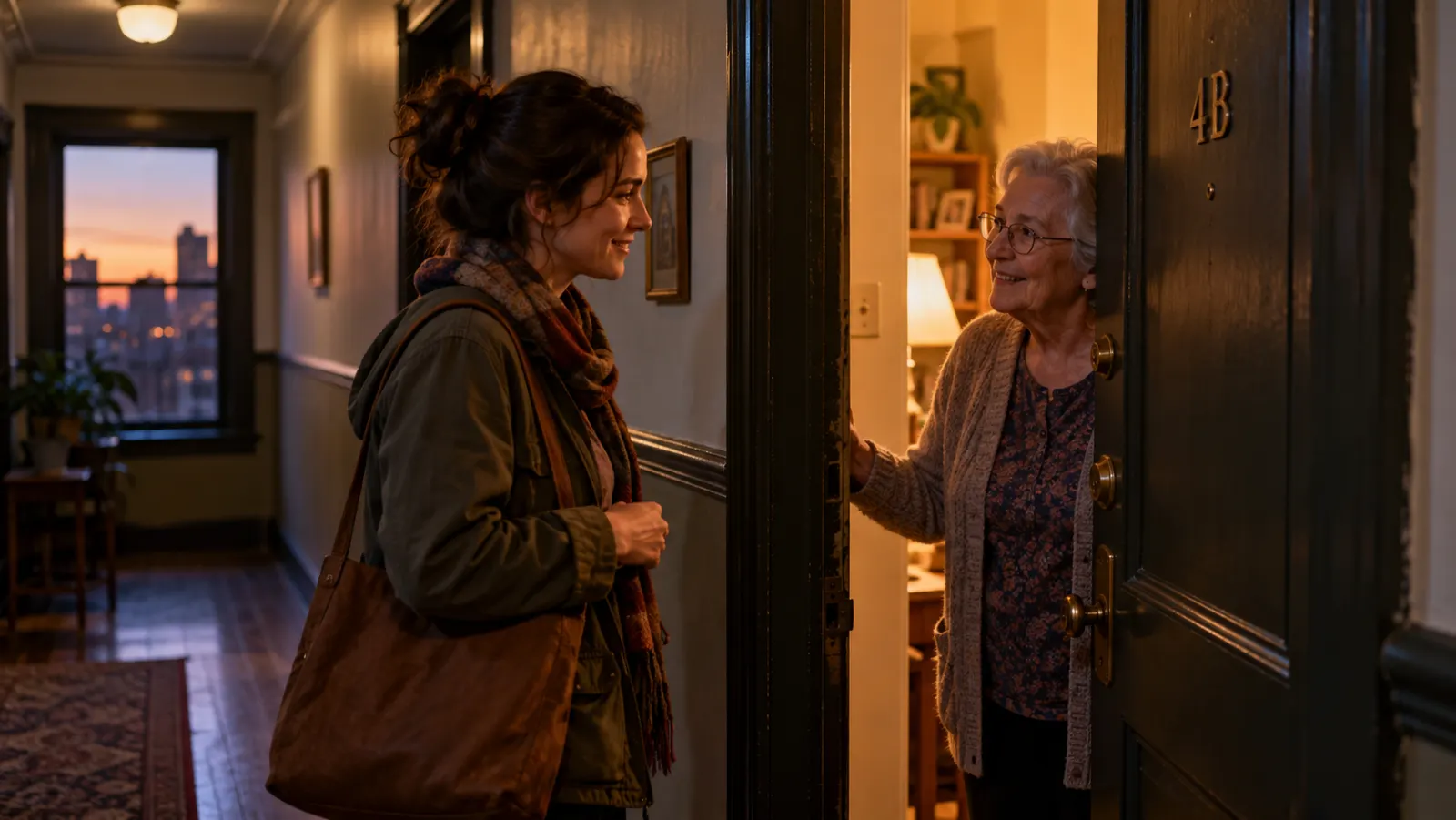
The package had been left just where the hallway roof leaked.
Daniel noticed it on his way back from the grocery store, one paper bag in each hand and his knee complaining about the three flights of stairs. The elevator had been stuck between floors since Tuesday. In apartment 4C he had enough milk for his coffee, a loaf of rye bread, and half a chicken already cooked. He had what he needed. He could keep walking.
Outside 4B sat a cardboard box, not quite soaked but soft at one corner. A seam of water ran down the wall and dripped from a blister in the paint. Someone had written the apartment number in black marker. Daniel shifted his bags and listened. Behind the door, there was a scrape, then silence.
He had spent the last eleven months not knocking on doors. He knew how to avoid the superintendent when the man went door to door discussing the building's future. He knew how long it took to collect his mail without meeting the students on the second floor. It wasn't that he disliked his neighbors. He had merely learned that if he stopped asking how people were doing, they eventually stopped asking him.
His wife, Ellen, had called that arrangement a slow way to disappear.
Daniel set the bags down, moved the box out of the wet place, and knocked twice. There was a pause long enough for him to regret it. Then a chain rattled. The door opened the width of a hand.
A woman with short dark hair looked at him. She might have been thirty-five, perhaps older. Daniel had seen her in the stairwell twice, balancing a canvas tote against the rail. She glanced at the parcel, then his mouth, as though she had missed something.
"This was getting wet," he said, pointing. He spoke too loudly and heard himself doing it.
She held up one finger, stepped away, and returned with a small spiral notebook. On the top page, in tidy blue ink, she wrote, I read lips, but not well in this light. Please face me or write. Thank you for moving it.
"Oh." He tried again, facing her. "I'm Daniel, next door."
She wrote, Mina. And thank you, Daniel.
He lifted the box without being asked. She quickly held out her hands to take it. Daniel nearly pulled back on instinct; a younger mechanic at the bus garage used to shout that the old man had never met a piece of machinery he didn't want to take apart himself. But Mina had asked for the package, not for a demonstration of neighborly strength. He let go.
"Have a good afternoon," he said.
Mina smiled briefly and closed the door.
He carried his groceries inside and stood for a moment beside the kitchen sink, staring at the wall between their apartments. Ellen had once painted their kitchen a yellow so pale he had thought the store had mixed the wrong can. There was still a bright square above the stove where she'd hung a clock. Daniel had packed the clock away after the funeral. He hadn't replaced it.
That evening, a note slid under his door.
The delivery driver left that package in the rain because I was at work. If another one appears, you can leave it beside my door, under the dry part of the wall. Please don't take it into your apartment. I appreciate it. —Mina.
The note was polite. It was also a boundary. Daniel read it twice and placed it beneath the salt shaker. He had spent his working life respecting the difference between a request and a permission. A driver's words might mean the bus was pulling left; they did not mean it was time to yank the steering assembly apart. Still, he felt an unexpected sting. He hadn't taken her parcel into his apartment. Did she think he would?
He started to write back, then stopped. He didn't know what response was required. Finally he found a scrap of the paper Ellen used to keep near the phone and wrote, Understood. I only moved it out of the water. —D. He slipped it beneath 4B and went home feeling like a schoolboy who had misunderstood the assignment.
A week later the elevator made one exhausted clunk and went quiet. Daniel heard it from his chair. The building had a way of announcing its problems in sound: pipes knocking in the walls, a buzzing lamp at the top of the stairs, a front door that never quite latched. He could tell which stair someone was standing on by its creak. These noises once meant Ellen was coming home with library books and whatever bargain produce she had found at the market. Now he heard only that other people were living on the same floor.
The next morning Mina waited by the elevator carrying a wheeled case of art supplies. Daniel had seen paint on her cuffs before. She was frowning at a notice taped to the doors, its writing too small to read from a distance.
"It's not running," he said, carefully turning so she could see him.
She nodded. I figured that part out, her expression seemed to say. Then she pulled the notebook from her bag and wrote, Any idea when it's fixed?
"They say Friday. Which could mean Friday." He glanced at the case. "If you'd like, I can carry—"
She shook her head before he finished. "I can do it," she said, her own voice steady. Her hearing was not the absence of a voice; Daniel realized he'd been behaving as though it were.
"Okay." He held the stairwell door open. "I'll just get out of your way."
At the landing she stopped and wrote, Could you hold the lower door? The one that closes too fast.
"That I can do."
They descended together, not matching each other's pace so much as noticing it. His knee slowed him. The case was heavy for her. She asked once whether he needed a break. He said no, then took one anyway. They both smiled at that.
Outside, autumn had got into the trees overnight. Copper leaves lifted in the parking lot. Mina walked toward the bus stop, her case making an uneven rhythm over the pavement. Daniel stood by the entrance longer than he meant to. He remembered how Ellen had always asked whether someone wanted help before plunging into a problem. It had irritated him at times. He could fix a thing in half the time it took to discuss it. But people were not hinges or wheel bearings.
By Thursday the hallway bulb outside 4B began to flicker. One moment the ceiling fixture glowed amber, the next the corridor went almost black. Daniel had replaced enough parts during forty years at the bus depot to know there was likely an ordinary explanation. He also knew he no longer wanted to climb a ladder with his knee and uncertain balance. He called the management office. A recorded voice thanked him for his patience.
He told himself he had done his part. Then he watched Mina come home through the dim hallway, pausing to angle her face toward the remaining light as she searched for her key. She couldn't read lips in the dark, the notebook had said. He wondered what else a broken light made difficult for her, and caught himself imagining a whole life he knew little about.
Instead of writing another complaint describing what the light might mean for Mina, he knocked and held out a sheet of paper: I reported the bulb. Management hasn't responded. Would you like to add anything when I follow up?
Mina read it, then pulled out her pen. Yes. I work evenings twice a week. Please ask when they can repair it, not just whether they know.
"That's a better question," Daniel said.
Her pen hovered. Please don't tell them about my hearing unless I decide it's relevant.
"I won't," he said, facing her. He wondered how often people explained her life for her.
The next morning they wrote one short email together on Daniel's old laptop. Mina typed the part about returning home in low light. Daniel supplied the dates of the first report. They asked the management office for a repair timeline and a temporary safe lighting plan, without proposing to touch wiring themselves. He made tea while she checked the spelling. The apartment smelled faintly of oil from the toolbox he still kept near the entryway and cinnamon from Ellen's last tin of cookies.
Mina looked at the bare wall over the stove. She didn't ask about the rectangle of lighter paint. He was grateful. He was also, to his surprise, a little sorry.
"Do you make paintings?" he asked, seeing the blue stain on her sleeve.
"Sometimes," she said. She opened the notebook: Community art classes. Mostly I teach people how not to be afraid of making something bad.
"I'd need a long class."
She laughed, and he heard it clearly.
He nearly asked where she was from, how long she'd been living alone, why she seemed determined to manage every box herself. Instead he asked whether she wanted sugar. She shook her head. They sat for ten minutes discussing the terrible building mailboxes and the price of tomatoes. It felt like a conversation that had been allowed to be ordinary.
After she left, Daniel opened the cabinet where Ellen kept her church bulletins and grocery lists. On one torn margin she had copied a reference from Romans, a passage about showing devotion to one another and practicing hospitality. She had scribbled beneath it, Ask first. Daniel sat with the paper in his hands. He could still hear her saying that when somebody suffered, offering help was different from claiming ownership of their suffering.
He prayed a short prayer that evening. It had no noble words. He told God he missed Ellen. He said he didn't know whether asking Mina to tea had been kind or intrusive. He said he was tired of measuring each day by what had not happened in it. He sat through the quiet after the prayer. It did not suddenly become an answer.
On Friday the building manager appeared carrying a small case of equipment and a work order. He examined the light and arranged for the maintenance technician to replace the failed fixture. Daniel and Mina watched from their separate doorways without commenting on the work. When the repaired light came on, it showed the scuffs on the walls just as clearly as the floor. Nothing looked new. The hallway merely worked.
"I saw your email," the manager said. "You two made it easy to locate the report."
Mina nodded. Daniel said, "Thank you for getting it done." He had spent much of his life complaining that nobody finished a job right. It occurred to him that being fair meant noticing when somebody did.
The following Tuesday he found a note beneath his door. Tea at six on Saturday, if you want. You can say no. —M.
He looked at the word no for a long time. Ellen had been dead almost a year. Saturdays still belonged to the two of them in his mind: her radio program in the morning, the market, soup, an evening walk when the weather was decent. Accepting tea felt, in a way he could not explain without sounding foolish, like altering a promise he'd never made aloud.
He wrote, Thank you. I'm not ready this Saturday. Then, after waiting until his hand stopped trembling, he added, Could I bring two of Ellen's old gardening books over next week? I remember you said you wanted plants for your window. You can decide if they're useful.
Mina replied by leaving a note beside his newspaper: Yes, next week. But only if you want to tell me who Ellen was.
He set the note near the blank place above the stove. That night he took the clock from its box. He didn't hang it. He wound it once, listened to the minute hand begin its uneven ticking, and put it on the table.
A week later Daniel stepped into the bright corridor carrying two thin books and a photograph he had chosen himself. The door of 4B stood open a little. Somewhere downstairs somebody argued with a vending machine. The elevator groaned and stopped. The repaired light hummed overhead, ordinary and dependable. Daniel knocked anyway.
Stories of Faith & Life
 HospitalityThe Last Table in the DinerAfter a long night shift, Rosa finds a customer’s sketchbook under the last table in the diner. One ordinary exchange offers kindness without demanding all she has left.Read the story →
 FamilyThe Porch StepsThe porch at their late mother’s house is unsafe, and Claire must ask the brother she barely speaks to for help. Repairing the wood proves simpler than their history.Read the story →
 NeighborsThe Snow on Maple StreetA routine winter outage brings neighbors into closer contact than they intended. Old tensions do not vanish, but practical care begins to reshape a block.Read the story →