
A Song Without the Solo
When the solo he has practiced is given to another singer, Evan must reckon with the disappointment of being unseen and the work of joining his voice to others.
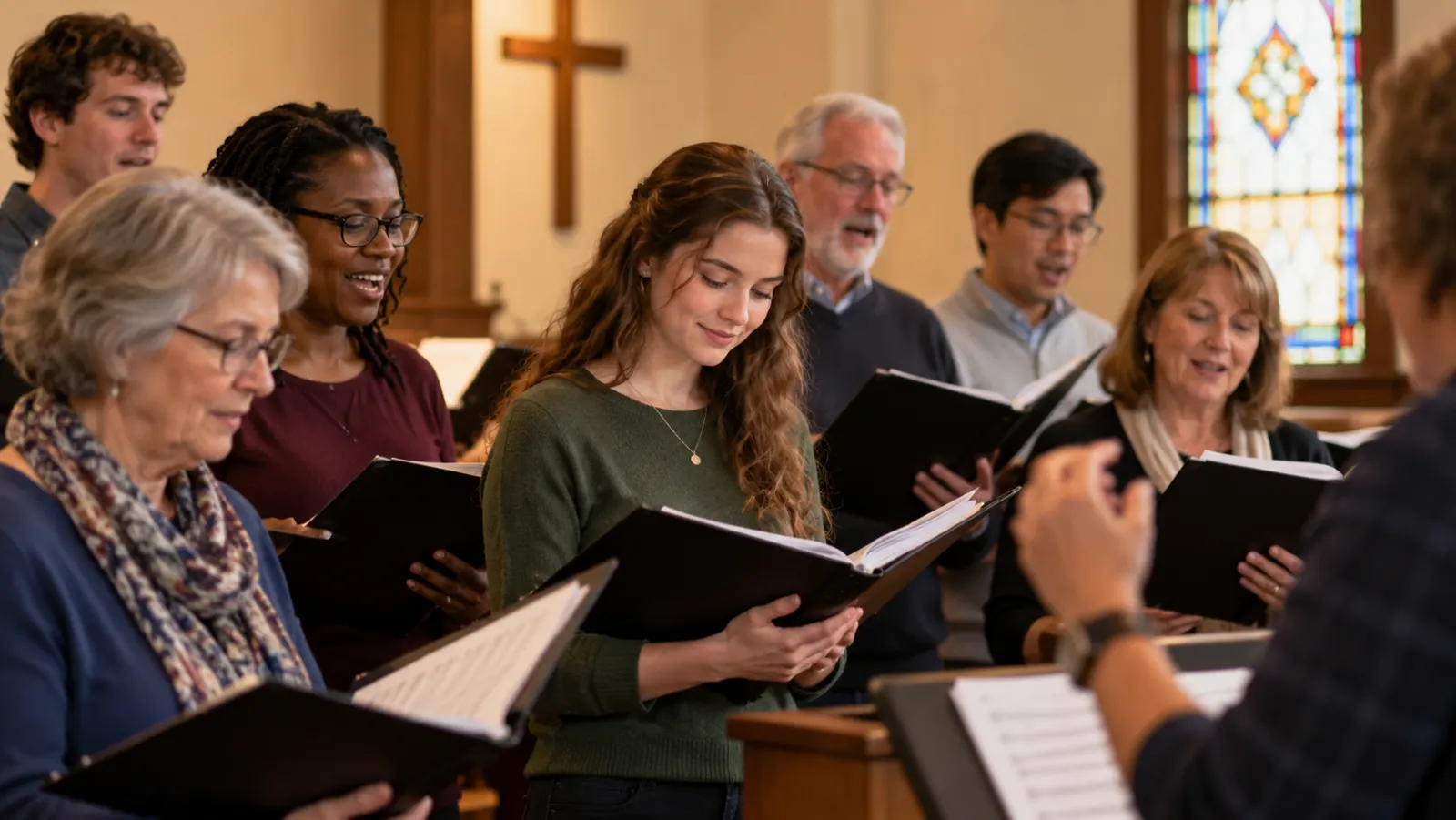
Evan finds a different name beside his solo before he hears anybody sing it.
The choir's rehearsal schedules are taped to a music stand near the borrowed auditorium's side door. Usually there are handwritten changes in the margins—someone's shift ran late, someone needs a ride, someone has a dentist appointment. This week there is a fresh copy. A blue star marks the opening solo. Next to it is the name Clara.
Evan reads the page twice. He had spent an hour the previous night marking his music, circling the phrases he intended to carry gently, scribbling breathe above a long line. He had told his grandmother he would be singing at the spring concert. She had already asked whether the program would have his name on it.
From the auditorium comes a piano chord, then another, as Priya tests the instrument. She is the choir's accompanist and usually arrives before the lights have properly warmed. The piano is old enough that the high notes sometimes sound as though they're arriving by different routes. Priya can coax them into agreement.
"Morning," she says when she spots Evan. "You got here early."
"Why is Clara's name on the solo?"
Priya looks at the stand. She does not pretend to be surprised. "You should talk to Ms. Wallace."
"Did everybody know but me?"
"I heard yesterday. I wasn't sure whether she'd called you."
Evan nods as if this answers something. He sits halfway down the empty auditorium, sets his backpack at his feet, and watches Priya play scales with a patience he has never practiced himself. In the spring he will finish his first year at community college. Singing has become the one thing he does that still feels unquestionably his. At home his time is borrowed by errands, by his grandfather's appointments, by picking up his younger sister when their mother's work shifts change. He doesn't resent his family. He resents how easily everyone assumes his own plans are movable.
Ms. Wallace arrives carrying three canvas bags and a travel mug whose lid never closes properly. She pauses when she sees him.
"Evan, I meant to talk to you before the notices went up."
"You changed it."
"I did. You've missed three rehearsals. The solo leads straight into the ensemble entrance, and I needed somebody who'd been here for the transitions."
"I know the music."
"I know you do. You're a strong singer."
"Then why not call me?"
She sets the bags on a chair. "I should have. I'm sorry I didn't. I was trying to finalize the program before the printer deadline."
Evan hears the apology but can't yet decide what it weighs. He hasn't told the choir why he missed those nights. At the first rehearsal he'd planned to explain the family schedule. Then someone joked about college students who didn't take anything seriously, and he'd said only that he had another commitment. At the second rehearsal, his grandfather had taken longer to see the clinician than anyone predicted. At the third, his sister had needed a ride from her debate competition. Evan chose not to share any of it. Privacy had seemed like the last corner of his week he could control.
"You could have asked," he says.
"You're right."
"And I could have told you more." The words surprise him. He does not want to donate his reasons to the room, but he doesn't want to treat them as weapons either. "I had family responsibilities. I wasn't skipping because I didn't care."
Ms. Wallace's face softens. "I believe you."
"Is there any chance you change it back?"
She looks toward the piano. "Not this close to the concert. Clara has already rehearsed the entrance. But let's talk after practice about how you can still contribute."
The phrase still contribute irritates him. He has been contributing since September: stacking chairs, reminding tenors which passage begins after the break, lending pencils, remembering whose ride arrives late. The solo was not a reward for those things, exactly, but he'd believed it would make them visible. Now it feels as though all he has done has gone uncounted.
On the bus home he leaves his grandmother's call unanswered. He imagines telling her he lost the solo. He imagines the careful pause before she says something encouraging, as if kindness could undo what has happened. His reflection in the dark window looks like a stranger wearing his coat.
The next rehearsal Clara begins the solo. Evan sits in the last row of the tenors, where his sound can disappear into other voices if he allows it. Clara's voice is clear, a little nervous at the beginning, then steady. She sings the passage differently than he planned to sing it. He realizes with an unwelcome jolt that it is beautiful.
Priya stops the group halfway through. "The chords under that last line are too heavy," she says to the director. "Can we try it more lightly?"
They run the passage again. Evan hears the shape of the harmony for the first time, the small note he holds beneath Clara's melody. A missed entrance from the baritones throws the next phrase. Ms. Wallace stops them and laughs. Nobody seems to be deciding whether a single person is worthy. They are trying to make a piece of music work.
At break Clara comes over holding her score. "I heard you were going to sing it," she says.
"I was."
"I'm sorry. That must feel awful."
Evan looks at her with immediate suspicion. "You don't have to apologize for saying yes."
"I know. I just didn't want to pretend I hadn't noticed."
There is nothing smug in her expression. He had spent two days building an argument with a person who never arrived.
"The third phrase," he says, pointing at the page. "I found that if you save your breath before it, the ending is easier."
"Would you show me?"
He does, quietly. He could give bad advice. A small corner of him wants to. He is disappointed by its existence, and he is disappointed to discover that helping her does not remove it. His voice catches when he demonstrates the last note. Clara tries again and thanks him.
That night on the bus his sister calls. "Did you tell Grandma about the concert?"
"Not yet."
"She asked me whether we're still going."
"We're going," he says. "I just won't have the solo."
His sister makes the sympathetic noise people make when they can't fix something. "I'm sorry."
"It's okay. Actually, it isn't. But I'll be there."
"She'll be proud anyway."
"I know."
He is less certain than he sounds. His grandmother has been losing mobility, slowly and unevenly. An outing involves arranging rides and finding a seat near an aisle. He worries that she is putting effort into a performance where he will scarcely stand out. Then he hears her voice in his memory: I like to see you doing what you love, not only when everybody looks at you. The line annoys him for being exactly the thing he needs.
At the final rehearsal Ms. Wallace asks him to stay for a minute. Evan expects an assignment: extra chairs to move, programs to staple. Instead she sits beside him in the front row, not on the stage.
"I wanted to say something more clearly," she begins. "I needed someone at every rehearsal for that transition. The change made sense musically. The way I told you did not. You deserved a conversation."
He studies the empty seats. "I could have told you why I was gone."
"Only what you were comfortable telling me. I should have asked about your availability before assuming you weren't committed."
"I'm not asking for pity."
"I don't think you are."
He rubs a thumb along the folded edge of his score. "I thought if I got the solo, maybe I'd have something that nobody could reschedule for me."
Ms. Wallace waits. She does not turn the sentence into advice. Priya is putting away the piano cover nearby, giving them the distance of someone who is present without listening in.
"You matter to this group without the solo," Ms. Wallace says finally. "And losing it hurts. I won't ask you to pretend otherwise."
He wants to argue. Instead he asks whether he can help rehearse the tenor entrance once more. They do. The music is difficult and not especially memorable on its own, a thread in the weave. He learns where to stand so he can hear Clara's breath before he comes in.
Two days before the concert, Priya finds him at the bus stop outside the school. She is carrying the piano bench cushion under one arm because the auditorium stores nothing safely. "You know," she says, "I have played in the background for twenty years, and some nights I still want the audience to notice." Evan laughs despite himself. "Does it go away?" "Not entirely. But sometimes I hear a note that would be missing if I weren’t there." She shifts the cushion into his hands so she can zip her coat. "That’s different from pretending attention never matters."
At the concert the auditorium smells of dust and the cheap flowers a parent has brought in a paper sleeve. His grandmother arrives with his mother and sister. She waves as if she is trying to signal from a distant shoreline. Evan waves back. He is still disappointed when Clara steps forward. He wishes, fiercely and without shame, that the room were about to hear him.
Then the first chord sounds. Clara takes her breath. Evan watches Ms. Wallace's hand and enters exactly when the tenors need him. He feels the lower voices settle around his note, then the altos, then a quiet lift from the sopranos. For one moment the harmony isn't owned by anyone. It is held between people who have arrived with their own reasons for being there.
Afterward his grandmother hugs him and says, "I heard you."
"There were a lot of us," he replies.
"Yes," she says. "That's what was good about it."
He does not suddenly stop wanting solos. He folds his score carefully and carries it home. On the back page, beneath his old annotations, he writes the date of the performance. The space beside the title is blank, where his name once might have appeared. He leaves it blank and puts the music on the shelf where he keeps the things he intends to sing again.
Stories of Faith & Life
 HospitalityThe Last Table in the DinerAfter a long night shift, Rosa finds a customer’s sketchbook under the last table in the diner. One ordinary exchange offers kindness without demanding all she has left.Read the story →
 FamilyThe Porch StepsThe porch at their late mother’s house is unsafe, and Claire must ask the brother she barely speaks to for help. Repairing the wood proves simpler than their history.Read the story →
 NeighborsThe Snow on Maple StreetA routine winter outage brings neighbors into closer contact than they intended. Old tensions do not vanish, but practical care begins to reshape a block.Read the story →