
A Second Signature
A food-pantry assistant notices that a signed inventory does not match the food on hand. Correcting it may strain a friendship, but the numbers concern real people.
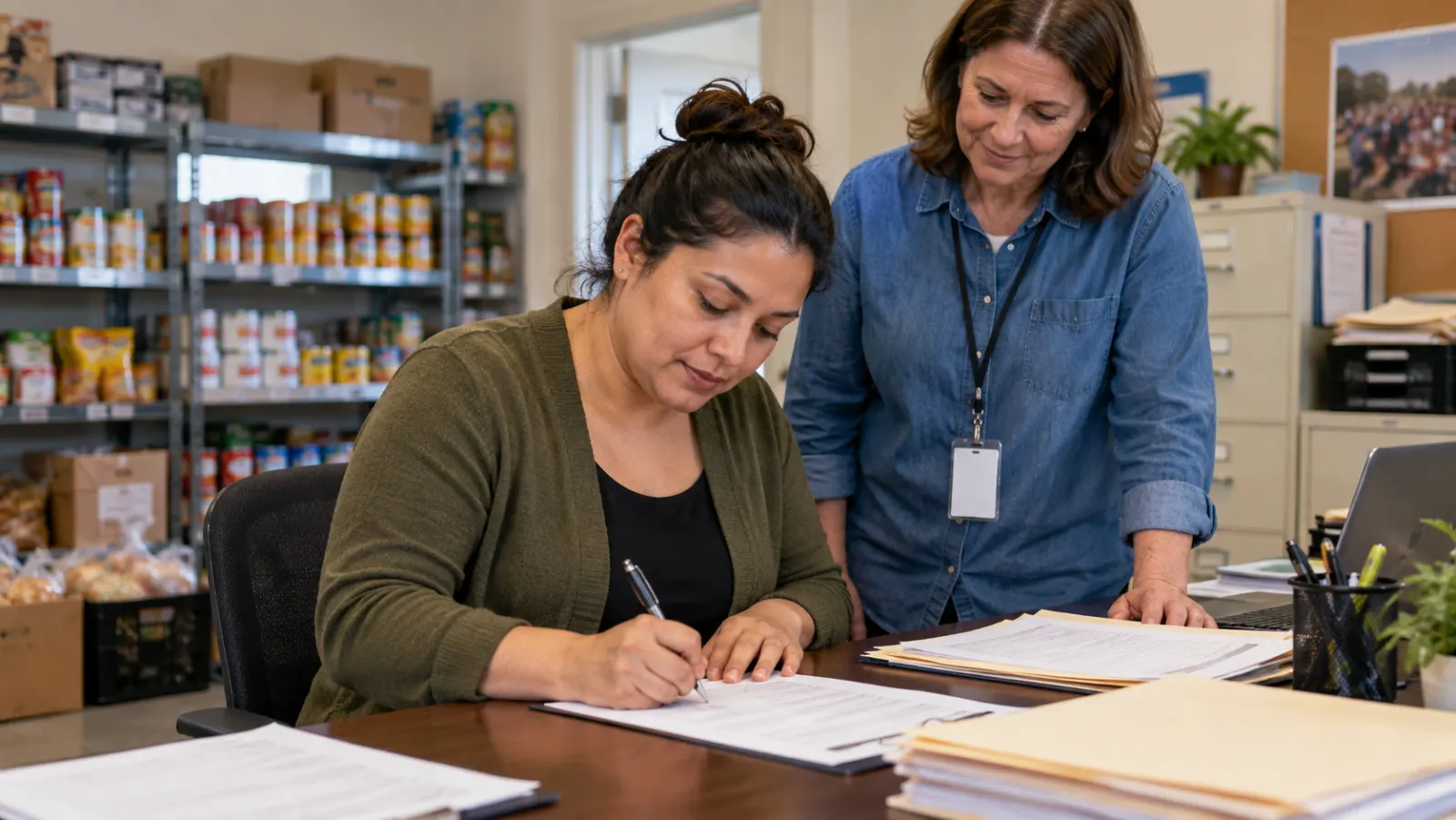
I found the missing boxes on a Thursday when everybody had already begun talking about Friday.
Friday was the day our pantry's monthly report went to the small network of churches and local donors who helped keep the shelves stocked. It wasn't a dramatic event. Nobody arrived with a camera. Joy, my supervisor, usually put on her reading glasses, checked our handwritten counts against the spreadsheet, and asked a series of patient questions I had come to find irritating. Then we sent the report. On Thursday evenings, we folded the tables and tried not to think about numbers for forty-eight hours.
That Thursday I was counting food boxes in the storage room while the last volunteer swept the hallway. The fluorescent light above the shelf flickered when the refrigerator turned on. I had a paper inventory sheet in one hand and a pen that kept refusing to write in the other. Twenty-four boxes of dry staples, seventeen produce boxes, and six that had not arrived. I counted again. They had not arrived in the thirty seconds between counts.
The spreadsheet on the counter said they had all been distributed.
At the bottom of the printed tally was my signature, beside the words checked at close. Under it, in larger letters, was a second signature: Marcus, the volunteer coordinator, had approved the number the previous afternoon. The boxes were supposed to come in late Wednesday. A truck delay pushed delivery to Friday morning. The spreadsheet had never been changed.
"Probably just how we planned it," Marcus said when I showed him. He was wiping down a metal shelf, exhausted enough that he looked older than thirty-eight. "They'll be here tomorrow. The families will get them. Put the sheet back and Joy can send it."
"But the report says today."
"It will be true by breakfast."
I held the paper so tightly that a corner bent around my thumb. Marcus had been covering shifts all month because two volunteers were caring for sick relatives. He wasn't careless by nature. He had been kind to every visitor who came through the door, even when the supply lines moved like molasses. I had no desire to become the person who announced he'd done a bad job.
"Maybe it's how the spreadsheet carries forward," he offered. "I don't remember which number we used."
Neither did I. That was the part I kept circling. Wednesday afternoon I'd signed my own verification line before checking the receiving log. Joy had told me not to sign anything I couldn't personally confirm. I'd nodded, thinking of the twenty other tasks waiting. Then I'd signed, assuming a scheduled delivery meant a completed delivery.
I told Marcus I'd look again. The phrase gave me room to breathe without telling him what I intended to do. It also gave me room to put the paper in a folder and leave it there.
When I started working at the pantry, I was certain accuracy meant getting every entry right on the first try. I came from offices where a mistake could become a person's reputation before anyone asked what had happened. I wanted to be known as efficient. I had a drawer of carefully labeled folders and used a ruler to mark the days on our calendar. It pleased me when people said, "Ask Lena. She'll know."
There was a reason for that hunger, though I rarely admitted it. Five years earlier I'd been on the other side of a pantry counter after a stretch of unpredictable work. A volunteer had looked at my name on a form and asked, loudly, whether I "still needed" help. She meant to find the right list. Everyone heard. I went home with the food and with the sensation that the most inconvenient thing in the room had been me.
At our pantry I promised myself nobody would become an embarrassing story. We asked names privately. We tried not to call out what someone was taking home. When a family declined an item, we respected it. I was proud of those habits. I didn't notice that I sometimes used that pride to avoid admitting ordinary failure.
I took the tally to the small desk beside the supply closet. If the delivery arrived at eight and we distributed the six boxes by noon, I reasoned, the number in the report would be right eventually. But it wouldn't have been right on Thursday. And the record would say we had given food to people who had not yet received it. That distinction seemed too plain to wriggle around. I thought of our visitors, many of whom planned their meals more carefully than we planned our paperwork. If we couldn't distinguish available supplies from expected ones, what did our assurances mean?
Marcus appeared at the door. "Listen," he said. "I don't want anyone in trouble."
"Neither do I."
"Joy's already stretched. You know that."
"I know."
"Then don't turn six boxes into a thing."
I wanted to tell him that six wasn't much. A person could make six sandwiches before lunch, or lose six hours to a delayed paycheck. Numbers were small only until you were the one waiting. Instead I said, "I signed it. I'm part of why it's wrong."
He watched me for a moment, looking less angry than bewildered. "So what happens now?"
"I need to ask Joy."
"You'll say my name?"
"I'll say what the sheet shows, including my own part. I won't invent a story about what you meant."
He put the rag on a shelf. "I really thought they'd come."
"I did too."
The church office was closed, but Joy answered her phone after three rings. She sounded as though she'd been walking through a grocery store. There was music behind her and the high beep of a checkout scanner.
"This isn't an emergency," I said immediately. "But I need to correct something before you send the report."
"All right. Tell me what happened."
I began with the boxes. Then I told her about my signature. Halfway through, I heard my own voice getting professional and careful: a discrepancy was identified, the distribution column had not been reconciled. It was language that made mistakes sound like weather.
"Lena," she interrupted gently. "What did you do?"
"I signed before I checked the receiving log."
There was a pause long enough for a cashier to ask Joy about her receipt.
"Thank you for telling me plainly," she said when she came back. "Does anyone have the actual delivery confirmation?"
"No. It was postponed."
"Then we can only report what we know. We'll update the numbers and explain the correction. It may take another day."
"Will it affect the support we get?"
"I don't know. I won't promise you it won't. But sending a number we know is wrong won't improve anyone's trust in us."
I had imagined she would be angry. Perhaps she was, but if so she kept her voice level. She asked me to save the original sheet, make a dated correction, and show her the receiving log in the morning. There were procedures for this kind of thing, it turned out, and I was not the first person ever to make an error. Her final question was whether Marcus had stayed late again.
"Yes," I said. "He wanted to finish the shelves."
"Tell him to go home. You too."
I hung up, surprised by how little relief I felt. The next morning still existed. So did the conversation with Marcus, who had not waited for my permission to feel exposed.
He stood outside in the parking lot, one foot on the curb, searching for his keys. I told him what Joy said. He looked past me toward the loading door.
"I told you we'd get them," he said.
"And we probably will."
"You think I was asking you to lie."
"I think we signed a number before we had the boxes. I signed it too."
He slid his keys into his pocket. "Those are different things."
"They are. And neither one makes you a dishonest person forever."
He didn't answer. I could see the fatigue in him, the kind that accumulates when other people's needs never seem to slow down. But the hurt in his expression wasn't something I could erase by explaining my intentions a third time. He went to his car without saying good night.
On Friday the delayed truck arrived late enough that we had time to make coffee twice. Joy sat with me at the office table and compared the receiving log to the pantry sheet. We recorded the actual delivery when it happened, adjusted the reported distribution count to reflect what had truly gone out, and kept the correction alongside the original. I had imagined a confession would end with a loud pronouncement. Instead it ended with a stack of papers, two signatures in the right places, and an email whose most important sentence was short and unremarkable: We have corrected an earlier entry that included expected items not yet received.
Joy read it once, nodded, and pressed send.
"You should have waited to sign," she told me. "We need you to do that next time."
"I know."
"And I'm glad you called. Both can be true."
That afternoon I carried boxes to the distribution room. A volunteer asked whether the numbers were settled, and I said yes. I didn't turn the incident into a lesson for the team. Marcus did not come in until his regular shift the next week. When he arrived, he greeted everyone but me. We worked on opposite sides of the room, each pretending that was ordinary.
Near closing time a visitor asked whether we would have rice next Thursday. I looked at the shelf, checked the incoming list, and said, "We're expecting it. I can tell you what we have today, but I can't promise what will arrive."
She thanked me and chose another staple. The exchange took perhaps twenty seconds. Nobody applauded. Nobody knew it had cost me anything.
After the visitor left, Marcus set a new receiving sheet beside my elbow. "The next delivery," he said. "I'm not signing until it's here."
"Me either," I answered.
He nodded without smiling. It wasn't forgiveness, exactly, and it wasn't a return to the ease we'd had before. But he had come to tell me something true. I picked up a pen, checked that it worked, and left the signature line blank.
Stories of Faith & Life
 HospitalityThe Last Table in the DinerAfter a long night shift, Rosa finds a customer’s sketchbook under the last table in the diner. One ordinary exchange offers kindness without demanding all she has left.Read the story →
 FamilyThe Porch StepsThe porch at their late mother’s house is unsafe, and Claire must ask the brother she barely speaks to for help. Repairing the wood proves simpler than their history.Read the story →
 NeighborsThe Snow on Maple StreetA routine winter outage brings neighbors into closer contact than they intended. Old tensions do not vanish, but practical care begins to reshape a block.Read the story →