The Good Samaritan
Jesus Teaches What It Means to Be a Neighbor

Before You Read
Jesus tells this story after a man asks an important question: Who is my neighbor?
The story includes an injured traveler, two people who pass by, and a Samaritan—someone Jesus's listeners may not have expected to become the example of mercy.
As you read, notice not only who receives help, but what the Samaritan actually does.
The Bible Story
One day, an expert in the law stood up to test Jesus with a question.
He asked what he must do to inherit eternal life.
Jesus answered by turning the question back to him. What was written in God's law? How did he understand it?
The man answered with two great commands: love God with all your heart, soul, strength, and mind, and love your neighbor as yourself.
Jesus told him that he had answered correctly.
But the man wanted to justify himself, so he asked another question:
Who is my neighbor?
Jesus answered with a story.
A man was traveling from Jerusalem down to Jericho.
The road passed through rough country, and travelers could be vulnerable there.
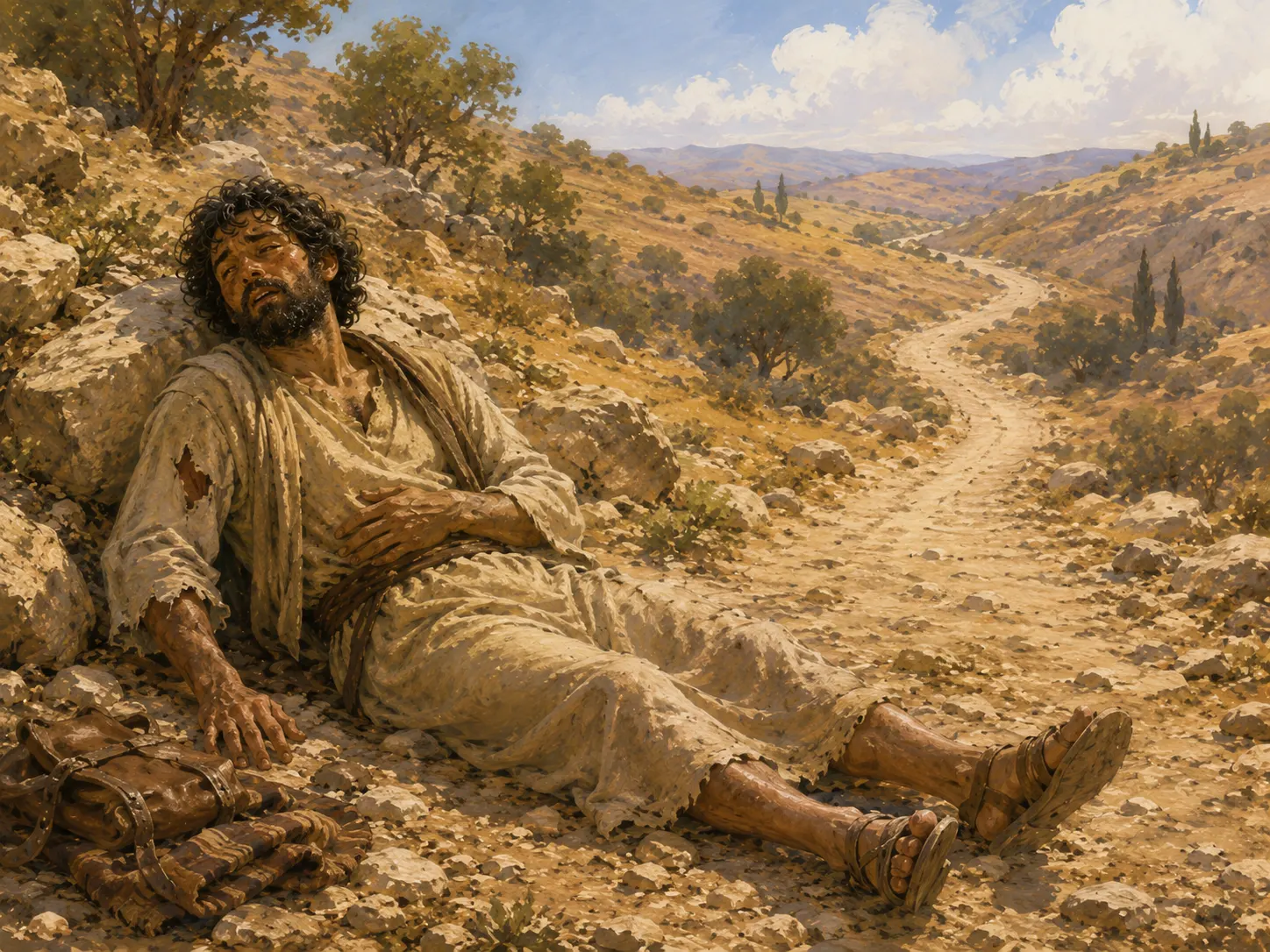
Robbers attacked the man.
They took what he had, beat him, and left him badly hurt beside the road.
Jesus did not describe the attack in graphic detail. The important fact was clear: the man was injured, alone, and in need of help.
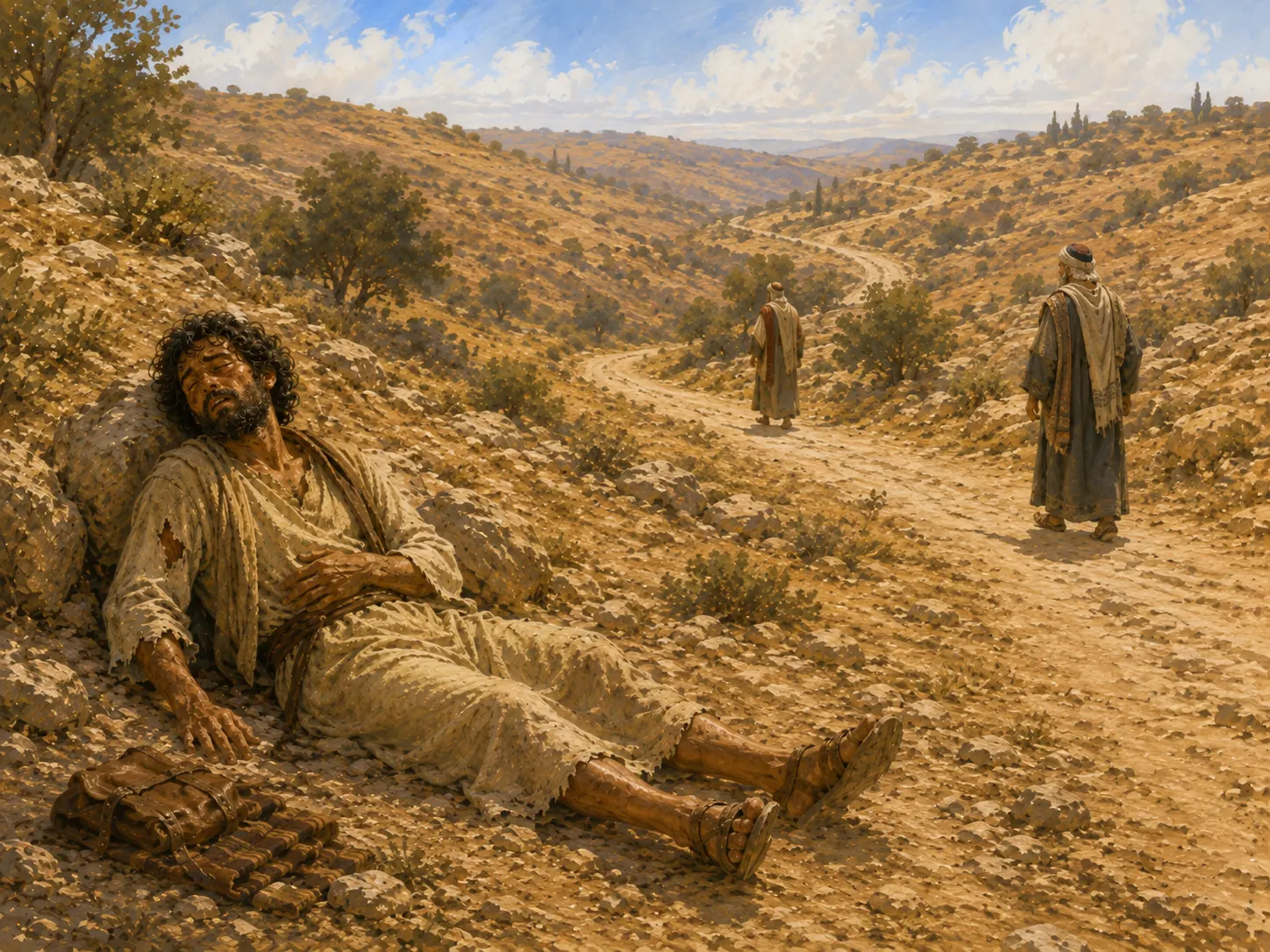
After some time, a priest came down the road.
He saw the injured man.
But he passed by on the other side.
Later, a Levite came to the same place.
He also saw the man.
And he too passed by.
Jesus gave no explanation for why the priest or the Levite kept going. He simply described what they did: each saw the wounded man and passed by on the other side.
Then another traveler came along.
He was a Samaritan.
That detail would have surprised Jesus's listeners.
Jews and Samaritans had a long history of tension, disagreement, and mistrust. They shared important parts of their history, yet they were divided by deep religious and social conflict.
Yet when the Samaritan saw the wounded man, he felt compassion.
He went to him instead of keeping his distance.
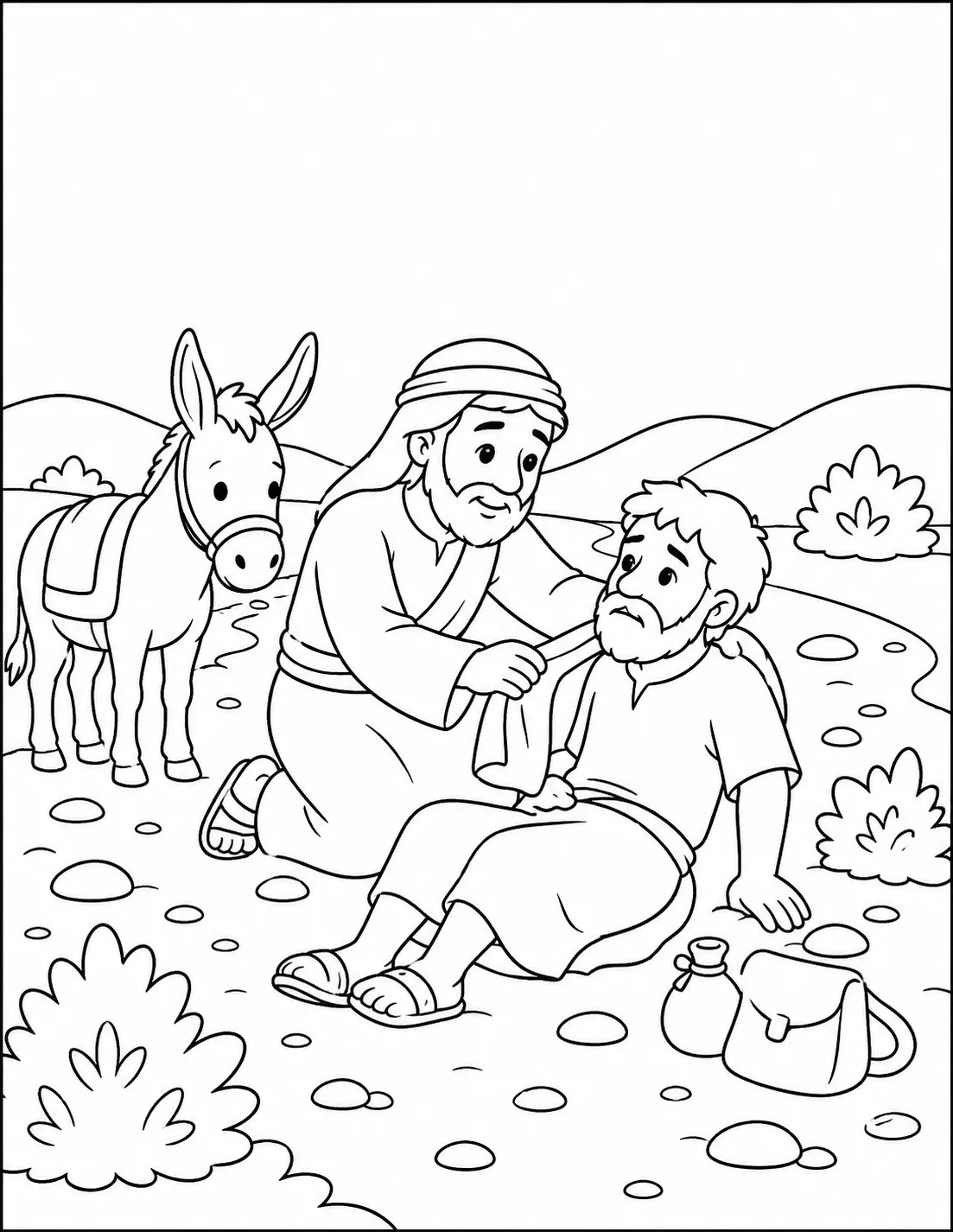
He treated the man's wounds as best he could and helped him onto his own animal.
Then he brought the injured man to a place where travelers could stay.
The Samaritan cared for him there.
The next day, he gave money to the innkeeper and asked that the man continue to be cared for.
He even promised to cover additional reasonable costs when he returned.
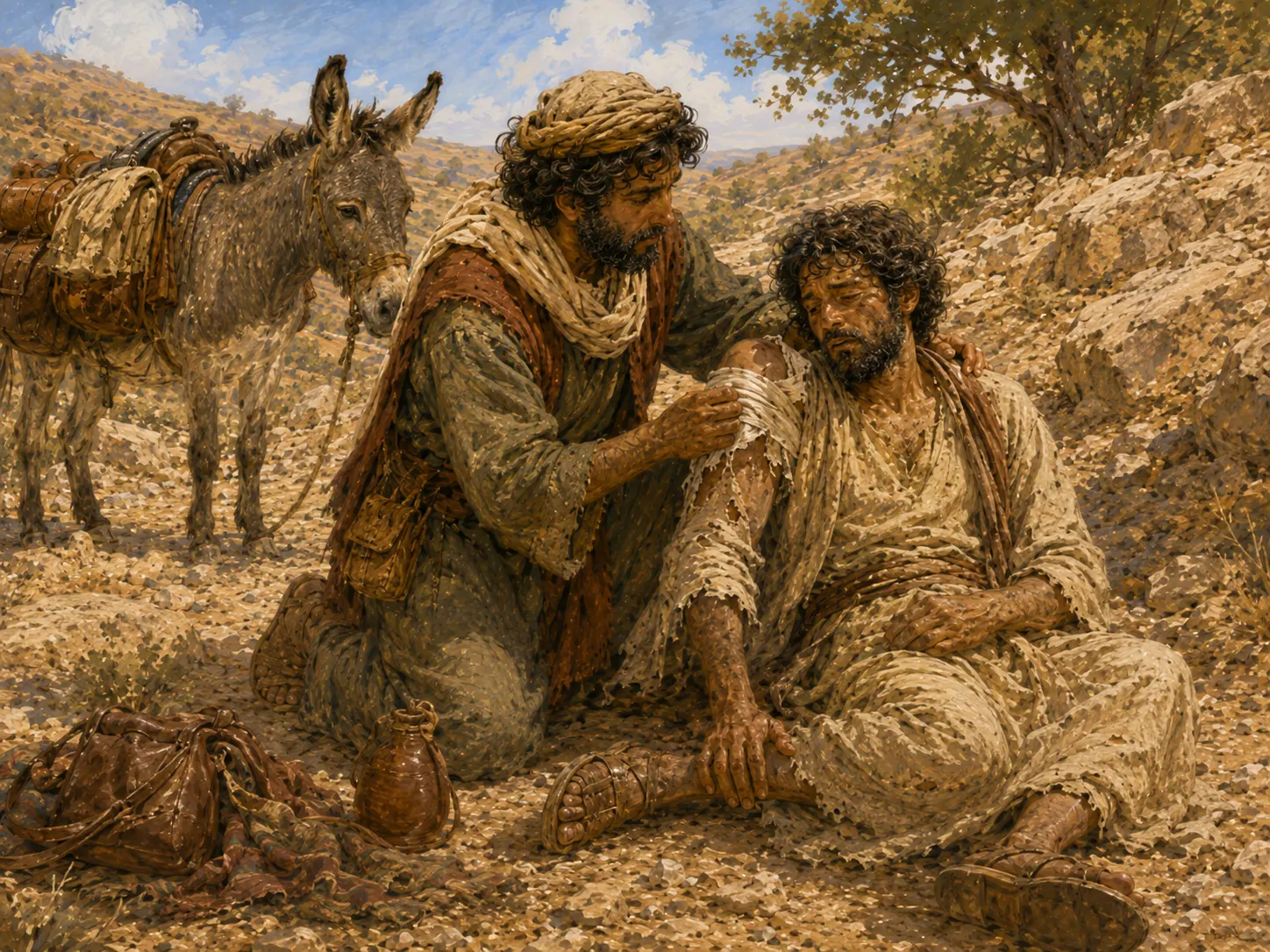
The Samaritan did not simply feel sorry for the injured man.
His compassion became practical action.
He gave time.
He used his own supplies.
He changed his travel plans.
He spent money.
He took responsibility for making sure the wounded man was not left alone.
None of these actions made the Samaritan magical or perfect. Jesus's point was that he acted with mercy when the wounded man needed it.
When Jesus finished the parable, He asked the expert in the law which of the three travelers had acted like a neighbor to the wounded man.
The man answered that it was the one who had shown mercy.
Jesus told him to go and do likewise.
The point was not that every priest or Levite was uncaring, or that every Samaritan was automatically better than every Jewish person.
The expert had begun by asking, 'Who is my neighbor?' Jesus had turned the question around. The important question was not how small a circle a person could draw around the word neighbor, but whether he would show mercy when someone needed help.
The wounded man needed mercy.
The Samaritan saw him and acted.
The wounded man's need had crossed every social boundary in the parable. Mercy had crossed those boundaries too. The Samaritan had become a neighbor by stopping, helping, and making sure the injured man received continued care.
Jesus was calling His listeners to real mercy—mercy that notices suffering and responds wisely. Helping someone never requires a child to walk alone into danger; wise mercy can begin by getting a trusted adult or other safe help.
If someone is hurt, unsafe, unconscious, or threatened, a child should get a trusted adult or emergency help rather than trying to handle the situation alone.
Mercy can be courageous and practical without being reckless.
Jesus's story shows that love of neighbor crosses social boundaries.
It is not built on whether someone is from our group, looks like us, agrees with us, or can repay us.
Real mercy notices need and responds wisely.
And in Jesus's teaching, love for God and love for neighbor belong together.

What This Story Teaches Us
1. Love of God and Love of Neighbor Belong Together
The conversation begins with the commands to love God and love your neighbor.
Jesus does not treat mercy as an optional extra disconnected from faith.
2. Mercy Crosses Social Boundaries
The Samaritan helps someone who is not identified as belonging to his own group.
Jesus challenges the attempt to make the word neighbor too small.
3. Compassion Becomes Practical
The Samaritan stops, gives care, provides transportation, finds shelter, and pays for continued help.
Mercy is more than feeling sorry for someone.
4. We Should Not Invent Motives the Bible Does Not Give
Jesus does not explain why the priest and Levite passed by.
The point is what they failed to do, not a speculative story about what they were thinking.
5. Mercy Is Not the Same as Unsafe Risk
The Samaritan is an adult traveler making adult decisions.
Children can show mercy by getting trusted adults and appropriate help rather than entering dangerous situations alone.
6. Jesus Changes the Question
The man asks, 'Who is my neighbor?'
Jesus ends by asking which person acted like a neighbor. The focus moves from limiting responsibility to practicing mercy.
How It Fits into God's Bigger Story
God's law had long taught His people to love Him and to love their neighbor. Jesus brings those commands together and shows what neighbor-love looks like when someone is vulnerable and in need.
The parable also challenges human habits of dividing people into groups that deserve care and groups that do not. Mercy reflects God's concern for people rather than our instinct to protect only our own circle.
Christians understand Jesus's own life as the fullest revelation of God's mercy: He welcomed outsiders, cared for the suffering, gave Himself for sinners, and called His followers to love others because they have received mercy from God.
The Samaritan should not be treated as a complete one-to-one picture of Jesus. Instead, the parable belongs within Jesus's larger teaching about a life shaped by love for God, mercy toward others, and the grace His followers themselves need.
Talk About It
- What happened to the traveler on the road to Jericho?
- What practical things did the Samaritan do to help the injured man?
- How does Jesus's story connect love for God with mercy toward people?
- Why do you think Jesus made the unexpected Samaritan the person who stopped to help?
- If you saw someone hurt or unsafe, what is a wise and safe way you could help without putting yourself in danger?
- What is one practical act of mercy our family could do together for someone who needs care?
A Short Prayer
Jesus, thank You for teaching us that mercy is more than kind words. Help us notice people who need care and respond with wisdom and compassion. Teach us not to decide that only people from our own group deserve kindness. Give us courage to get safe help when someone is hurt, and help our family find practical ways to love our neighbors. Thank You for the mercy You show us. Amen.
Try This Together
Notice — Get Help — Show Mercy 10–15 min
You will need: Printable activity page, Pencil, Crayons or colored pencils if desired
- Under NOTICE, write what need the Samaritan saw.
- Under GET HELP, name a trusted adult you could tell if someone were hurt or unsafe.
- Under SHOW MERCY, choose one safe family-led way to care for someone this week.
- Talk together about the difference between compassion and taking an unsafe risk.
- Finish with the short prayer or your own simple prayer.
Help children connect mercy with practical care while preserving strong safety boundaries.
Safety: Children should not enter dangerous situations, approach violent scenes, or provide medical care alone.
Memory Verse
“Go and do likewise.”— Luke 10:37
For Parents and Teachers
Avoid Anti-Jewish Framing
The priest and Levite are individual characters in a parable, not representatives proving that Jewish people are uncaring.
Jesus Himself, the law expert, and most people in the story's setting are Jewish.
Explain Jews and Samaritans Carefully
Jews and Samaritans had deep historical and religious tensions, but the distinction should not be simplified into modern racial categories.
The surprise of the parable comes from expected social boundaries being crossed by mercy.
Do Not Invent Why the Priest and Levite Passed By
Luke does not tell us their motives.
Avoid claiming ritual purity, fear, selfishness, or scheduling pressure as though the text explicitly says so.
Keep the Violence Child-Safe
The traveler was robbed and beaten, but the attack does not need to be dramatized.
Focus on the injured man's need and the Samaritan's response rather than the violence itself.
Mercy Does Not Require Unsafe Contact
A child who encounters an injured or unsafe stranger should get a trusted adult or emergency help rather than imitate every adult action in the parable.
Compassion and safety are not opposites.
Do Not Turn the Parable into a Works-Salvation Formula
The framing question concerns eternal life, but Jesus's teaching should not be flattened into 'do enough good deeds and you earn salvation.'
Within the larger Gospel story, Christians understand obedience and mercy in the context of God's grace and the call to follow Jesus.