Paul and Silas in Prison
Trusting God in a Frightening Night
Original age-appropriate retelling based on Acts 16:16–40.

Before You Read
Have you ever been scared and still chosen to trust someone you knew was good? Paul and Silas were about to face a frightening night even though they had been serving Jesus.
As you read, notice that trusting God does not mean pretending something difficult is easy. Watch how Paul and Silas pray, how Paul protects another person's life, and how the good news about Jesus reaches an unexpected home.
The Bible Story
Paul and Silas were in Philippi, a Roman colony where they had been telling people about Jesus. A slave girl who was being used by her owners to make money kept following them. Paul commanded the troubling spirit to leave her in the name of Jesus Christ, and it left her. Her owners were angry because the way they had been making money from her was gone.
The owners grabbed Paul and Silas and dragged them before the city authorities. A crowd joined the attack. Paul and Silas were treated harshly, beaten, and ordered to be locked securely in prison. The jailer put them in the inner part of the prison and fastened their feet. They had been hurt, and now they could not simply walk away.
Night settled over the prison. Paul and Silas were surrounded by stone walls, locked doors, and other prisoners. Nothing about the situation was easy. Yet around midnight they began praying and singing hymns to God. They were not pretending that being hurt or imprisoned was pleasant. In the middle of a frightening night, they chose to turn toward God.
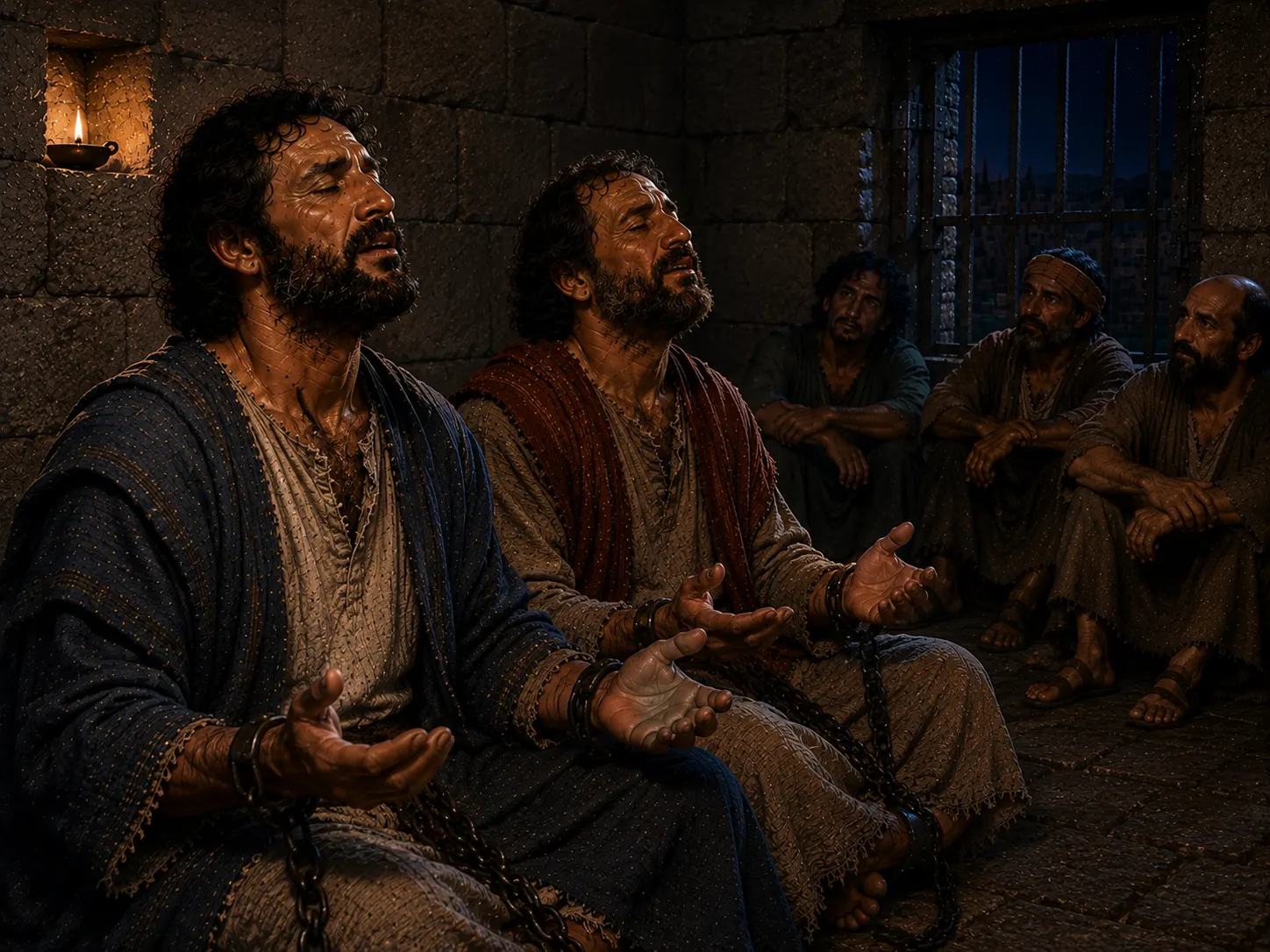
The other prisoners listened. Then, suddenly, a powerful earthquake shook the prison so strongly that its foundations moved. The doors opened, and the prisoners' restraints came loose. This was not something Paul and Silas had caused. God had acted in an extraordinary way.

The jailer woke and saw the prison doors standing open. He immediately thought the prisoners had escaped. He knew that losing prisoners could bring terrible consequences for him. Overcome with fear and despair, he was about to harm himself.
Paul saw the danger and called out loudly, telling the jailer not to hurt himself because all the prisoners were still there. Paul could have thought only about his own escape. Instead, he cared about the life of the man who had been guarding him.
The jailer called for lights and hurried inside. Trembling, he came before Paul and Silas. Then he brought them out and asked what he needed to do to be saved. The night's events had shown him that something far greater than an ordinary prison escape was happening.
Paul and Silas answered by pointing him to Jesus: he should believe in the Lord Jesus. Then they spoke the word of the Lord to him and to the others in his household. Their message was not that an earthquake could save him. Their message was about Jesus.

That same night, the jailer began caring for the men he had been guarding. He washed their wounds. He and his household were baptized. Then he brought Paul and Silas into his home and gave them food. Fear and hostility were being replaced by care, welcome, and joy because he had come to believe in God.
The next morning, the city authorities sent word that Paul and Silas could be released. But Paul explained that they were Roman citizens and had been publicly punished without a proper trial. He did not quietly pretend that the injustice had never happened.
The officials became alarmed when they learned that Paul and Silas were Roman citizens. They came to speak with them, escorted them from the prison, and asked them to leave the city. Paul and Silas were free, but they did not leave Philippi immediately.
Before departing, Paul and Silas went to Lydia's home, where they met with the brothers and sisters in the young church. They encouraged them and then left. A night that had begun with pain and imprisonment had become part of the way the good news about Jesus reached a jailer, his household, and the growing church in Philippi.

What This Story Teaches Us
We Can Turn to God in Hard Times
Paul and Silas prayed and sang while they were hurt and imprisoned. Trust did not make the prison pleasant; it meant they continued turning toward God in the middle of it.
God's Power Is Not a Formula
God sent an extraordinary earthquake in this story. The Bible does not promise that prayer or singing will always make danger disappear or produce a miracle on demand.
Another Person's Life Matters
When the jailer was in immediate danger, Paul did not use the confusion only for his own advantage. He called out to protect the jailer's life.
Salvation Is Found in Jesus
When the jailer asked about salvation, Paul and Silas pointed him to the Lord Jesus and then explained God's word to his household.
Faith Can Produce Real Change
The jailer moved from guarding Paul and Silas to washing their wounds, welcoming them, feeding them, and rejoicing in God.
How It Fits into God's Bigger Story
Jesus had sent His followers to carry the good news outward, and the message was now reaching cities far beyond Jerusalem.
In Philippi, the gospel reached people in very different circumstances, including Lydia and her household and then a jailer and his household. Jesus was building His church in a Roman colony through ordinary witnesses and unexpected events.
Paul and Silas did not present freedom from prison as the way to be saved. They pointed the jailer to Jesus. The rescue God offers through Christ is deeper than escaping one difficult night.
Talk About It
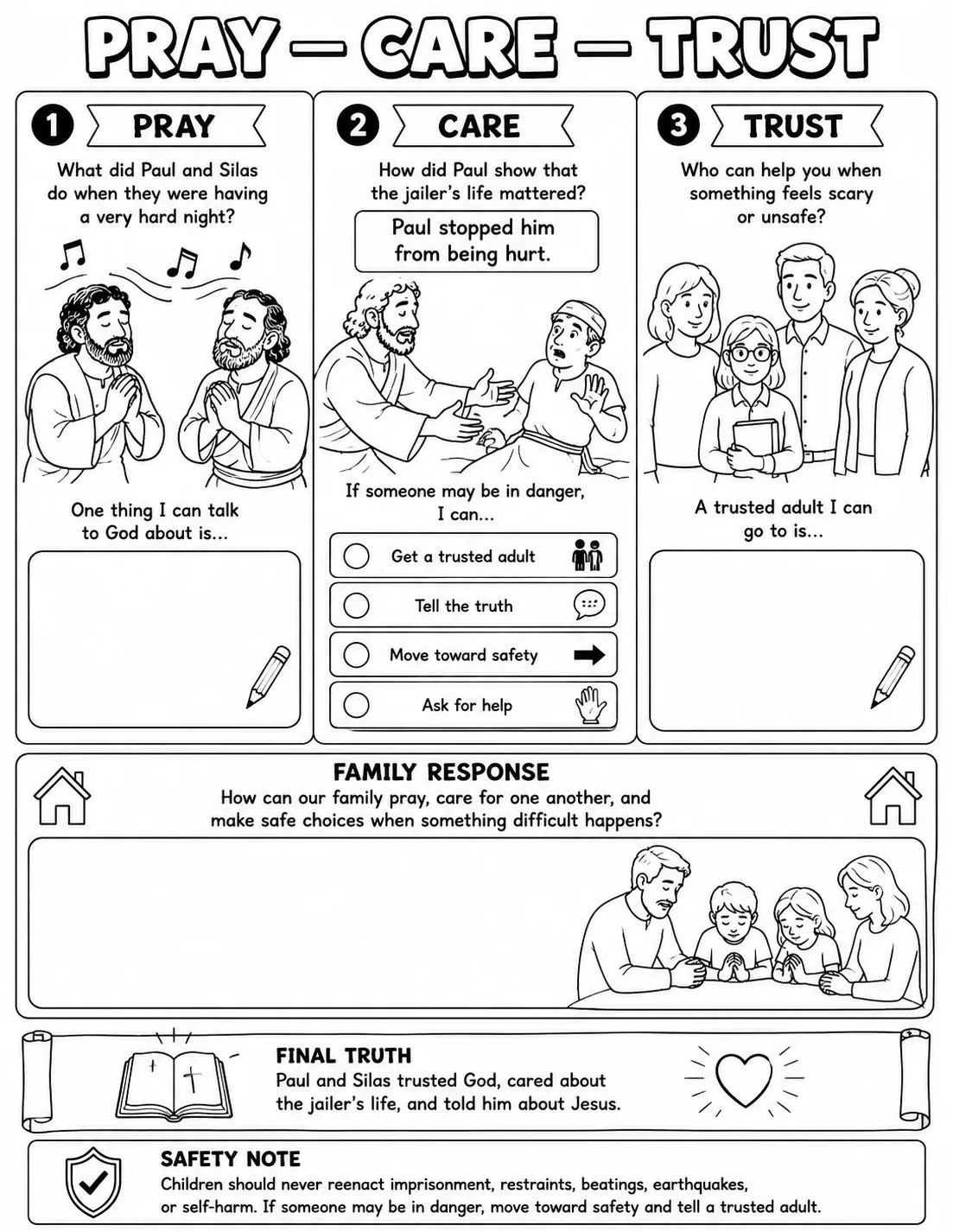
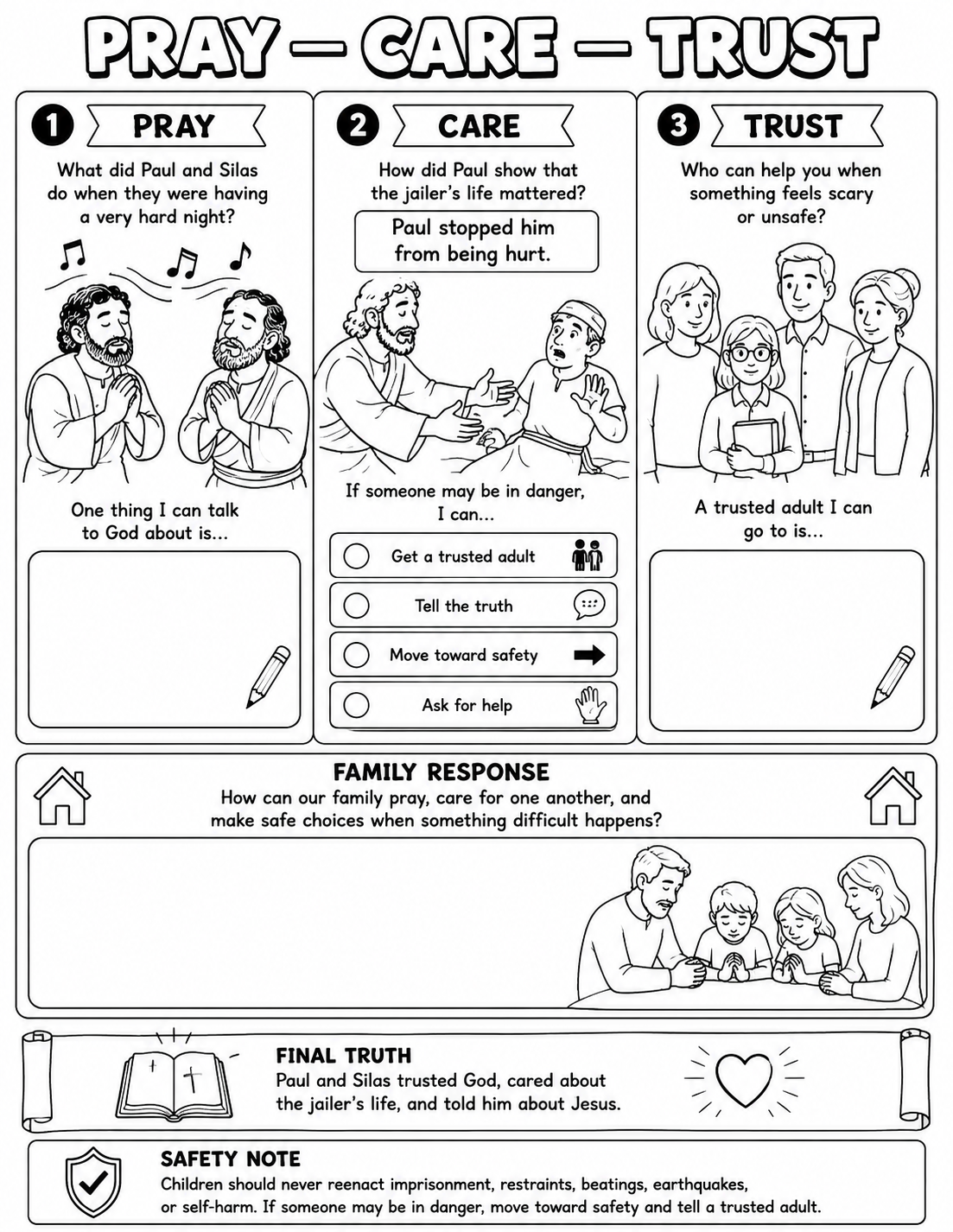
- What were Paul and Silas doing in prison around midnight?
- What happened when the earthquake shook the prison?
- What does this story teach us about God and about trusting Him in difficult times?
- Why did Paul stop the jailer from harming himself instead of simply thinking about escape?
- When you feel frightened or trapped in a difficult situation, who are safe people you can ask for help?
- How can our family pray, encourage one another, and make safe choices when something difficult happens?
A Short Prayer
God, thank You that we can talk to You when life is peaceful and when life is hard. Help us trust You without pretending that frightening things are easy. Give us wisdom to move toward safety and ask for help when we need it. Help us care about other people's lives, just as Paul cared about the jailer. Thank You for the good news that salvation is found in Jesus. In His name, amen.
Try This Together
Pray — Encourage — Get Help 10–15 min
You will need: Paper, Crayons or markers
- Fold a sheet of paper into three sections labeled PRAY, ENCOURAGE, and GET HELP.
- Under PRAY, write or draw one thing you can talk to God about when you feel afraid.
- Under ENCOURAGE, write or draw one safe way family members can comfort one another.
- Under GET HELP, name trusted adults a child can go to when something feels dangerous or overwhelming.
- Finish by praying together for courage, wisdom, and care for other people.
Help children connect trust in God with prayer, encouragement, and wise safety choices.
Safety: Do not reenact imprisonment, restraints, beatings, earthquakes, or the jailer's crisis. Children should move toward safety and tell a trusted adult when someone is in danger.
Memory Verse
“Believe in the Lord Jesus, and you will be saved.”— Acts 16:31
For Parents and Teachers
Acts 16 includes exploitation, mob violence, beating, imprisonment, an earthquake, and an acute self-harm crisis. For ages 6–9, preserve the biblical sequence without describing or visualizing the mechanics of violence or self-harm.
Historical Context
Philippi was a Roman colony. Roman citizenship carried legal protections, which explains why the officials became alarmed when Paul disclosed that he and Silas were Roman citizens who had been publicly punished without proper process.
Handle the Jailer’s Crisis Carefully
Say only that the jailer became overwhelmed and was about to harm himself. Do not describe the method to children.
If a child encounters someone who may hurt themselves or someone else, the child's role is to move toward safety and tell a trusted adult immediately.
Do Not Turn the Earthquake into a Formula
The earthquake is an extraordinary act of God in this specific biblical story.
Do not promise children that enough prayer, singing, or faith will always produce immediate physical rescue.
Keep Salvation Centered on Jesus
The jailer's question leads Paul and Silas to point him to the Lord Jesus.
Do not make the story mainly about bravery, positive thinking, or prison escape.
Trust and Safety Belong Together
Children can pray and trust God while also leaving danger, seeking responsible adults, and accepting appropriate professional help.
Forgiveness or faith never requires remaining available to someone who is threatening or hurting them.
A Question Your Child May Ask
“If Paul and Silas prayed, will God always make a scary problem disappear?”
God always hears His people, but the Bible does not promise that every prayer will bring an earthquake or immediate escape. We can trust God, pray, and also use wise, safe help when we are in danger.
Common Misunderstandings
- Prayer and singing do not guarantee miraculous physical escape.
- Trusting God does not require a child to stay in an unsafe place.
- The jailer's crisis must not be reenacted, described methodically, or used to frighten children.
- Paul's concern for the jailer's life does not mean children should personally manage an adult's crisis.
- Household baptism should be presented as part of the Acts narrative rather than turned into a denominational argument.
- Paul and Silas addressing injustice is compatible with Christian faith and forgiveness.
Safeguarding
Do not ask children to reenact beating, shackling, imprisonment, earthquakes, escape attempts, or self-harm. If a child reports that they or someone else may be in danger, follow appropriate safeguarding procedures and involve responsible adults or emergency support as required.