God Provides in the Wilderness
Manna and Water

Before You Read
Israel is free from Egypt, but the wilderness brings new problems.
In this story, the people need water, food, rest, and then water again.
Watch how God cares for real needs and how He teaches His people not to let fear make them forget what He has already done.
The Bible Story
After crossing the Red Sea, the Israelites traveled into the wilderness.
They were free from Egypt, but the road ahead was still difficult.
The land was dry and unfamiliar, and many families, children, older adults, and animals depended on the supplies they carried.
Rescue from Egypt did not mean that every hard day was over.
For three days the people traveled without finding good water.
At last they came to a place called Marah.
There was water there, but it was bitter and not fit to drink.
The people turned to Moses and asked what they were going to drink.
Their need was real. Safe water mattered for every household in the camp.
Moses cried out to God.
God showed Moses what to do, and the bitter water became fit to drink.
The wood Moses used was not magical. God was the One who provided.
After Marah, Israel came to Elim.
There they found springs of water and palm trees.
For a while, the people rested where there was water and shade.

Then the journey continued.
As the days passed, the food they had brought from Egypt began to run low.
Hunger made the people afraid.
They complained to Moses and Aaron.
They began remembering Egypt as if it had only been a place of full cooking pots and plenty of bread.
But Egypt had also been the place where they had lived under harsh slavery.
Fear was making the past look safer than it really had been.
God heard the people.
He told Moses that He would provide food for them.
In the evening, quail came near the camp, and the people had meat to eat.
Then morning came.
Dew lay on the ground around the camp.
When the dew was gone, something small and flaky remained.
It was fine and pale, almost like frost.
The Israelites had never seen anything like it.
They looked at one another and asked, 'What is it?'
Moses told them that this was the bread God had given them to eat.
The people called it manna.
It was not a pile of loaves falling from the sky.
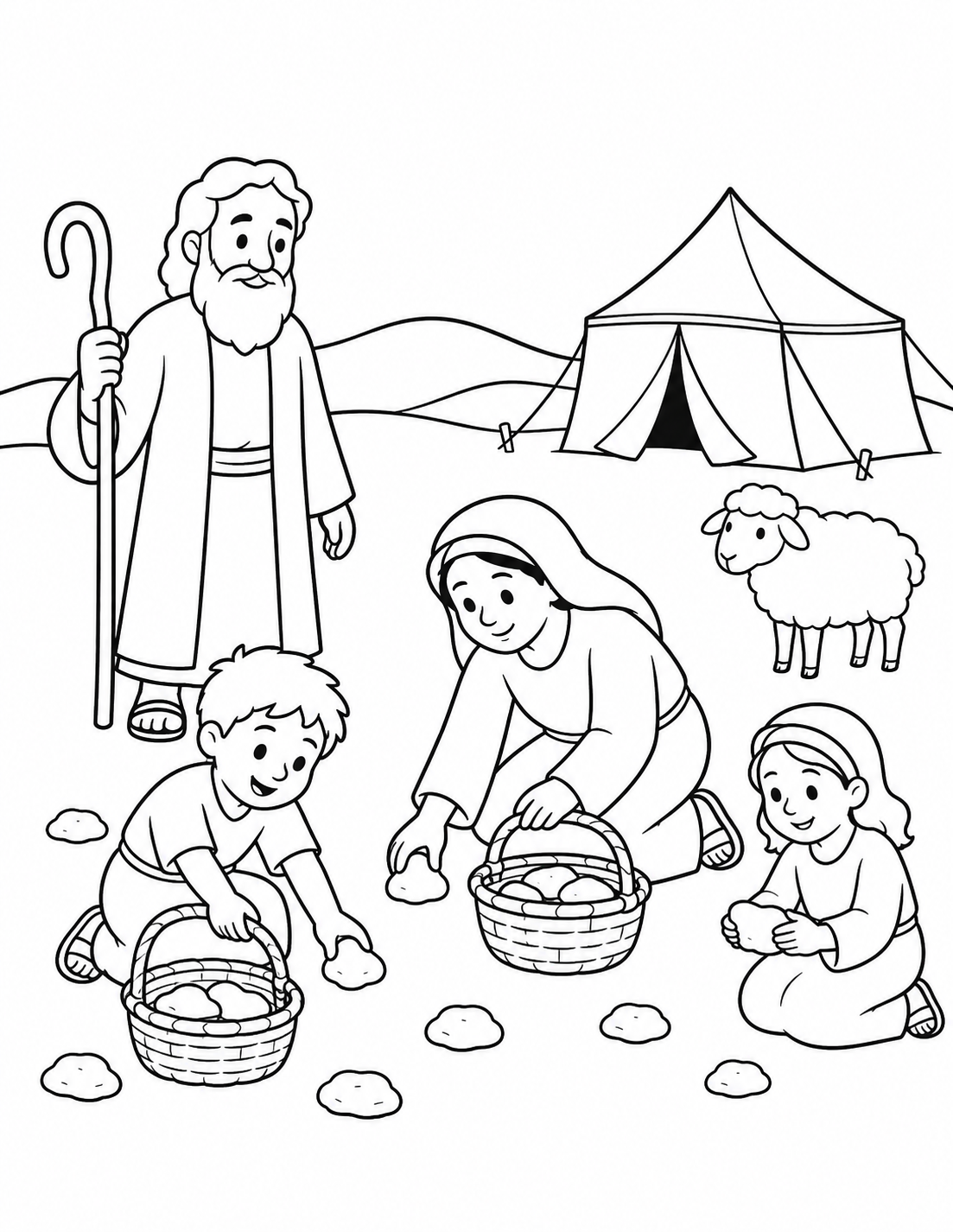
It was a small, flaky food that the people could gather from the ground.

Every household was told to gather what it needed for that day.
Parents and children went out with baskets.
Older people gathered too.
Each family collected enough for the people in the household.
When it was measured, there was enough.
The person who had gathered more did not end up with too much.
The person who had gathered less did not end up without enough.
God was teaching Israel to receive what they needed one day at a time.
On an ordinary day, the people were not to keep the manna until the next morning.
Some people did not listen.
They saved part of it overnight.
By morning it had spoiled and could no longer be eaten.
Every morning, the people gathered fresh manna.
When the sun grew hot, what remained on the ground melted away.

Then the sixth day came.
That morning the people gathered twice as much as usual.
The leaders noticed the difference and came to Moses.
Moses explained that the next day would be a day of rest.
The people were to prepare what they needed ahead of time.
The extra manna from the sixth day did not spoil overnight.
It remained good for the seventh day.
On the seventh day, the people were to rest instead of going out to gather.
Even so, some people went out looking for manna.
They found none.
God was teaching His people that His care included both provision and rest.
The seventh day was not a day when God stopped caring for them.
He had already provided what they needed.
Manna became part of Israel's everyday life in the wilderness.
God also told Moses to keep a portion of manna as a memorial.
Future generations were to remember how God had fed His people in the wilderness.
But Israel's lessons about trust were not finished.
After traveling farther, the people camped at a place called Rephidim.
There was no water for the people to drink.
Once again, fear spread through the camp.
The people argued with Moses and demanded water.
Moses asked why they were quarreling with him and why they were testing God.
But the people were thirsty, and their fear grew stronger.
They asked why Moses had brought them out of Egypt if they were only going to die of thirst in the wilderness.
Their words showed how quickly fear could make them forget what God had already done.
Moses cried out to God again.
He asked what he should do.
God told Moses to go ahead of the people and take some of Israel's elders with him.
Moses was also to take the same staff he had carried before.
The staff itself was not magical.
It was simply the staff Moses carried as he obeyed God's instruction.
God directed Moses to the rock at Horeb.
There, in the presence of the elders, Moses struck the rock as God had commanded.
Water came out from the rock.
There was water for the people to drink.

Families could fill their containers.
Children, older adults, and the rest of the camp had what they needed.
God had provided again.
Moses named the place Massah and Meribah because the people had quarreled and tested God there.
They had asked, 'Is the Lord among us or not?'
That question revealed the deeper struggle in the wilderness.
The Israelites had seen the Red Sea open.
They had tasted water made drinkable at Marah.
They had eaten quail and gathered manna morning after morning.
And now they had received water from the rock.
Still, trust did not always come easily.
God was teaching His rescued people that they could bring real needs to Him without letting fear erase the truth of what He had already done.
The wilderness was not comfortable, but Israel was not abandoned.
Again and again, God provided food, water, direction, and rest.
He was caring for His people and teaching them to trust Him as they traveled toward Mount Sinai.
What This Story Teaches Us
1. Real Needs Matter
Israel really needed safe water and food.
Faith does not mean pretending that hunger, thirst, fear, or other needs are not important.
2. Fear Can Make Us Forget
When Israel became hungry or thirsty, some people spoke as if God had never helped them before.
Fear can make one hard moment feel like the whole story.
3. God Provided Again and Again
God provided drinkable water at Marah, quail and manna in the wilderness, and water at Rephidim.
The repeated pattern shows God's care for His rescued people.
4. Daily Trust Includes Wise Obedience
The people had instructions for gathering manna and preparing for the seventh day.
Trust was not passive; they still gathered, prepared, listened, and obeyed.
5. Moses' Staff Was Not Magic
At Rephidim, Moses used the staff because God told him what to do.
The power did not come from the staff or from Moses.
6. Remembering Helps Us Trust
Israel's deeper struggle was the question, 'Is the Lord among us or not?'
Remembering God's past faithfulness can help us respond more wisely when new needs arise.
Talk About It
- Why could the people not drink the water at Marah?
- What did Moses do when the people needed water?
- What happened when the food from Egypt began to run low?
- What did God provide in the evening?
- What appeared on the ground in the morning?
- Why did the people call it manna?
- What happened when some people kept ordinary manna overnight?
- What was different on the sixth day?
- What problem did the people face at Rephidim?
- What did God tell Moses to do at the rock?
- Where did the water come from?
- What question showed Israel's deeper struggle to trust God?
A Short Prayer
God, thank You for caring about real needs. Help us ask for help when we need it, remember what is true when we feel afraid, and trust You one day at a time. Amen.
Try This Together
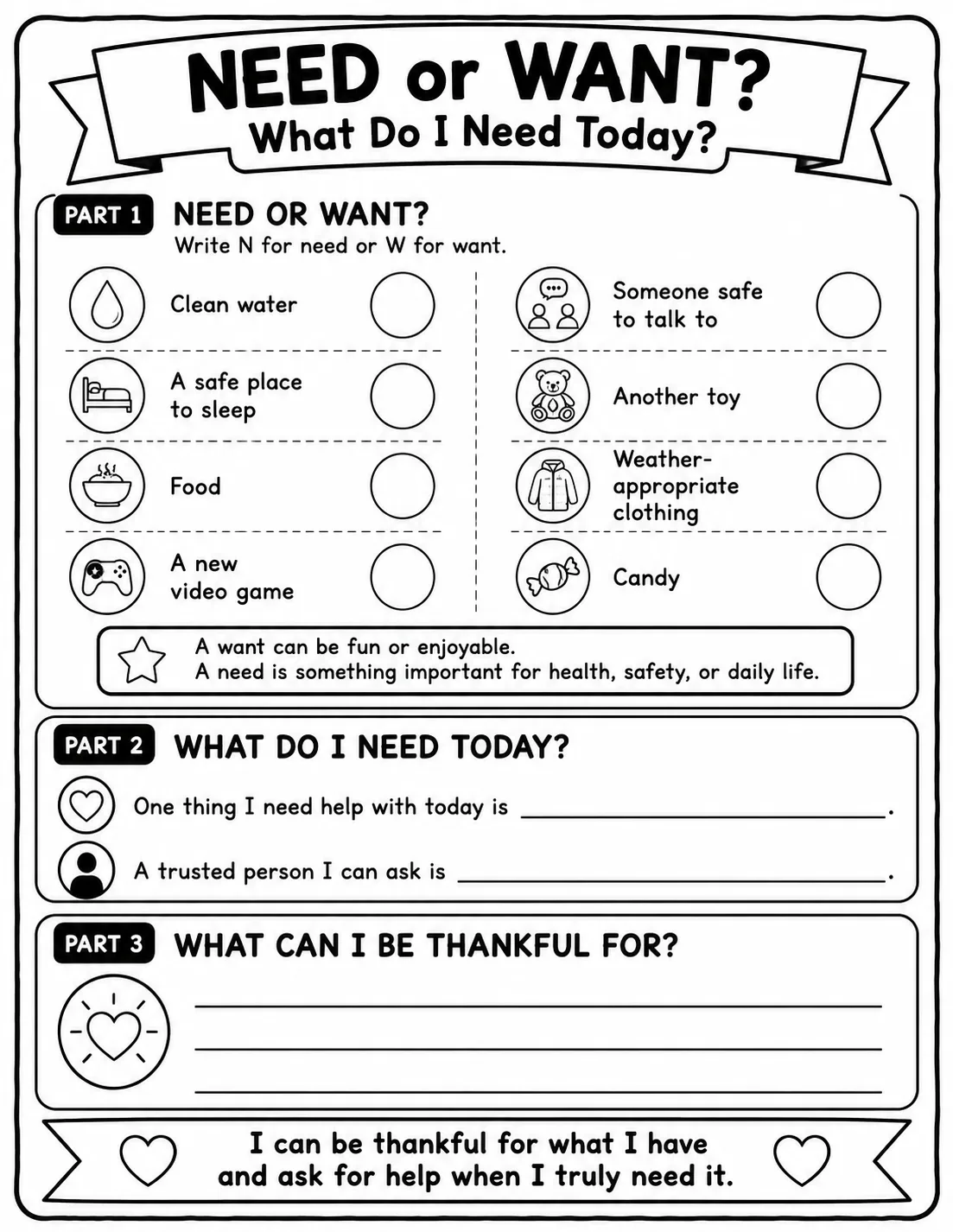
Needs, Wants, and Asking for Help
- Use the printable to sort everyday examples into needs and wants.
- Remind the child that wants are not automatically bad.
- Name one real need the child can appropriately ask a trusted adult to help with.
- Finish by naming three things the family is thankful for today.
Memory Verse
“I will rain down bread from heaven for you.”— Exodus 16:4
For Parents and Teachers
Do Not Shame Real Needs
The story includes sinful fear and quarrelling, but it also includes objectively serious needs for food and water.
Avoid using 'complaining Israelites' as a label for every child who expresses discomfort or asks for help.
Provision Is Not a Blank Check
This passage records God's specific covenant care for Israel in the wilderness.
Do not promise children that faith guarantees every wanted result in the form or timing they expect.
Practical Help Still Matters
If a child lacks food, safe water, housing, or another basic need, the application is not to tell them to trust harder.
Trusted adults should respond with practical help and appropriate support.
Keep the Staff Non-Magical
Children may easily read the staff as a magic wand if the story or image emphasizes it incorrectly.
Make clear that Moses obeys God's instruction; the staff itself has no independent power.
Keep Sabbath Discussion Broad
Christian traditions differ in how they understand Sabbath observance today.
Keep the story focused on what Exodus says about Israel's wilderness rhythm of provision, preparation, and rest.
Where the Story Goes Next
Israel has learned that the God who rescued them also cares for them in the wilderness.
Next, the people come to Mount Sinai.
There God will make His covenant known and teach His rescued people how to live as His people.
The next story is God Gives the Ten Commandments — Exodus 19–20.