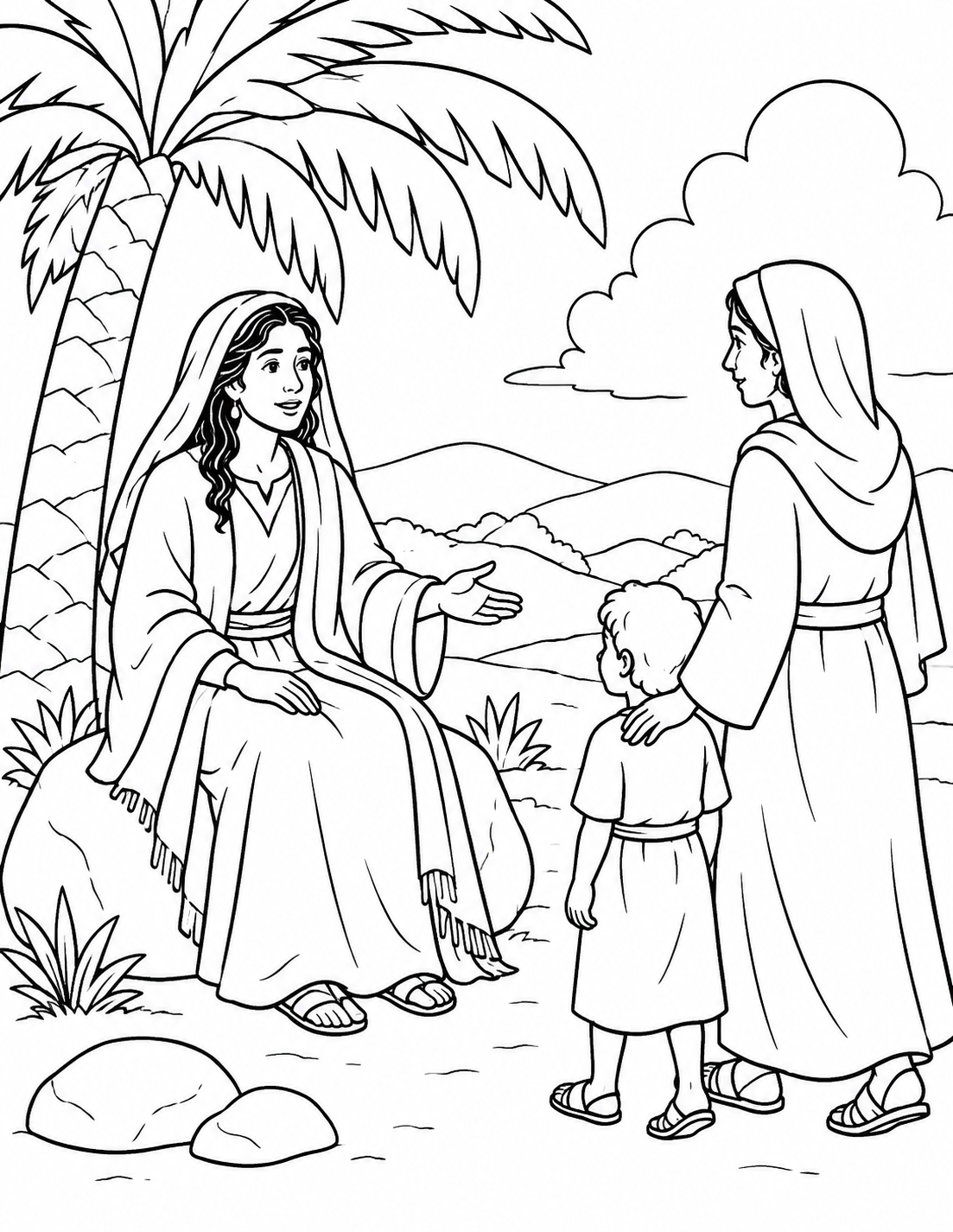
Deborah Leads God’s People
God Brings Help in a Time of Trouble
Original child-friendly retelling based on Judges 4–5.

Before You Read
Have you ever faced a problem that seemed much bigger than you? Sometimes courage does not begin with feeling strong. It begins with listening carefully, asking for help, and taking the next right step.
In the days of the judges, Israel was in serious trouble. The people cried out to God, and He used several very different people—including a wise leader named Deborah—to bring them relief.
The Bible Story
During the time of the judges, Israel often turned away from God. Again and again, the people suffered under enemies, cried out for help, and then experienced God’s mercy.
After one judge died, Israel again did what was wrong. King Jabin of Canaan gained power over them, and Sisera, the commander of his army, became a frightening name among the people.
Sisera had nine hundred iron chariots. To people who traveled and fought mostly on foot, hundreds of strong chariots looked almost impossible to overcome.
For twenty years, Israel lived under harsh oppression. At last, the people cried out to the Lord for help.
God heard them. Their past choices had been unfaithful, but their failure did not make God weak or unable to act with mercy.
At that time, a woman named Deborah served Israel as a prophet and judge. People came to her beneath a palm tree in the hill country so she could help settle difficult matters.
Deborah was not important because she wore a crown or commanded attention like a powerful queen. She was important because God had given her a responsibility to listen, judge wisely, and speak His message faithfully.

One day Deborah sent for Barak, an Israelite leader. She told him that the Lord had commanded him to gather men from the tribes of Naphtali and Zebulun and lead them toward Mount Tabor.
Deborah explained that Sisera and his chariots would come toward the Kishon River. God promised that Sisera would not have the final victory.
Barak was willing to go, but he did not want to go without Deborah. He told her that if she went with him, he would go too.
Deborah agreed to go. She also told Barak that the honor connected with Sisera’s final defeat would come in an unexpected way—through a woman.
Barak gathered ten thousand men, and Deborah went with him. They prepared near Mount Tabor while word of their movement spread.

When Sisera heard what was happening, he brought out his chariots and troops. From a human point of view, his army looked stronger.
But Israel’s hope was not that its army was secretly more powerful. Their hope rested in the God who had spoken.
Deborah told Barak that the time had come. She reminded him that the Lord was going ahead of them.
Barak and his men came down from Mount Tabor. As the battle unfolded, the Lord threw Sisera’s forces into confusion.
Judges 5 later describes the Kishon River sweeping through the battle area. The chariots that had seemed so powerful could not guarantee Sisera’s victory.
Sisera’s army lost its advantage. The commander left his chariot and fled on foot while Barak continued the pursuit.

Sisera ran to the tent of a woman named Jael, the wife of Heber the Kenite. He believed he might be safe there because there had been peaceful relations between King Jabin and Heber’s household.
Jael invited Sisera inside. He was exhausted, and after receiving something to drink, he lay down to rest.
While Sisera slept, Jael killed him. The commander who had oppressed Israel could no longer threaten God's people.
Barak soon arrived while searching for Sisera. Jael showed him that Sisera was dead, and Deborah’s earlier words had come true: the final honor connected with Sisera’s defeat had come through a woman.
This did not mean Deborah had done everything alone, or that Barak’s role did not matter. God had worked through Deborah, Barak, Jael, and many Israelites in different ways.
After Sisera’s defeat, Israel grew stronger against King Jabin. In time, his oppressive power was broken.
Judges 5 records a song sung by Deborah and Barak. They praised God, remembered those who willingly stepped forward, and celebrated the relief He had brought.
The song calls Deborah “a mother in Israel,” a picture of someone who had taken responsibility to help and lead God’s people during a dangerous time.
No one could honestly boast that human strength had won the day. God's people remembered what He had done and praised Him for bringing relief.
After the conflict, the land had rest for forty years. The people who had once cried out under oppression now had a season of peace.

What This Story Teaches Us
God Heard His People
Israel had been unfaithful, but when the people cried out, God was still able to act with mercy and bring help.
God Can Work Through Different People
Deborah, Barak, Jael, and many Israelites had different roles. God’s work was not limited to one kind of person.
Human Power Is Not Ultimate
Sisera’s nine hundred chariots looked overwhelming, but military strength could not make him greater than God.
Faithful Leadership Requires Listening
Deborah listened, spoke God’s message, and carried responsibility seriously rather than acting like a flawless hero.
God’s Help Should Lead to Gratitude
Deborah and Barak responded to deliverance with praise.
How It Fits into God's Bigger Story
The judges brought real rescue, but it was temporary. Israel repeatedly returned to the same cycle of turning away, suffering, crying out, and needing another deliverer.
That repeated pattern helps prepare the Bible’s larger story for a better and lasting King. Christians understand that the story ultimately points forward to Jesus, whose rescue reaches deeper than one battle or one generation.
Talk About It
- Who was Deborah, and what did people come to her for?
- Why did Sisera’s army seem so powerful?
- What does this story show us about God when Israel cried for help?
- Why do you think Barak wanted Deborah to go with him?
- When something feels too big for you, who are safe people you can ask to help you think about the next step?
- What is one way our family can remember to thank God after receiving help?
A Short Prayer
God, thank You that You hear Your people and that no human power is greater than You. Thank You for people who lead wisely, help others, and speak what is true. When we feel unsure or afraid, help us ask for wise help and take the next right step. Teach us not to trust only in our own strength, and help us remember to thank You when we receive help. In Jesus’ name, amen.
Try This Together
Wise Courage — Pause, Ask, Choose 10–20 min
You will need: Printable activity page, Pencil, Crayons or colored pencils if desired
- Choose one simple situation on the printable.
- PAUSE: Write or draw what you know.
- ASK: Name a trusted safe adult or helper.
- CHOOSE: Write or draw one wise next step.
- Repeat with another situation if desired.
- Finish by talking about how courage can include asking for help.
Connect Deborah’s wise leadership with a safe process for responding when a problem feels difficult.
Safety: Children should never be pressured to share private experiences.
Memory Verse
“Praise the Lord!”— Judges 5:2
For Parents and Teachers
Parent Note: This story includes oppression, battle, and the death of Sisera. We recommend reading it together.
Historical Context
Judges describes a repeated covenant cycle in Israel’s history.
Deborah is both a prophet and a judge.
Judges 5 poetically reflects on the deliverance narrated in Judges 4.
A Question Your Child May Ask
“Why did Jael kill Sisera?”
Sisera was the commander of an army that had oppressed Israel for many years, and this happened during a violent conflict. The Bible tells us what Jael did, but that does not mean children should copy violent actions. The important point here is that Sisera could no longer continue harming Israel and that his powerful army did not have the final word.
Common Misunderstandings
- Do not generalize the covenant pattern in Judges into a rule that every hardship is punishment for a person’s specific sin.
- Do not reduce Deborah to a shallow lesson about being fearless.
- Do not caricature Barak as a comic coward.
- Do not treat Jael’s violent wartime action as something children should imitate.