
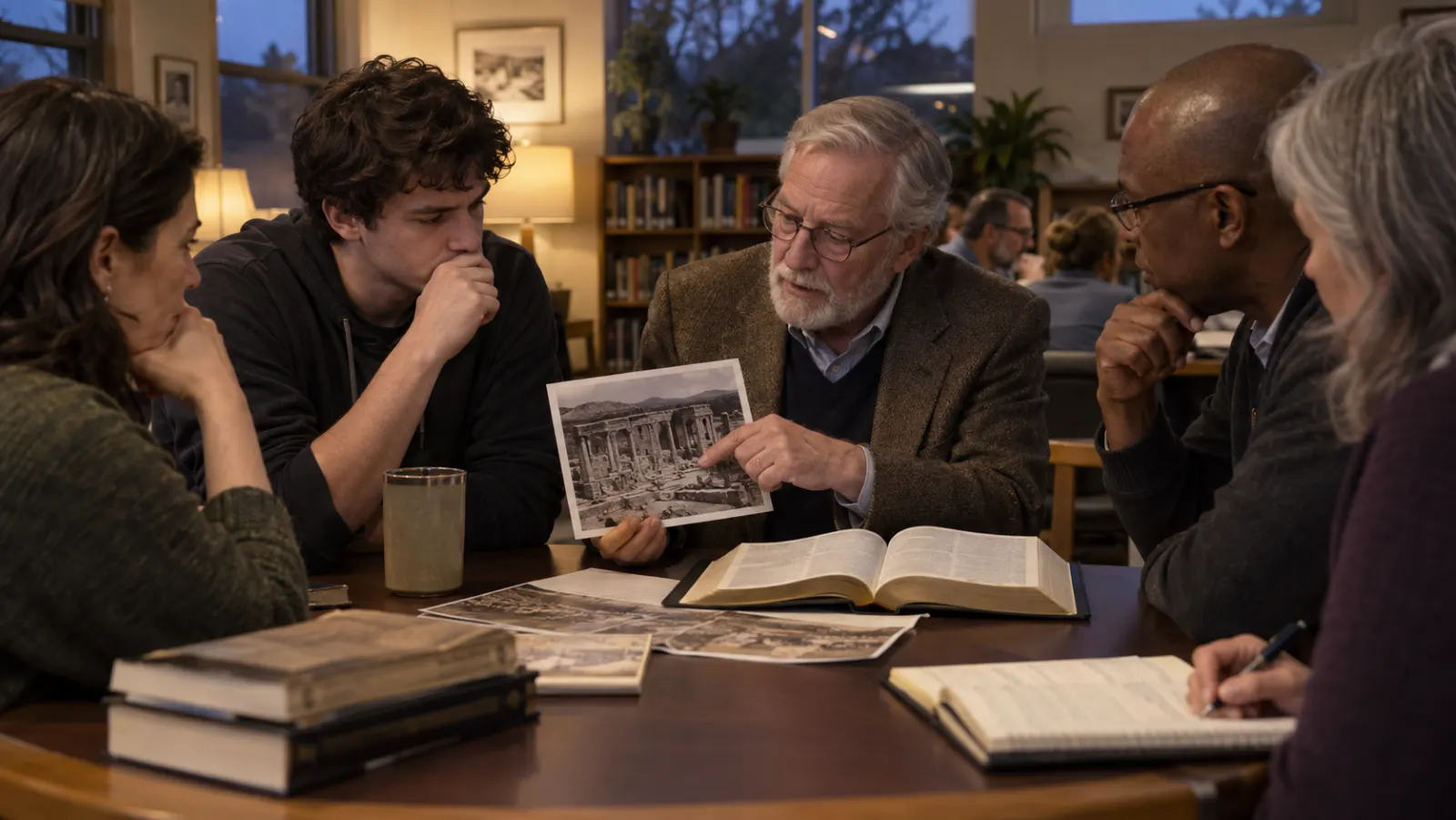
The evidence for Jesus is neither a secret archive that proves every Christian claim nor an empty space filled by faith. A careful historical case is more modest and more interesting.
A campus flyer promises to prove that Jesus never existed. A church video answers with a list of ancient writers and announces that the case is closed. Both approaches make history sound easier than it is. Ancient lives rarely leave modern documentation, and a source can be valuable without answering every question Christians ask of it.
The New Testament writings are themselves ancient sources, not evidence that historians must discard because Christians value them. They must be dated, situated, compared, and read according to genre. Non-Christian references add context and confirmation, but they do not secretly contain the whole gospel. The responsible question is not whether one spectacular artifact settles everything. It is what the surviving evidence reasonably supports.
Start with the earliest material
Paul's letters precede the written Gospels and assume that Jesus was a recent Jewish teacher who was crucified, had followers, and was proclaimed risen. Paul knew leaders connected to Jesus' family and first disciples. That does not prove every theological conclusion, but it makes the idea of a late invented character historically strained.
The Gospels are interested witnesses
The evangelists write to persuade, yet persuasion does not make a document useless. Court testimony, memoir, and political history also come from interested people. Historians ask what traditions are early, what details fit the period, where sources differ, and what an author is trying to communicate. Faith interest must be examined, not used as an automatic disqualification.
Outside references are limited but real
Josephus and Tacitus are often treated like hidden Christian books. They are not. Their brief notices help locate Jesus and the early movement within first-century Judea and the Roman world. Textual questions deserve honesty, especially around later Christian editing, but caution is different from declaring the evidence worthless.
Archaeology supplies a world, not a portrait
Inscriptions, coins, houses, roads, fishing installations, burial practices, and public buildings illuminate the settings of the Gospels. Archaeology cannot recover Jesus' tone of voice or photograph a miracle. It can expose anachronisms, sharpen geography, and show what daily life made plausible. The strongest use of archaeology is often ordinary context.
History has proper limits
Historical reasoning weighs explanations of public evidence. It does not place God in a laboratory. A historian can investigate what followers claimed, how early they claimed it, and what happened to the movement. Whether God raised Jesus involves historical evidence and a larger judgment about reality, testimony, and God. Pretending the disciplines are identical weakens both.
Certainty is not the only honest outcome
Some readers will reach Christian confession; others will remain unconvinced. The church should not punish questions or manufacture certainty. It can present sources accurately, admit disputed points, and explain why Christians find the cumulative case compelling. Intellectual hospitality is not surrender. It is confidence that truth does not need a rigged hearing.
Questions to carry into community
A useful conversation about “Can We Know Anything About Jesus Outside the Bible?” can begin here: Which sources are earliest and how are they dated? Ask for concrete examples, distinguish what Luke 1:1–4 actually says from a reasonable inference, and name the information still missing. People who will live with the decision should speak before leaders close the question. Then choose one bounded action, assign responsibility, and set a review date. Faithfulness is not proved by solving everything in an evening; it appears when truth, care, and accountability stay together.
The question has to leave the study room: Are we dismissing interested testimony too quickly? In American congregations, the same policy lands differently depending on income, race, gender, disability, work schedule, family status, and institutional power. Hearing those differences does not weaken biblical authority. It helps a church avoid mistaking the habits of decision-makers for the center of the gospel. Before announcing a rule, test it against actual cases, seek relevant expertise, and explain how someone can appeal without losing belonging.
To keep historical Jesus from becoming a slogan, ask again: What does a non-Christian reference actually establish? A Christian answer needs more than sincere intent. It needs boundaries, resources, consent, and visible ownership. It should also state what the congregation cannot provide and which qualified partner it will involve. Prayer and study belong in the process, but neither replaces checking facts or protecting the person who would bear the cost of a preventable mistake.
A useful conversation about “Can We Know Anything About Jesus Outside the Bible?” can begin here: Where does historical method reach its limit? Ask for concrete examples, distinguish what Luke 1:1–4 actually says from a reasonable inference, and name the information still missing. People who will live with the decision should speak before leaders close the question. Then choose one bounded action, assign responsibility, and set a review date. Faithfulness is not proved by solving everything in an evening; it appears when truth, care, and accountability stay together.
The question has to leave the study room: Can our community welcome an unresolved question? In American congregations, the same policy lands differently depending on income, race, gender, disability, work schedule, family status, and institutional power. Hearing those differences does not weaken biblical authority. It helps a church avoid mistaking the habits of decision-makers for the center of the gospel. Before announcing a rule, test it against actual cases, seek relevant expertise, and explain how someone can appeal without losing belonging.
One final check
Before closing “Can We Know Anything About Jesus Outside the Bible?,” return to Luke 1:1–4 and summarize three things separately: what the text states, what interpretation the community holds, and what application it proposes for this moment. That distinction allows a practice to be corrected without treating every correction as abandonment of faith. A reader from another generation, a person affected, and someone with relevant expertise can test the conclusion. If there is no way to receive new evidence or acknowledge unintended harm, discernment is not finished.
In a later review of “Can We Know Anything About Jesus Outside the Bible?,” leaders can record what happened after asking: Which sources are earliest and how are they dated? An impression from one service or the view of those who designed the response is not enough. Hear voluntary testimony, notice unexpected costs, and identify who remained outside. If the practice did not produce truth, justice, care, and communion, changing it does not betray biblical conviction; it may be a humble way to obey more faithfully. Review step 1 should end with a decision people can understand and see communicated.
In a later review of “Can We Know Anything About Jesus Outside the Bible?,” leaders can record what happened after asking: Are we dismissing interested testimony too quickly? An impression from one service or the view of those who designed the response is not enough. Hear voluntary testimony, notice unexpected costs, and identify who remained outside. If the practice did not produce truth, justice, care, and communion, changing it does not betray biblical conviction; it may be a humble way to obey more faithfully. Review step 2 should end with a decision people can understand and see communicated.
History can take us farther than the slogan that Jesus is only a matter of private faith. It can also remind believers that evidence does not give them control over another person's conscience.
The documents lead to a real first-century Jewish life and an early, disruptive claim about resurrection. At that point the question becomes more than whether Jesus existed. It becomes whether we will hear what the witnesses say he did and who they believed him to be.


