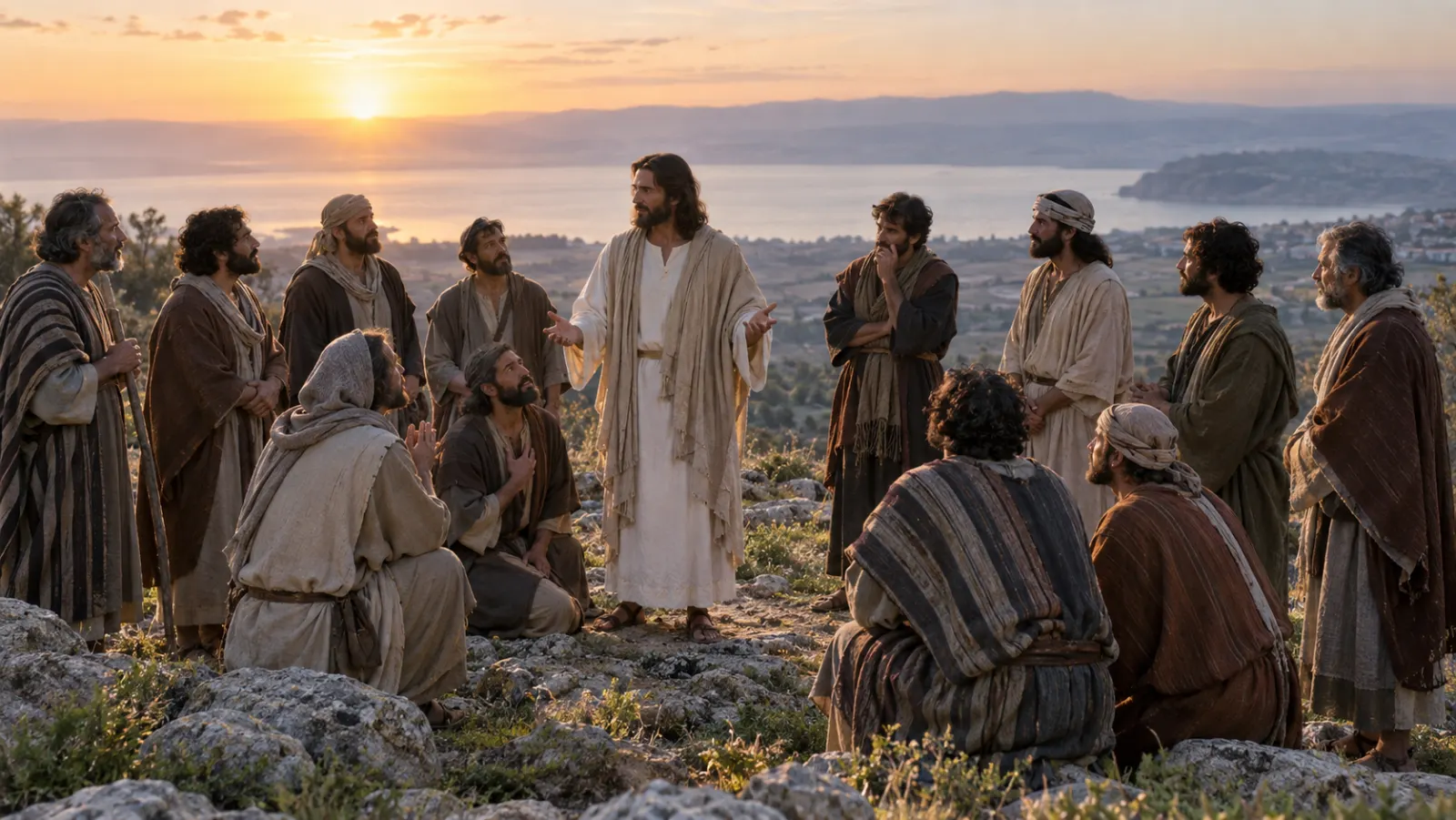
Jesus calls Himself the light of the world. His light reveals and guides; it does not authorize Christians to glare at neighbors with moral superiority.
Modern life is saturated with brightness: phone screens before dawn, stadium lights after sunset, breaking-news banners, and public opinions delivered at full intensity. Visibility has become a currency, and even Christian witness can be confused with being impossible to ignore.
The passage does not offer a slogan floating above history. It presents light of the world without blinding people within a particular conversation, with real listeners, inherited Scriptures, and consequences. Reading it well means noticing both the claim Jesus makes and the kind of community that claim is meant to form.
Light during a festival
Many readers connect Jesus’ saying with the Festival of Tabernacles and its remembrance of God’s guidance. Whether a specific lamp ceremony stands immediately behind the verse or not, John’s scriptural world makes light a sign of creation, revelation, presence, and salvation.
Spiritually, that distinction matters in the United States, where biblical phrases can be detached from their setting and recruited for causes the passage never names. Here the first task is patient attention: who speaks, who is vulnerable, what question is being answered, and how the wider Gospel shapes the meaning.
Spiritually, a mature reading therefore keeps historical study and spiritual response together. Background can prevent anachronism, while prayer keeps study from treating Jesus as an artifact. The goal is understanding that leads to worship, repentance, and a more truthful way of life.
Spiritually, for an individual reader, light of the world without blinding people raises a diagnostic question: what assumption about Jesus has become too small? The answer may involve doctrine, but it may also involve imagination—the stories we tell about success, safety, deserving people, or the limits of grace.
Guidance before exposure
Jesus promises that followers will not walk in darkness but have the light of life. The first emphasis is guidance and communion, not permission to inspect everyone else. Light shows disciples where to place their own feet.
Spiritually, the scene also resists a purely private reading. What Jesus says reaches habits of leadership, money, neighborliness, worship, and public responsibility. A confession becomes credible when a congregation allows the text to correct its instincts instead of using the text only to correct outsiders.
Spiritually, this is especially important in a polarized culture. Christians are tempted to sort every verse into a preexisting camp. Jesus repeatedly unsettles those arrangements, confronting self-protection on the right and the left while calling people into allegiance that no coalition can own.
Spiritually, in a local congregation, the passage can be read aloud before anyone rushes to defend a position. Listening for repeated words, narrative tension, and surprising actions often changes the room. It places Scripture ahead of our reactions and makes shared discernment possible.
The witness question
The following dispute concerns valid testimony and Jesus’ relationship with the Father. John does not present faith as credulity. It invites attention to words, works, character, and the narrative coherence of Jesus’ mission while acknowledging that evidence can still be resisted.
Spiritually, there is pastoral wisdom in refusing a quick application. People arrive with different histories—church joy, religious injury, intellectual questions, grief, or simple curiosity. The same truth can require comfort, warning, patience, or courage, and faithful teaching learns the difference.
Spiritually, pastoral care should follow the same movement. It names reality without cruelty, offers grace without denial, and refuses to make another person’s pain into a platform. The authority of Jesus is safest in hands that remember they remain accountable to Jesus.
Spiritually, for people carrying religious wounds, careful distinctions are not academic luxuries. They can separate the voice of Christ from a leader’s misuse of it. Healthy teaching welcomes appropriate questions, names limits, and does not demand instant trust from someone whose trust was violated.
When certainty becomes glare
Religious certainty turns into glare when it humiliates, oversimplifies suffering, or treats questions as rebellion. The man healed in John 9 grows in understanding through honest testimony, while confident leaders become less able to see. That reversal should make churches teachable.
Spiritually, john’s language often works on more than one level. A familiar image opens toward Israel’s Scriptures, Jesus’ identity, and the life of discipleship. Holding those levels together keeps interpretation from becoming either a technical exercise or a motivational caption.
Spiritually, the passage invites practices small enough for an ordinary week: an honest conversation, a changed schedule, a repaired promise, a shared meal, a decision to listen, or a refusal to pass along a convenient falsehood. Discipleship becomes visible through such choices.
Spiritually, the American setting adds its own pressure: speed, branding, consumer choice, and the expectation that every truth become content. Light of the World Without Blinding People asks for slower attention. Some words of Jesus must be inhabited before they can be summarized without distortion.
Walking in light together
Walking in light includes confession, truth-telling, and bringing hidden harm into accountable community. It cannot mean compulsory disclosure to unsafe leaders. Wise churches pair moral clarity with confidentiality, trauma awareness, due process, and protection for those reporting abuse.
Spiritually, for churches, the practical test is communal. Do policies, budgets, speech, and relationships reflect the character revealed here? The question moves beyond what Christians say they believe toward what neighbors actually experience in contact with Christian people.
Spiritually, christians do not embody this perfectly. Churches need confession, outside expertise, and sometimes structural reform. Hope rests not in an institution’s flawless record but in Christ’s ability to expose what is false and create a people who learn obedience.
Spiritually, a church may use this section as an examination of conscience. Where have convenience, fear, or reputation quietly overruled the text? Naming one concrete contradiction is more useful than producing another broad declaration that leaves existing habits untouched.
A gentler radiance
A lamp helps people see; a spotlight can make the performer the center. Christian witness is luminous when it directs attention beyond itself—through patient presence, truthful speech, beautiful work, repaired wrongs, and hope that does not need to shout.
Spiritually, none of this weakens the passage’s claim. Context gives conviction its proper contours. It helps believers speak clearly without pretending to know more than the text says, and it makes room for wonder where Jesus exceeds our categories.
Spiritually, the final posture is trust. Readers are not asked to master Jesus but to receive His testimony and follow where it leads. That trust remains intellectually serious, morally demanding, and open to the transforming work of the Spirit.
Spiritually, the passage also leaves room for joy. Jesus does not reveal Himself merely to burden conscientious people with more tasks. He gives life, companionship, forgiveness, and a future. Obedience grows best as grateful response to that prior gift.
Light of the World Without Blinding People is finally more than a subject to explain. It is an invitation to see Jesus with greater clarity and to let His identity reorder the loyalties that compete for the heart. The passage gives the church something firmer than cultural nostalgia: Christ Himself, encountered in Scripture and followed in community.
For readers considering Light of the World Without Blinding People, the most faithful response may begin quietly—with renewed attention, an honest confession, or one concrete act of love. Christian witness does not become smaller when it takes that form. It becomes recognizable as the life of the One whose words Christians are trying to understand.
Returning to John 8:12–30 after the discussion is worthwhile. Read it once for the people in the scene, once for what Jesus reveals about Himself, and once for the response the passage asks from its hearers. That unhurried practice often exposes what a familiar quotation concealed and gives the church language for faithful action.