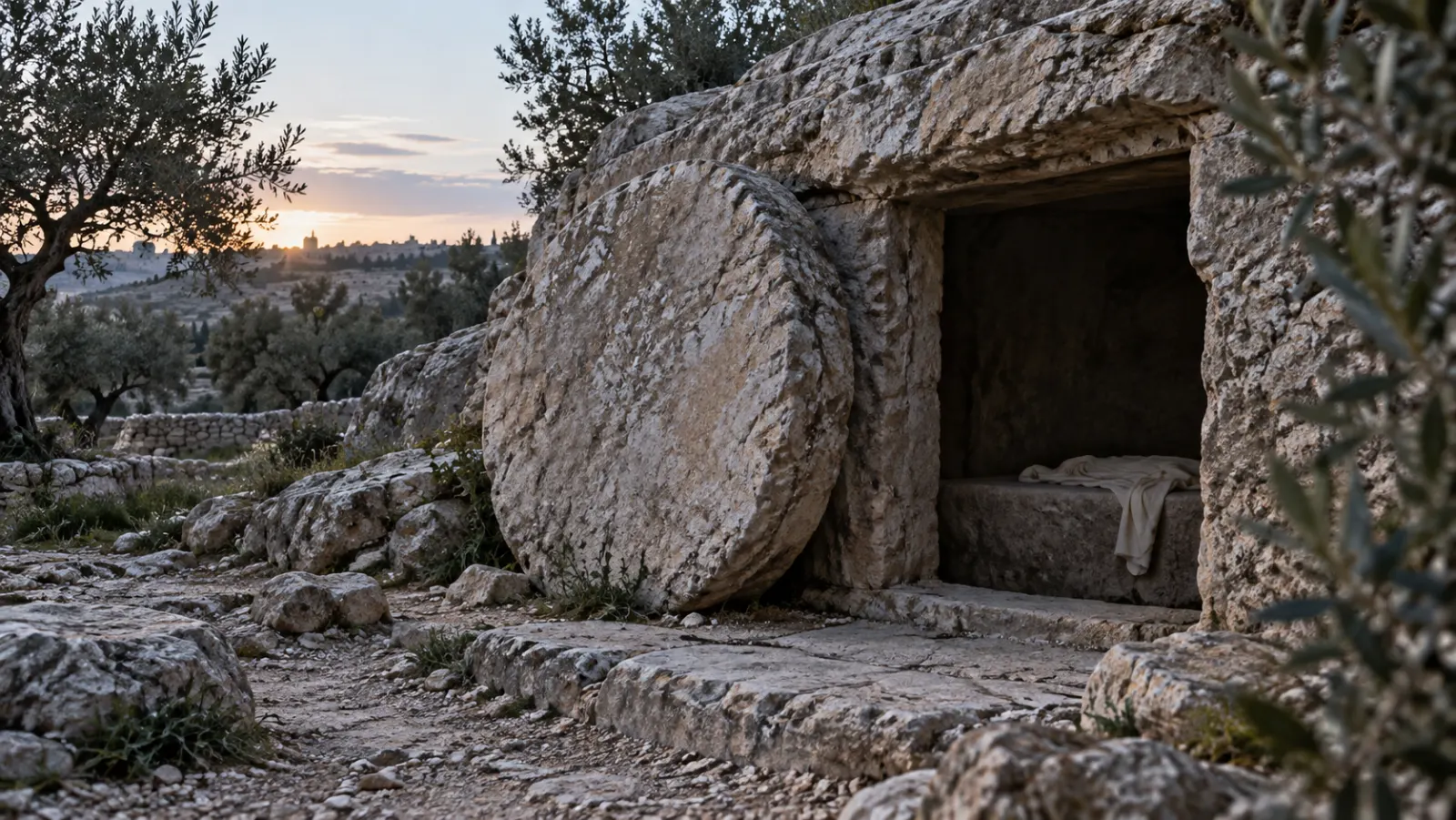
An open grave created a question. The Christian claim arose from people who said the crucified Jesus met them alive.
The stone is moved, the burial place is open, and the body is gone. For many modern readers, that sounds like the entire Easter case compressed into one startling fact. Yet the Gospels refuse to move so quickly. An empty tomb can produce bewilderment, fear, accusation, or hope. By itself, it does not tell the women what happened. Mary Magdalene’s first conclusion in John is painfully ordinary: someone has taken Jesus away.
That detail matters. The earliest Christian writers were not so gullible that any vacant grave automatically meant resurrection. Their claim was more specific and more demanding. The Jesus who had been executed and buried was raised by God and encountered followers who knew he had died. The tomb is part of that claim, but the encounters give the absence its meaning.
An absence has several possible explanations
When detectives find an empty room, they do not call the emptiness a solution. They ask who was there, what changed, and which account best fits the evidence. The Gospel narratives do something similar in story form. Matthew records a charge that the disciples stole the body. John has Mary suspect removal. Luke says the first report sounded like nonsense to the apostles. Each possibility recognizes that absence alone is ambiguous.
Christian preaching sometimes flattens this ambiguity because Easter morning feels familiar. We know the final line before the first line is read. The people in the story do not. They arrive carrying spices, grief, and obligations to the dead. Their confusion is not a failure inserted for skeptical readers; it is evidence that resurrection was not the explanation they were prepared to invent.
The claim is not merely that Jesus survived
The Gospels do not portray a badly wounded man crawling out of a cave and needing months of private recovery. They insist that Jesus truly died, was buried, and entered a transformed life no longer subject to death. He can be touched and can eat, yet he also appears in ways that surprise his friends. Continuity and transformation stand together. It is Jesus, but not a return to the old conditions.
That distinction separates resurrection from resuscitation. Jairus’s daughter and Lazarus were restored to mortal life and would eventually die. Easter announces something new: death’s rule has been broken in one human life as the beginning of what God intends for creation. A misplaced corpse could not sustain that proclamation. Neither could a survivor who later died in obscurity.
Mary needed to hear her name
In John 20, Mary looks into the tomb, sees angels, and still weeps. Even when Jesus stands near her, she mistakes him for the gardener. Recognition comes when he addresses her by name. The narrative’s center is not an archaeological vacancy but a personal encounter. The one she mourned knows her, speaks, and sends her to tell the others.
This is not an argument against evidence. It is a clue about the kind of event the witnesses believed had occurred. Resurrection is not presented as a riddle solved from clues at a distance. It is disclosure: the risen Jesus makes himself known. Christians today depend on apostolic testimony rather than repeating Mary’s sensory experience, but the testimony concerns a person, not merely a missing object.
The appearances were not all alike
Paul’s summary in 1 Corinthians 15 names Cephas, the Twelve, a large gathering, James, the apostles, and finally Paul. The Gospels add women at the tomb, frightened disciples behind doors, travelers on the Emmaus road, and fishermen beside the lake. The variety makes the tradition harder to reduce to one private vision or one emotional temperament.
It also keeps readers from treating every narrative detail like a police transcript. The evangelists select and arrange memories for theological purposes. Their sequences and settings are not identical. What they share is the conviction that the initiative belonged to Jesus. Grieving followers did not climb toward faith by positive thinking; they were interrupted by someone they believed God had raised.
The tomb anchors the claim in public history
Although it is not sufficient by itself, the tomb remains important. Bodies mattered in Jewish burial, and the identity of the dead man mattered to the Easter proclamation. If resurrection meant only that Jesus’ influence continued, the location of his remains would be irrelevant. The Gospel insistence on burial and vacancy guards against turning Easter into a metaphor for fond memories.
The tomb also places the claim near Jerusalem, where Jesus had been executed and where opponents as well as followers could contest the message. Acts does not picture the apostles retreating to a distant region to announce an unverifiable private comfort. They speak where the death was known. Christianity begins with a public claim whose first hearers could challenge its witnesses.
Encounters explain the changed announcement
Before Easter, the disciples scatter, hide, and grieve. Afterward, they announce that God raised the crucified Messiah. Fear does not disappear, and their understanding grows slowly, but the direction of their lives changes. Something requires explanation: not simply why a grave was empty, but why disappointed Jews began proclaiming a risen Messiah when crucifixion ordinarily exposed messianic pretensions as false.
Sincerity does not prove truth; people can be sincerely mistaken. Martyrdom stories should not be exaggerated into evidence we do not possess for every apostle. Still, the emergence of the proclamation belongs in any historical account. The appearances, as reported by multiple streams of early Christian tradition, explain why the empty tomb became good news rather than a cold case.
History can investigate without manufacturing faith
Historical reasoning can ask whether Jesus was crucified, whether he was buried, how early the resurrection tradition is, and what experiences the disciples reported. It can compare sources and consider rival explanations. It cannot place God in a laboratory or force a reader to confess that Jesus is Lord. A divine act is not repeatable under controlled conditions.
That limit cuts both ways. Believers should not pretend historians can deliver mathematical proof of Easter. Skeptics should not define history so that no divine action could ever be considered, then present the exclusion as a discovered result. Everyone brings judgments about reality to the evidence. Intellectual honesty means naming those judgments while giving the ancient testimony a fair hearing.
The church sometimes asks the wrong question
American Christians often look for one knockout fact that will end every argument. The empty tomb can be recruited for that purpose: establish it, and faith supposedly becomes unavoidable. But people are not debate machines. Some have moral objections to Christian behavior, painful church memories, or assumptions about miracles that a single fact will not address. Pressure can make honest inquiry feel like a sales pitch.
The Gospels offer a slower hospitality. They show witnesses misunderstanding, running, comparing reports, touching wounds, eating, and receiving instruction. A congregation can make room for that pace. It can state what Christians believe, explain why, admit where historical judgment remains contested, and trust that truth does not need manipulation.
Easter is an announcement before it is an argument
The first Christian message is news: God has acted for Jesus and, through him, for the world. Arguments serve that announcement by clearing confusion and answering objections. They cannot replace it. If Easter becomes only a case to win, the risen Christ is reduced to a conclusion and neighbors become opponents to defeat.
The announcement asks for more than agreement that a strange event happened long ago. It calls people to turn, trust, be baptized, join a reconciled community, and live under Jesus’ reign. The empty tomb opens the question. The apostolic witness identifies the answer. Discipleship explores its consequences.
The empty tomb matters because resurrection concerns Jesus’ body and God’s victory over death. Yet the Gospels wisely do not ask silence and stone to preach the whole sermon. They lead from absence to encounter, from confusion to commission, and from a burial place to a living Lord.
That fuller movement protects faith from both credulity and reduction. Christians need not call every mystery proof, and skeptics need not treat every testimony as fantasy. Easter invites a patient hearing of the witnesses’ actual claim: the one who was crucified did not merely leave a legacy. God raised him, and he made himself known.