The Christian future is not permission to abandon the earth. Resurrection and new creation give churches reasons to care for places and neighbors under pressure now.
A teenager hears that the climate future is catastrophic. At church she hears that the earth will burn and Jesus will return, so worrying about ecosystems sounds faithless. Between despair and dismissal, she is handed two ways not to act. One says human beings must save everything; the other says nothing here will matter. The New Testament offers a hope more demanding than either.
Christian expectation centers on resurrection. God does not discard Jesus' body and call the tomb victory. Romans imagines creation groaning for liberation, and Revelation pictures God's dwelling arriving among human beings. Whatever discontinuity judgment brings, the future belongs to the Creator who reconciles all things in Christ. A disposable earth sits uneasily inside that story.
Read fire with the whole canon
Second Peter's language about fire is interpreted in different ways: annihilation, purifying exposure, or radical transformation. The passage itself calls for holy conduct while believers wait for righteousness to dwell. It does not instruct them to accelerate damage. A disputed image cannot cancel the Bible's consistent naming of creation as God's possession and gift.
Anxiety deserves truth, not slogans
Climate anxiety may include grief, fear, anger, and a sense that adults failed. Young people do not need exaggerated certainty, but neither do they need pastors dismissing documented risks. Churches can pair accurate local information with practices that restore agency: preparedness, conservation, advocacy, mutual aid, prayer, and rest.
Love begins with exposed neighbors
Heat, storms, smoke, flooding, insurance loss, and energy costs do not fall equally. Older adults, low-income renters, outdoor workers, disabled people, and communities with fewer resources often face greater danger. Creation care becomes neighbor love when a church maps who needs cooling, transportation, backup power, clean air, or help after a disaster.
Resilience is not salvation
Community planning can reduce harm but cannot guarantee safety. Christians should resist turning environmental action into a new righteousness by achievement. We work because neighbors and places are worth loving, not because our project can secure the final future. Limits, lament, and collaboration are part of faithful action.
Beauty trains expectation
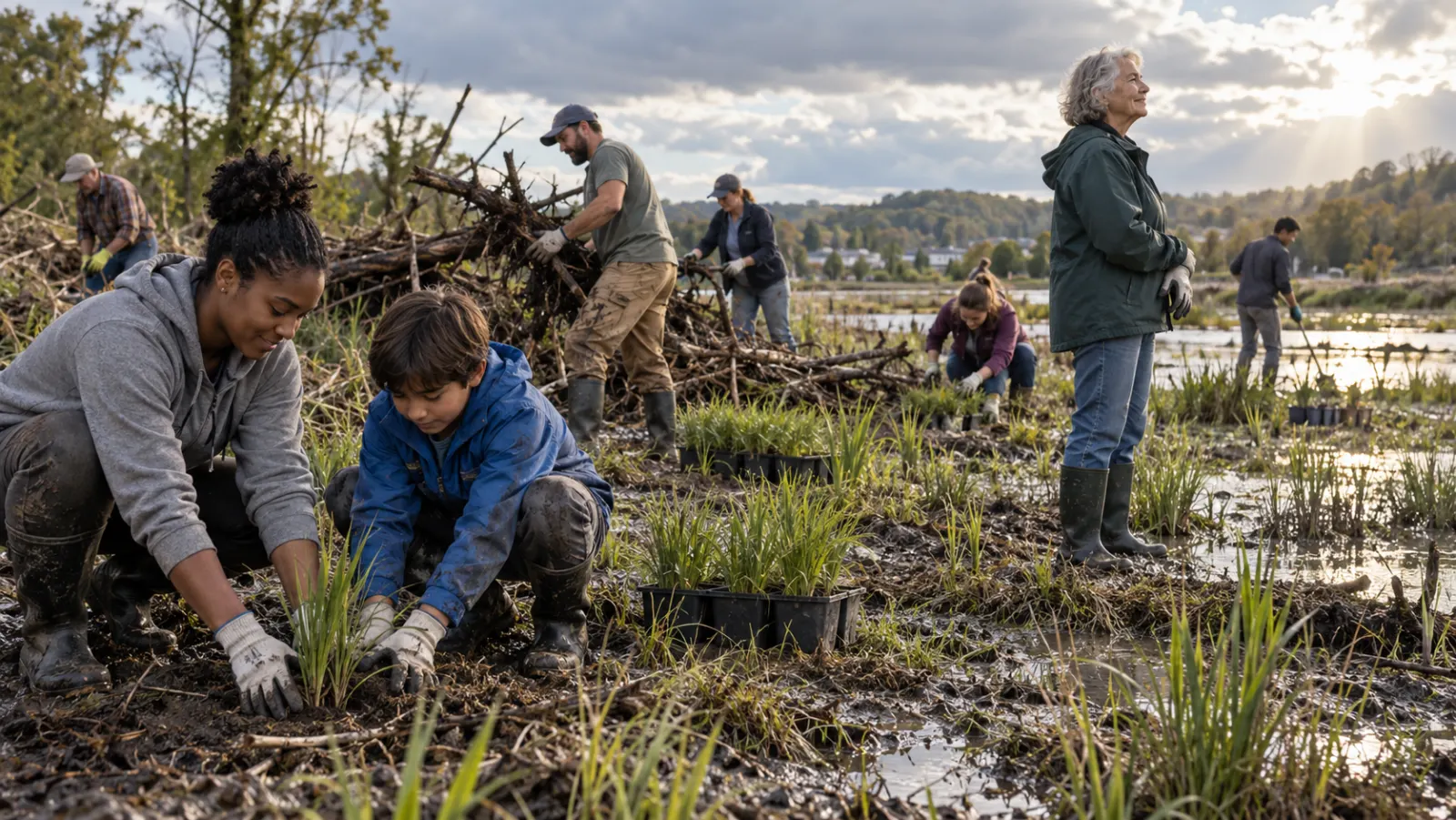
A restored wetland, shaded schoolyard, community garden, or cleaner stream is not the kingdom in full. It can be a sign that repair is imaginable. Churches that only speak of catastrophe may forget the biblical future is desirable. Protecting beauty helps people practice gratitude for a creation promised liberation rather than abandonment.
Hope keeps long commitments
End-times urgency can favor dramatic projects. Ecological repair often takes years of maintenance, permits, data, and partnership. A congregation can choose one local place, follow expert guidance, budget beyond a photo day, and report outcomes. Waiting for Christ includes keeping promises after enthusiasm fades.
Questions to carry into community
A useful conversation about “A Future Worth Caring For Now” can begin here: Have we used Christ's return to excuse environmental neglect? Ask for concrete examples, distinguish what Romans 8:18–25 actually says from a reasonable inference, and name the information still missing. People who will live with the decision should speak before leaders close the question. Then choose one bounded action, assign responsibility, and set a review date. Faithfulness is not proved by solving everything in an evening; it appears when truth, care, and accountability stay together.
The question has to leave the study room: Which local neighbors face the greatest climate risk? In American congregations, the same policy lands differently depending on income, race, gender, disability, work schedule, family status, and institutional power. Hearing those differences does not weaken biblical authority. It helps a church avoid mistaking the habits of decision-makers for the center of the gospel. Before announcing a rule, test it against actual cases, seek relevant expertise, and explain how someone can appeal without losing belonging.
To keep creation care from becoming a slogan, ask again: What action restores agency without promising control? A Christian answer needs more than sincere intent. It needs boundaries, resources, consent, and visible ownership. It should also state what the congregation cannot provide and which qualified partner it will involve. Prayer and study belong in the process, but neither replaces checking facts or protecting the person who would bear the cost of a preventable mistake.
A useful conversation about “A Future Worth Caring For Now” can begin here: How does resurrection shape our view of material creation? Ask for concrete examples, distinguish what Romans 8:18–25 actually says from a reasonable inference, and name the information still missing. People who will live with the decision should speak before leaders close the question. Then choose one bounded action, assign responsibility, and set a review date. Faithfulness is not proved by solving everything in an evening; it appears when truth, care, and accountability stay together.
The question has to leave the study room: What long commitment can our church sustain after the photo day? In American congregations, the same policy lands differently depending on income, race, gender, disability, work schedule, family status, and institutional power. Hearing those differences does not weaken biblical authority. It helps a church avoid mistaking the habits of decision-makers for the center of the gospel. Before announcing a rule, test it against actual cases, seek relevant expertise, and explain how someone can appeal without losing belonging.
One final check
Before closing “A Future Worth Caring For Now,” return to Romans 8:18–25 and summarize three things separately: what the text states, what interpretation the community holds, and what application it proposes for this moment. That distinction allows a practice to be corrected without treating every correction as abandonment of faith. A reader from another generation, a person affected, and someone with relevant expertise can test the conclusion. If there is no way to receive new evidence or acknowledge unintended harm, discernment is not finished.
In a later review of “A Future Worth Caring For Now,” leaders can record what happened after asking: Have we used Christ's return to excuse environmental neglect? An impression from one service or the view of those who designed the response is not enough. Hear voluntary testimony, notice unexpected costs, and identify who remained outside. If the practice did not produce truth, justice, care, and communion, changing it does not betray biblical conviction; it may be a humble way to obey more faithfully. Review step 1 should end with a decision people can understand and see communicated.
In a later review of “A Future Worth Caring For Now,” leaders can record what happened after asking: Which local neighbors face the greatest climate risk? An impression from one service or the view of those who designed the response is not enough. Hear voluntary testimony, notice unexpected costs, and identify who remained outside. If the practice did not produce truth, justice, care, and communion, changing it does not betray biblical conviction; it may be a humble way to obey more faithfully. Review step 2 should end with a decision people can understand and see communicated.
In a later review of “A Future Worth Caring For Now,” leaders can record what happened after asking: What action restores agency without promising control? An impression from one service or the view of those who designed the response is not enough. Hear voluntary testimony, notice unexpected costs, and identify who remained outside. If the practice did not produce truth, justice, care, and communion, changing it does not betray biblical conviction; it may be a humble way to obey more faithfully. Review step 3 should end with a decision people can understand and see communicated.
Christians do not care for creation because they believe history can be perfected by technique. They care because the earth belongs to the Lord and neighbors live here now.
The promise of Christ's return loosens both panic and apathy. The future is God's gift; our task is faithful, informed love of the portion of creation placed within reach.