
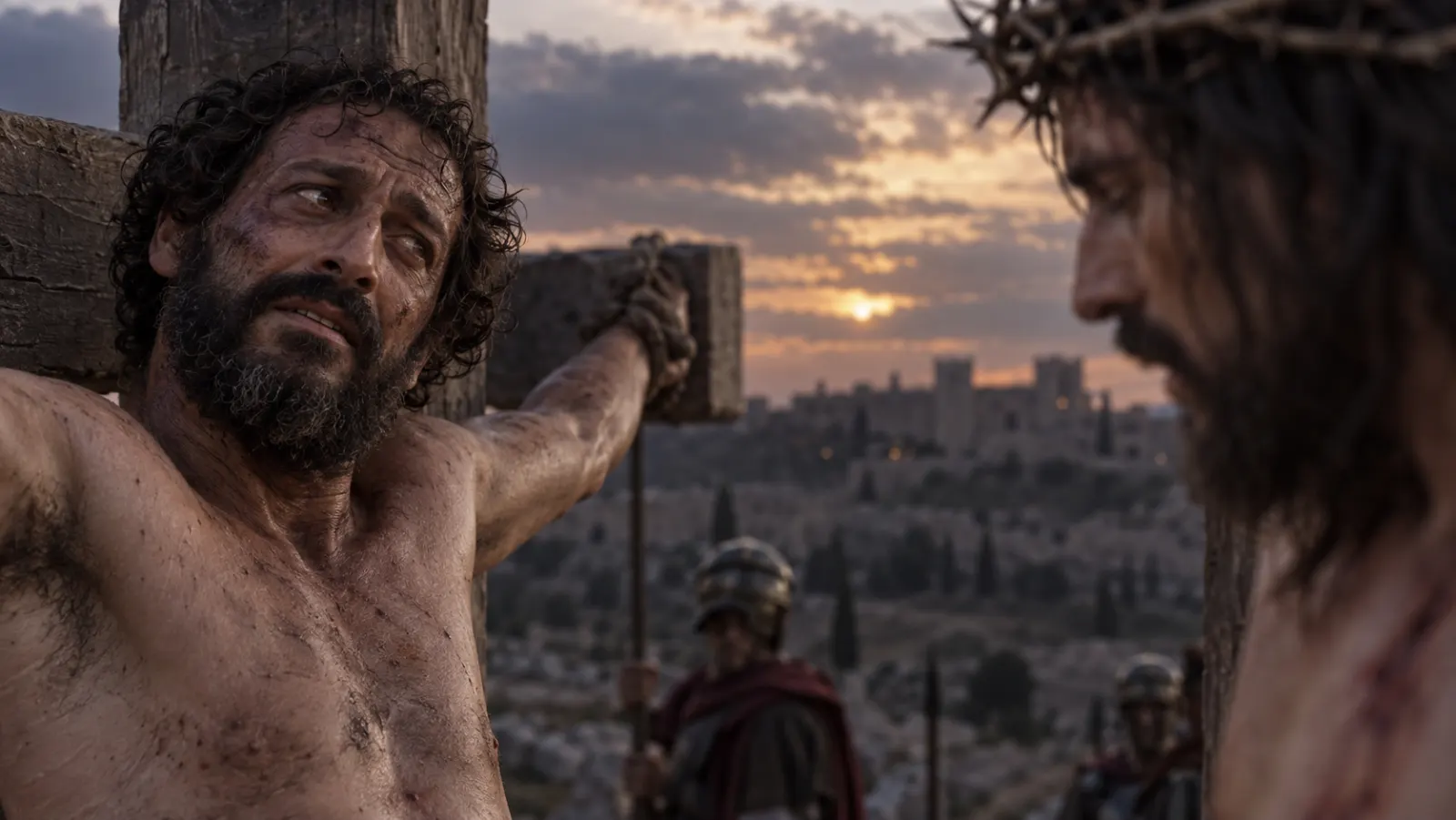
To a dying man without time to rebuild his life, Jesus promises more than survival. He promises presence: with me, today.
There is almost no future tense left in Luke 23. The three crucified men will not climb down, return home, or repair what has been broken. One joins the chorus of mockery. The other sees something that the officials and soldiers refuse to see: Jesus is innocent, his kingdom is real, and death has not canceled his authority. He asks to be remembered.
Jesus answers with a promise built from three small words: today, with me, paradise. Each word matters. Hope is not postponed to a vague religious horizon. Salvation is not an impersonal change of location. And paradise is not a reward the man can earn during the few breaths he has left. The center of the promise is the company of Jesus.
Luke’s ‘today’ is a theological clock
Throughout Luke, today marks the arrival of God’s saving action. At Jesus’ birth, a Savior is born today. In Nazareth, Scripture is fulfilled today. At Zacchaeus’s house, salvation comes today. The word is not an argument that every question about the intermediate state has been solved. It announces that grace is present and decisive. The condemned man does not receive a waiting-list number; Jesus claims his future while Rome is ending his life.
The man does not defend himself
He acknowledges that his sentence is connected to what he has done, though Luke does not identify the offense or invite readers to invent a criminal biography. His confession is remarkably spare. He tells the other man that Jesus has done nothing wrong, then turns toward Jesus’ coming reign. Repentance here is not self-loathing performed for an audience. It is the end of self-justification and the beginning of truthful appeal.
‘Remember me’ is a kingdom-sized request
In Scripture, divine remembering is more than recalling information. When God remembers, God acts in covenant mercy. The man asks Jesus to take account of him when the kingdom arrives. Perhaps he expects a distant future; Jesus answers with today. The request contains no bargaining chip. It depends entirely on who Jesus is and whether his reign can reach a person whom society has reduced to a dying body.
‘With me’ is the heart of Christian hope
Popular pictures of heaven often begin with scenery, reunions, or relief from pain. Those hopes can carry real comfort. Jesus begins with relationship. Paradise is desirable because he is there. Christian salvation is not simply relocation from a bad destination to a good one; it is communion with the crucified and risen Lord. The man who has been publicly abandoned will not enter the future alone.
Paradise reaches back to a lost garden
The Greek word translated paradise could evoke a garden or royal park and, within biblical imagination, the garden where life with God was fractured. Jesus’ promise gathers that story without supplying travel details. Humanity’s exile is being answered through the obedient Son. The cross looks like a gate closing, yet Jesus speaks as the one opening fellowship with God. The image is restoration, not an invitation to satisfy every curiosity about geography beyond death.
The promise is personal without being private
Jesus addresses one man, but Luke has spent a Gospel showing salvation creating a people: the poor welcomed, sinners eating at a table, outsiders brought near. The promise does not make community unnecessary. It shows that no institution controls access to Christ at the final edge of life. The church bears witness to the promise; it does not own the keys as private property.
Grace arrives without denying consequence
The man is not spared crucifixion. Forgiveness does not reverse every earthly outcome or remove all damage caused by a life. This distinction matters in American churches where conversion stories can overshadow victims or imply that a dramatic testimony settles restitution. Jesus can receive the offender fully while communities still name harm, support those affected, and honor lawful responsibility.
The scene resists spiritual résumé culture
Americans learn to narrate worth through accomplishment: education, career, service hours, parenting, ministry. The man beside Jesus has no remaining opportunity to assemble a record. His empty hands expose the illusion that anyone brings a spiritual portfolio impressive enough to purchase communion with God. Mature discipleship bears fruit, but fruit is evidence of life received, not the admission price for grace.
The punctuation debate should stay modest
Because ancient Greek manuscripts did not use punctuation as modern English does, some groups place the comma after today: Jesus is saying today that the man will eventually be with him. The natural grammar and Luke’s recurring use of today strongly favor the traditional reading, where the promised fellowship begins today. Still, the verse should not be forced to answer every chronological question. Its unmistakable claim is that death cannot sever the man from Jesus’ saving presence.
Hope at the bedside can use ordinary words
People near death do not always need a lecture about timelines. The rhythm of Jesus’ sentence offers pastoral wisdom: this day belongs to God; you will not be abandoned; Christ receives those who call on him. Families may pray, read a short psalm, ask forgiveness, express love, and sit quietly. Presence often communicates the promise better than nervous explanation.
The dying are persons, not illustrations
A hospice patient, incarcerated person, or neighbor with a terminal diagnosis should never become material for an inspirational anecdote without consent. Jesus speaks to the condemned man, not about him to enhance a platform. Christian ministry preserves dignity by listening, using the person’s name, respecting medical care, and allowing fear or unfinished questions. Paradise is not a reason to become casual about another person’s death.
The promise also addresses the living
Most readers still have time the criminal did not. His story should not encourage delay, as though repentance were a loophole best used in the final minute. It dismantles despair: no one is saved by accumulated merit, and no honest appeal falls outside Christ’s authority. Today is therefore both comfort and summons. The King who receives a dying man calls living people to enter his merciful reign now.
The promise is spoken from one cross to another
Jesus does not make the promise from a throne untouched by suffering. His own breathing is labored; his public shame is still underway. The authority in his words is therefore startling. He offers fellowship while appearing to have lost every earthly resource. Luke wants the reader to see kingship precisely there: Jesus rules through faithful mercy, not the ability to escape pain. The condemned man recognizes a kingdom where the visible evidence seems to say there is none.
Christian hope need not despise the present world
Paradise language can be misused to make present suffering unimportant. Jesus never treats bodies or earthly justice as disposable. He heals, feeds, restores, and will be raised bodily. The promise beyond death gives courage to care more deeply for life before death, not less. Hospice, pain relief, advocacy, and loving presence are not signs that eternal hope is weak. They honor the person who will be with Christ by honoring the person who is here now.
Remembering becomes a practice for the church
The man asks Jesus to remember him. Congregations can echo that mercy by remembering people whom public life forgets: the incarcerated, the unnamed dead, isolated elders, and families whose grief no longer receives attention. Remembrance is more than a memorial post. It keeps visiting, says the name, tends a grave, writes a prisoner, and calls after the anniversary. Those acts do not create paradise, but they bear witness to the Lord whose kingdom refuses erasure.
At funerals, promise without presumption
Christian funerals announce resurrection and commend the dead to God. They need not invent virtues, claim private knowledge, or describe paradise with details Scripture does not give. Honest remembrance can include a complicated life and confident proclamation can rest on Christ rather than sentiment. The promise to the condemned man teaches ministers to speak hope boldly and biography carefully. Mercy does not require a false eulogy.
The scene offers no romantic portrait of execution. It gives us a condemned man, an innocent Messiah, and a sentence stronger than the state’s sentence. Rome can determine the hour of death; it cannot determine whether Jesus will remember, receive, and accompany.
Today. With me. Paradise. Christian hope need not pretend to know more than Jesus says. It can rest in what he makes clear: the person who turns toward him is not met by an application process but by the crucified Lord’s own presence.


