
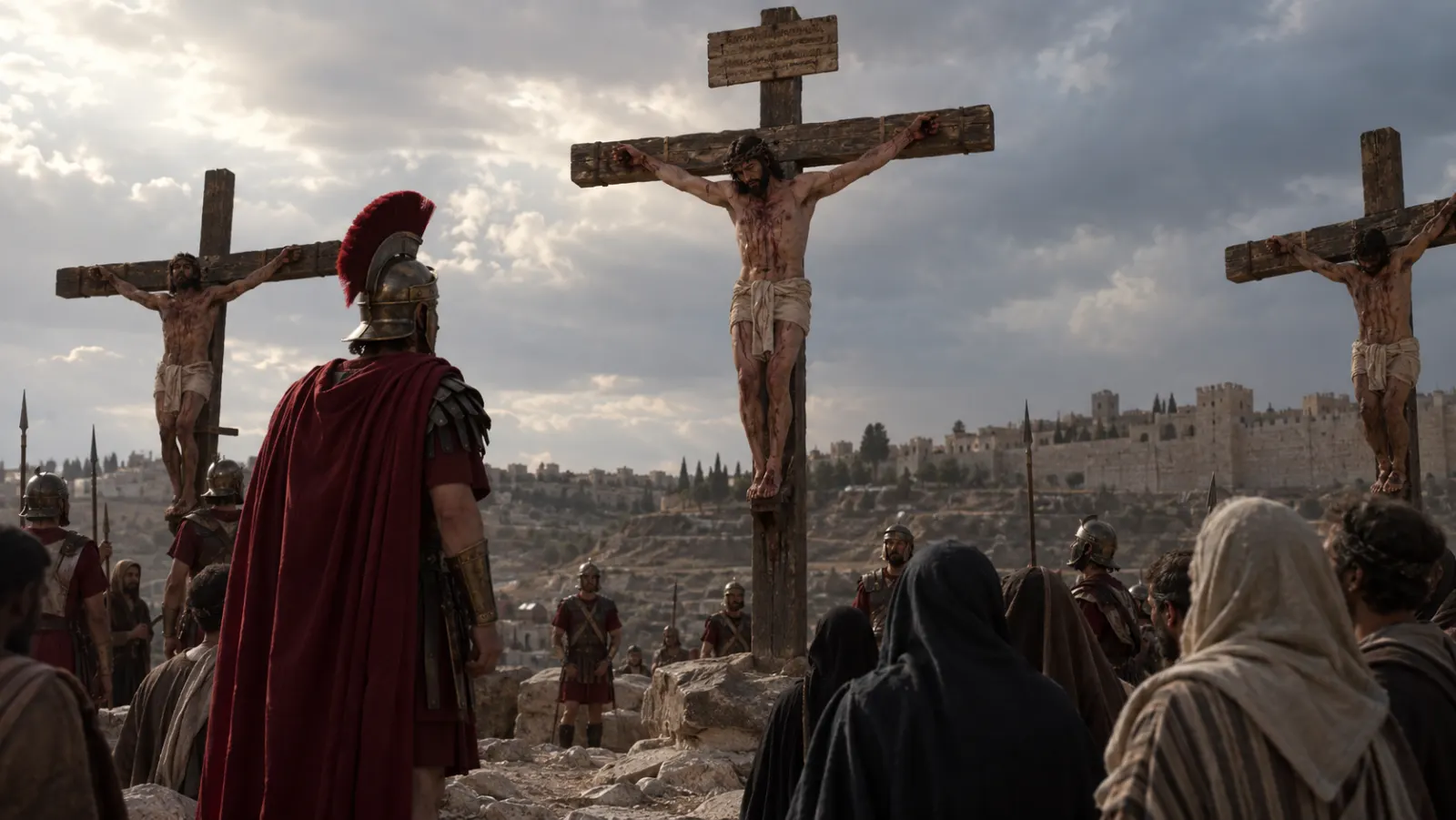
The soldiers break the legs of the two men crucified beside Jesus but not Jesus’ legs because he is already dead. The scene is historically intelligible, though popular medical explanations often sound more certain than the evidence allows.
John’s Gospel includes a detail that many readers hurry past. Because a festival Sabbath is approaching, authorities ask Pilate that the legs of the crucified men be broken and the bodies removed. Soldiers break the legs of the two men beside Jesus. When they reach Jesus, they judge that he is already dead and do not break his legs. One soldier then pierces his side.
The scene raises several questions. Why would breaking legs matter? Was this a normal Roman practice? Does John include the detail mainly for medical realism, for fulfillment of Scripture, or both? The best answer is layered. The action is historically intelligible as a way to hasten or confirm death, but the precise physiology of crucifixion is more complex than many popular explanations suggest.
The immediate issue is the approaching Sabbath
John explicitly connects the request to the Jewish concern that bodies not remain on the crosses during the Sabbath, especially a significant festival Sabbath. Deuteronomy’s command about not leaving an executed body exposed overnight forms part of the Jewish legal background. The request therefore arises from a clash of calendars and authorities: Rome controls execution, while local leaders are concerned about burial before sundown.
This does not mean Roman policy automatically required prompt burial. It means Pilate could be petitioned. The Gospel depicts a specific accommodation within occupied Judea. The bodies have to come down, but the men must first be dead. That practical problem explains why a method of hastening death enters the story at this point.
Breaking the legs could prevent the victim from continuing to support the body
The Latin term crurifragium is often used in modern discussions for breaking the legs. Ancient punishments did include severe leg-breaking, and in a crucifixion context it could make continued survival less likely. If a victim was using the legs to shift position or relieve pressure, fractures would remove that capacity and add major trauma.
Popular sermons sometimes reduce the mechanism to a single medical formula: the victim had to push up to breathe, so broken legs caused immediate suffocation. Crucifixion physiology was probably more variable than that. Position, prior injuries, blood loss, dehydration, shock, and restraint method all affected death. We can say leg-breaking would hasten death without claiming a stopwatch-like respiratory mechanism for every victim.
John emphasizes that Jesus was already dead
The soldiers do not spare Jesus because they are compassionate. They refrain from breaking his legs because they see he has already died. The subsequent spear thrust functions in the narrative as further confirmation. John then adds unusually strong eyewitness language about the observation, underscoring that the death is real rather than apparent.
That emphasis later became important in Christian debates because claims that Jesus merely fainted or survived crucifixion conflict with the Gospel presentation. Historically, Roman executioners had practical reasons to make sure a condemned person was dead before a body was released. John’s scene fits that responsibility even though the precise medical interpretation of the spear wound remains debated.
The unbroken bones also carry Passover meaning
John immediately connects the unbroken bones with Scripture. Readers have proposed several texts, including Psalm 34 and Passover instructions that the lamb’s bones were not to be broken. The Passover resonance is especially important in John, whose Passion chronology and imagery repeatedly invite readers to see Jesus in relation to festival themes.
This is a good example of how a Gospel can narrate an event at two levels. The soldiers have a practical reason for what they do and do not do. John sees theological significance in the result. Saying the detail fulfills Scripture does not require imagining soldiers consciously acting out a prophecy. In the narrative, ordinary execution procedure becomes part of a larger biblical pattern the soldiers themselves do not perceive.
The two men beside Jesus remind us that crucifixion was not unique to him
Christian art naturally centers Jesus, but John’s leg-breaking scene forces the other condemned men back into view. Rome is carrying out multiple executions. Their bodies are subjected to the same administrative problem—death must be completed before removal. The scene is brutal because it is procedural. These men are cases to be finished before the deadline.
That context matters historically. Jesus’ crucifixion took place within a wider Roman practice that affected many people whose names are lost. Christianity makes unique claims about the meaning of Jesus’ death, but the method itself was part of the empire’s ordinary repertoire of punishment. The soldiers’ movement from one cross to the next makes that institutional reality visible.
Historical caution strengthens rather than weakens the passage
Medical reconstructions of crucifixion can be useful, but they often become more confident than the ancient evidence permits. Different scholars have proposed asphyxiation, shock, cardiac complications, blood loss, exhaustion, or combinations. The Gospel does not diagnose a cause of death. It reports that soldiers found Jesus dead, did not break his legs, and pierced his side.
Readers do not need to choose one modern pathology in order to understand the historical point. Leg-breaking would add catastrophic trauma and make survival impossible or very brief. Jesus did not require it because the executioners judged the sentence already complete. John then interprets that fact through Scripture. History and theology meet without either needing a speculative medical certainty.
The broken-leg detail is not random cruelty inserted for drama. It arises from the approaching Sabbath, the need to remove the bodies, and the soldiers’ responsibility to complete the executions. Within that setting, John makes the absence of broken bones theologically meaningful.
Responsible reading therefore avoids two extremes. It should not dismiss the scene as pure symbolism detached from Roman practice, and it should not turn a few verses into a modern forensic report that answers every physiological question.
John’s claim is simpler and more focused: Jesus truly died; the soldiers recognized it; his bones were not broken; and the evangelist sees Scripture converging on that outcome. The physical detail serves the historical narrative while opening a biblical-theological horizon beyond it.
A final historical caution is useful here. Ancient execution evidence is uneven, and the Gospel writers are selective narrators rather than modern forensic reporters. Their silence about a mechanical detail does not mean the detail could not have occurred, while a later artistic convention should not be promoted into an explicit biblical statement. The strongest reconstruction keeps those categories separate: what the text directly says, what Roman evidence makes probable, what archaeology merely makes possible, and what later Christian tradition chose to visualize. That discipline may feel less dramatic than a completely reconstructed scene, but it gives readers a firmer basis for understanding the crucifixion in its first-century setting.
Historical humility does not make the event vague. It clarifies where confidence belongs. Jesus was crucified under Roman authority in Jerusalem, the punishment was public and degrading, and the Gospel writers interpret the event through Israel’s Scriptures. The remaining questions should be ranked by evidence rather than filled with certainty simply because a familiar painting has supplied an answer for centuries.
That evidence ladder also helps readers avoid a false choice between faith and historical care. A Christian can affirm the theological meaning of the crucifixion while still asking ordinary historical questions about Roman punishment, Jerusalem topography, burial custom, material remains, and the evangelists’ literary choices. Where evidence is strong, the article should say so plainly. Where reconstruction is probable, it should be labeled as probability. Where later art or devotion fills a gap, that contribution can be appreciated without being mistaken for an eyewitness detail. This approach does not drain the Passion of meaning; it keeps interpretation accountable to the sources that actually survive.


