
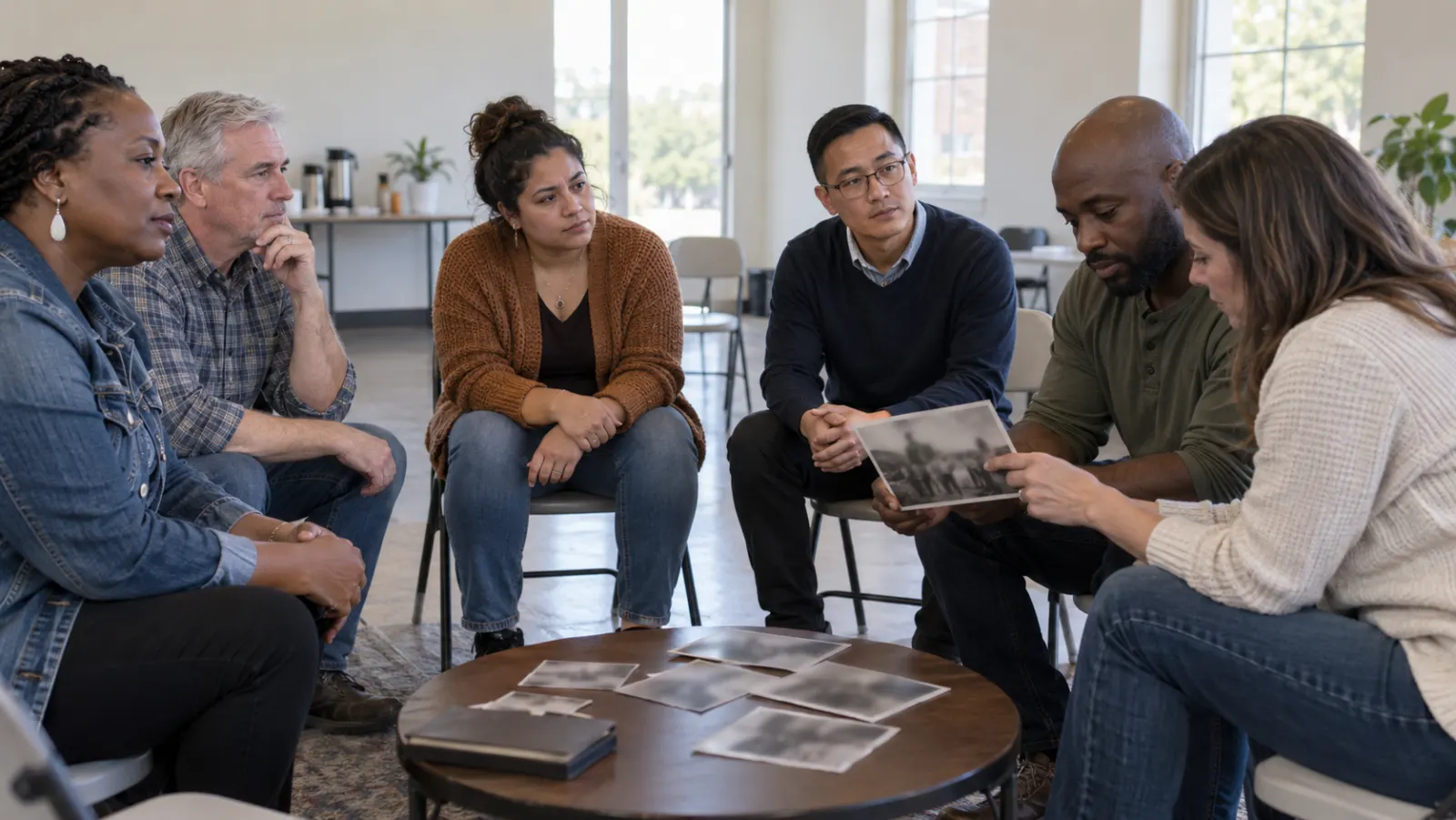
Paul's vision of reconciled peoples speaks powerfully to American racial division, but it should not be used to erase Black history, Jewish identity, or unequal power.
Few Pauline phrases sound more suited to an American reconciliation service than one new humanity. The words can carry genuine hope across segregated pews. They can also be asked to do dishonest work: declare race irrelevant, hurry past repair, or make wounded people appear divisive for remembering. Paul announces peace, but not through amnesia. Ephesians names an old hostility, a privileged nearness, an excluded people, and a costly act of reconciliation in Christ.
The first caution is historical. Jew and Gentile in Paul's world are not interchangeable with Black and white in the United States. Ancient covenant identity, circumcision, food, empire, and worship have their own texture. American racial categories emerged through different histories of conquest, slavery, law, migration, and resistance. Application becomes more truthful when analogy remains analogy rather than claiming the situations are the same.
Paul does not erase Israel
Romans 9–11 resists the idea that Gentile inclusion means Jewish rejection. Gentile believers are warned against arrogance and reminded that they do not support the root. Any Christian use of Paul that produces contempt for Jews contradicts his grief, gratitude, and argument. The church must confront antisemitism even while working on other racial wounds.
Unity has a cross-shaped cost
In Ephesians, peace is not a friendly feeling achieved by avoiding hard topics. Christ creates it through his death and forms a shared dwelling. Applied today, reconciliation cannot mean that people harmed by institutions must absorb all the discomfort while powerful people keep control. Peace tells the truth, changes relationships, and redistributes access to the common life.
Colorblindness can hide what remains
Saying God sees no race may intend equality, but communities still inherit unequal housing, education, wealth, policing, health, and church networks. A theology that refuses to observe those effects cannot love neighbors concretely. Galatians 3 denies hierarchy in belonging to Christ; it does not make biographies disappear. Baptism joins embodied people, not abstract souls.
Tables reveal the argument
Paul confronts Peter at Antioch because withdrawal from Gentile tables contradicts the gospel's truth. Shared meals are never merely symbolic when social pressure decides who can eat with whom. American churches can ask whose food is treated as normal, whose home is visited, who sets the agenda, and whether fellowship survives after a racial crisis leaves the headlines.
Repair needs local history
National language becomes concrete in deeds, school boundaries, property decisions, hiring patterns, and denominational records. Congregations can study their own archives and neighborhood, compensate teachers, build long-term partnerships, and publish changes. The purpose is not inherited personal guilt for everything; it is responsible stewardship of what this community has received and can change.
Difference can become gift
Paul's churches do not reach maturity by making Gentiles culturally Jewish or asking Jews to cease being Jews. The gospel creates communion across difference under one Lord. Multiracial ministry therefore needs more than varied faces on a stage. It needs shared authority, patient translation, conflict skills, and room for traditions that the dominant group did not invent.
Questions to carry into community
A useful conversation about “Paul, Race, and One New Humanity” can begin here: Where have we treated ancient Jew-Gentile relations as identical to American race? Ask for concrete examples, distinguish what Ephesians 2:11–22 actually says from a reasonable inference, and name the information still missing. People who will live with the decision should speak before leaders close the question. Then choose one bounded action, assign responsibility, and set a review date. Faithfulness is not proved by solving everything in an evening; it appears when truth, care, and accountability stay together.
The question has to leave the study room: Does our language of unity make room for history and repair? In American congregations, the same policy lands differently depending on income, race, gender, disability, work schedule, family status, and institutional power. Hearing those differences does not weaken biblical authority. It helps a church avoid mistaking the habits of decision-makers for the center of the gospel. Before announcing a rule, test it against actual cases, seek relevant expertise, and explain how someone can appeal without losing belonging.
To keep racial reconciliation from becoming a slogan, ask again: Who sets the terms at our shared tables? A Christian answer needs more than sincere intent. It needs boundaries, resources, consent, and visible ownership. It should also state what the congregation cannot provide and which qualified partner it will involve. Prayer and study belong in the process, but neither replaces checking facts or protecting the person who would bear the cost of a preventable mistake.
A useful conversation about “Paul, Race, and One New Humanity” can begin here: What local record should our congregation study? Ask for concrete examples, distinguish what Ephesians 2:11–22 actually says from a reasonable inference, and name the information still missing. People who will live with the decision should speak before leaders close the question. Then choose one bounded action, assign responsibility, and set a review date. Faithfulness is not proved by solving everything in an evening; it appears when truth, care, and accountability stay together.
The question has to leave the study room: How are authority and resources shared across cultural difference? In American congregations, the same policy lands differently depending on income, race, gender, disability, work schedule, family status, and institutional power. Hearing those differences does not weaken biblical authority. It helps a church avoid mistaking the habits of decision-makers for the center of the gospel. Before announcing a rule, test it against actual cases, seek relevant expertise, and explain how someone can appeal without losing belonging.
One final check
Before closing “Paul, Race, and One New Humanity,” return to Ephesians 2:11–22 and summarize three things separately: what the text states, what interpretation the community holds, and what application it proposes for this moment. That distinction allows a practice to be corrected without treating every correction as abandonment of faith. A reader from another generation, a person affected, and someone with relevant expertise can test the conclusion. If there is no way to receive new evidence or acknowledge unintended harm, discernment is not finished.
In a later review of “Paul, Race, and One New Humanity,” leaders can record what happened after asking: Where have we treated ancient Jew-Gentile relations as identical to American race? An impression from one service or the view of those who designed the response is not enough. Hear voluntary testimony, notice unexpected costs, and identify who remained outside. If the practice did not produce truth, justice, care, and communion, changing it does not betray biblical conviction; it may be a humble way to obey more faithfully. Review step 1 should end with a decision people can understand and see communicated.
In a later review of “Paul, Race, and One New Humanity,” leaders can record what happened after asking: Does our language of unity make room for history and repair? An impression from one service or the view of those who designed the response is not enough. Hear voluntary testimony, notice unexpected costs, and identify who remained outside. If the practice did not produce truth, justice, care, and communion, changing it does not betray biblical conviction; it may be a humble way to obey more faithfully. Review step 2 should end with a decision people can understand and see communicated.
One new humanity is not a slogan for skipping history. It is God's promise that hostility need not have the final word and that no ethnic group can claim Christ as private property.
The American church honors that promise when it rejects antisemitism, studies its racial inheritance, shares power, repairs what it can, and keeps returning to the difficult, ordinary table where peace becomes visible.


