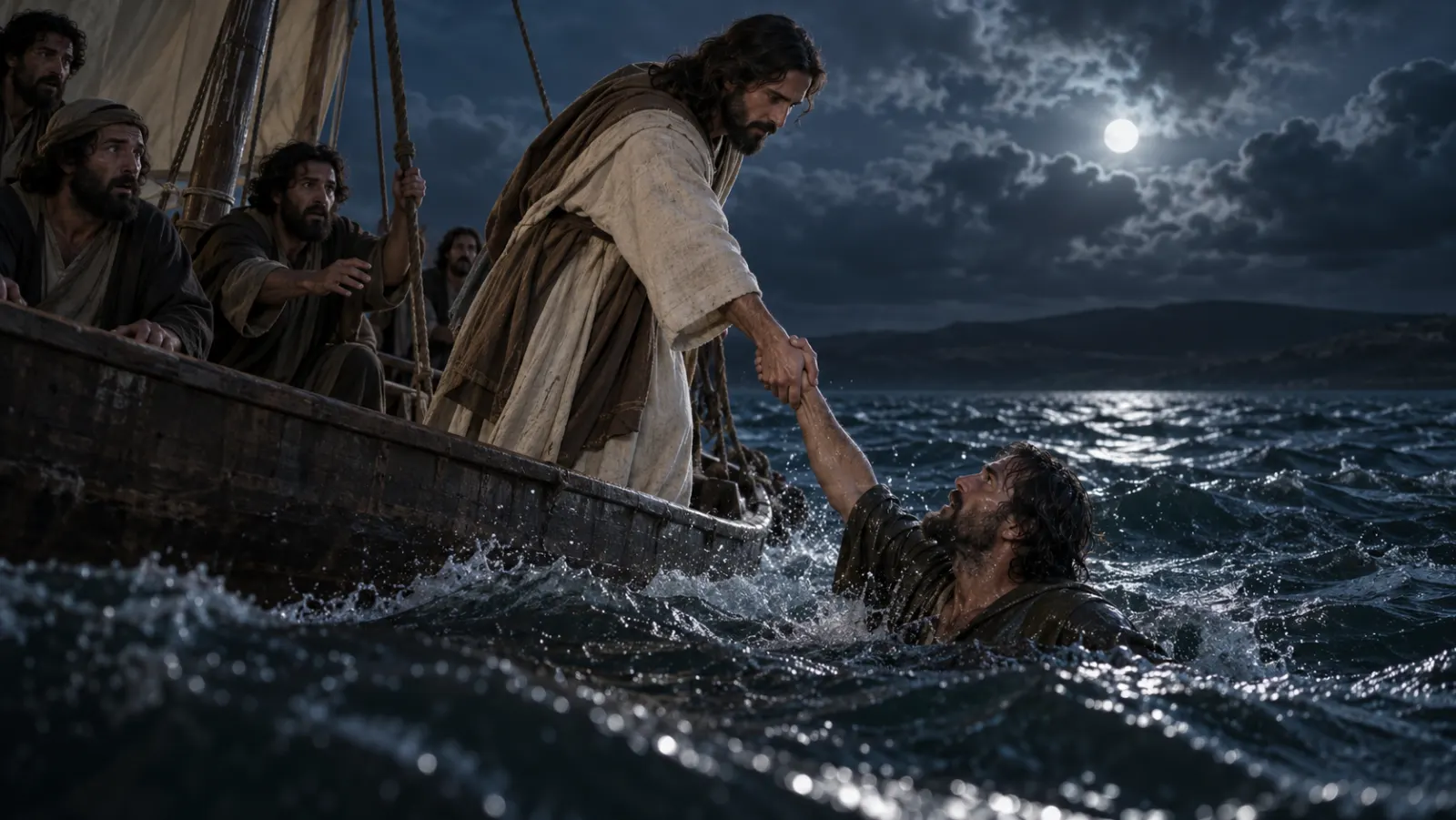
Peter steps onto the sea because he responds to Jesus, not because danger itself is holy. The story distinguishes obedient risk from spiritualized thrill seeking.
“Get out of the boat” is irresistible conference language. It can launch a business, justify a move, encourage a donation, or turn an untested impulse into a divine assignment. Peter becomes the patron saint of bold people who prefer action to caution. If the plan fails, the explanation arrives quickly: he looked at the waves, doubted, and lost the faith required to stay above them.
Matthew’s story is more demanding and less useful to motivational branding. Peter does not volunteer for danger to prove his potential. The disciples are already in trouble, Jesus comes across the sea, they fear he is a ghost, and Peter makes a conditional request: if it is you, command me to come. The decisive fact is not Peter’s appetite for risk. It is the identity and word of Jesus.
The disciples are in the boat because Jesus sent them
Jesus makes the disciples cross ahead while he dismisses the crowd and goes up the mountain to pray. The wind opposes them through the night. Their hardship is not evidence that they disobeyed. They are precisely where Jesus directed them to be, laboring against conditions they did not choose.
That matters for believers taught that difficulty proves a wrong decision or insufficient favor. Obedience can lead into resistance without becoming a mistake. The presence of waves does not settle the question of vocation. Sometimes faithfulness looks less like dramatic success and more like continuing to row in the dark.
Walking on the sea identifies Jesus before it inspires Peter
In Israel’s Scriptures, mastery over chaotic waters belongs to God. Jesus’ approach therefore makes a claim larger than supernatural balance. His words—often translated “It is I”—can also echo the divine language of “I am.” The scene asks readers to recognize the one who comes, not merely admire the unusual surface under his feet.
Popular retellings can shift the center of gravity until Peter becomes the hero and Jesus the coach unlocking human potential. Matthew does the opposite. Peter’s brief walk depends entirely on Jesus’ command, his rescue depends entirely on Jesus’ hand, and the scene ends with the disciples worshiping Jesus as God’s Son.
Peter asks for a command, not permission to improvise
The difference is easy to overlook. Peter does not say, “Watch what courageous faith can do.” He asks Jesus to command him. Only after Jesus says “Come” does he leave the boat. Biblical faith is responsive before it is adventurous. It does not manufacture danger and demand that God endorse it.
That distinction protects people from religious pressure. A leader cannot label a risky financial scheme, unsafe mission trip, abrupt medical decision, or impulsive career change an act of faith merely because caution sounds less exciting. The question is not whether a choice feels bold. It is whether it is faithful to Jesus’ character, teaching, wisdom, and actual call.
Fear is not the only thing Peter gets wrong
Peter sees the strong wind, becomes afraid, and begins to sink. Fear narrows his attention, but the story does not teach that awareness of danger is sinful. The wind is real, the water is deep, and human beings cannot normally stand on it. Mature faith does not require pretending conditions are safe.
The failure is often preached as a technique: maintain sufficient focus and spiritual laws will keep working. Matthew offers no such method. Peter cries, “Lord, save me,” and Jesus immediately reaches out. The center of faith is not flawless concentration. It is the saving Lord whom imperfect disciples can call.
Jesus’ rebuke does not cancel his rescue
Jesus asks why Peter doubted, but the hand comes before the lesson. He does not wait for a corrected confession while Peter disappears under the water. Grace interrupts the consequence, then addresses the divided trust. The sequence should shape Christian correction: preserve life and relationship before turning failure into instruction.
Church cultures sometimes use Peter’s sinking to shame anxious people. Anxiety disorders, trauma responses, and ordinary fear are not moral defects cured by scolding. Prayer and spiritual formation can help, and so can therapy, medication, sleep, community, and careful limits. Jesus’ rescue is not permission for us to become harsh.
The boat is not always cowardice
Eleven disciples remain aboard. Matthew does not condemn them, and the story ends with their shared worship. The boat is a place of obedience, work, community, and eventual encounter. Treating everyone who stays as spiritually timid adds a ranking the text does not provide.
Some people need courage to step into a new responsibility. Others need courage to remain, keep promises, accept treatment, rebuild savings, care for children, or decline a charismatic leader’s risky demand. Faithfulness has no single adrenaline level. The same Christ may call one person outward and another into patient steadiness.
The final confession is the destination
When Jesus and Peter enter the boat, the wind ceases. Those aboard worship and confess him as the Son of God. Matthew has moved from fear of a ghost to recognition of Jesus. Peter’s adventure is one movement within that revelation, not the final moral of the episode.
A sermon that ends with personal bravery has stopped too soon. The text intends worship, trust, and a clearer vision of Christ. The best outcome of risk is not an impressive biography. It is deeper allegiance to the One who comes through darkness, speaks peace, receives a desperate prayer, and steps into the boat.
Risk can be transferred to people who did not choose it
A charismatic decision-maker may feel courageous while employees, children, donors, or volunteers absorb the danger. Before calling a plan faithful risk, ask who loses housing, health coverage, reputation, or safety if it fails. Peter places his own body in the water. Leaders who place someone else there need more than an inspiring metaphor; they need consent, accountability, and a realistic plan.
Wise preparation is not unbelief
Life jackets, background checks, insurance, budgets, medical consultation, contingency plans, and legal review do not make a ministry spiritually cold. They acknowledge that people are valuable and leaders are fallible. Jesus’ unique authority over the sea cannot be transferred to every confident Christian. Preparation does not guarantee safety, but neglect should not be renamed dependence on God.
Failure is not proof that the call was false
Peter does sink, yet he was responding to Jesus’ invitation. Outcomes alone cannot interpret obedience. A faithful effort may expose weakness, require rescue, and still deepen worship. Conversely, a reckless plan may appear to succeed for a time. Discernment considers character, means, counsel, and truth, not merely whether the story can be edited into a triumphant ending.
Fear can carry information without becoming lord
The body’s alarm system notices wind, fatigue, memory, and threat. Trauma may make that alarm especially sensitive. Christian maturity does not demand its destruction. It learns to hear fear, test what it reports, and choose under the authority of Christ. Sometimes the next faithful action is forward; sometimes it is asking for a hand before the water reaches the mouth.
The sea is not a neutral playground in biblical imagination
For ancient hearers, deep water could signify chaos, danger, and forces beyond human mastery. Fishermen knew its practical threat, and Israel’s Scriptures celebrated God as the one who rules the waters. Jesus’ walk therefore announces sovereignty before it offers a lesson about Peter. The story is not telling Americans to seek our personal ocean—the startup, the extreme challenge, the impossible goal. It tells frightened disciples that the chaos beneath them is not beyond the Lord approaching through the night. Courage grows from recognition, not appetite for danger.
A rescued disciple can become a steadier leader
Peter's sinking is not the end of his usefulness. The Gospels neither conceal his instability nor reduce him to it. Communities need this kind of memory when a leader admits fear, accepts help, and changes course. Failure may require consequences, especially when others were harmed, but embarrassment alone is not disqualifying. A church shaped by grace can distinguish a teachable mistake from a defended pattern. Peter's wet clothes are evidence that he needed rescue—and that the hand of Jesus was close enough to give it.
Peter’s courage is real, his fear is human, and his rescue is immediate. But the sea is not a stage for proving that believers can do impossible things if they eliminate doubt. It is where the disciples discover more of who Jesus is.
Before leaving any boat, ask whether Christ has actually called, whether wise counsel confirms the direction, who may bear the cost, and what safety requires. Then remember that faith is not self-confidence baptized. It is trust in Jesus—trust bold enough to obey, honest enough to cry for help, and humble enough to worship when his hand brings us home.