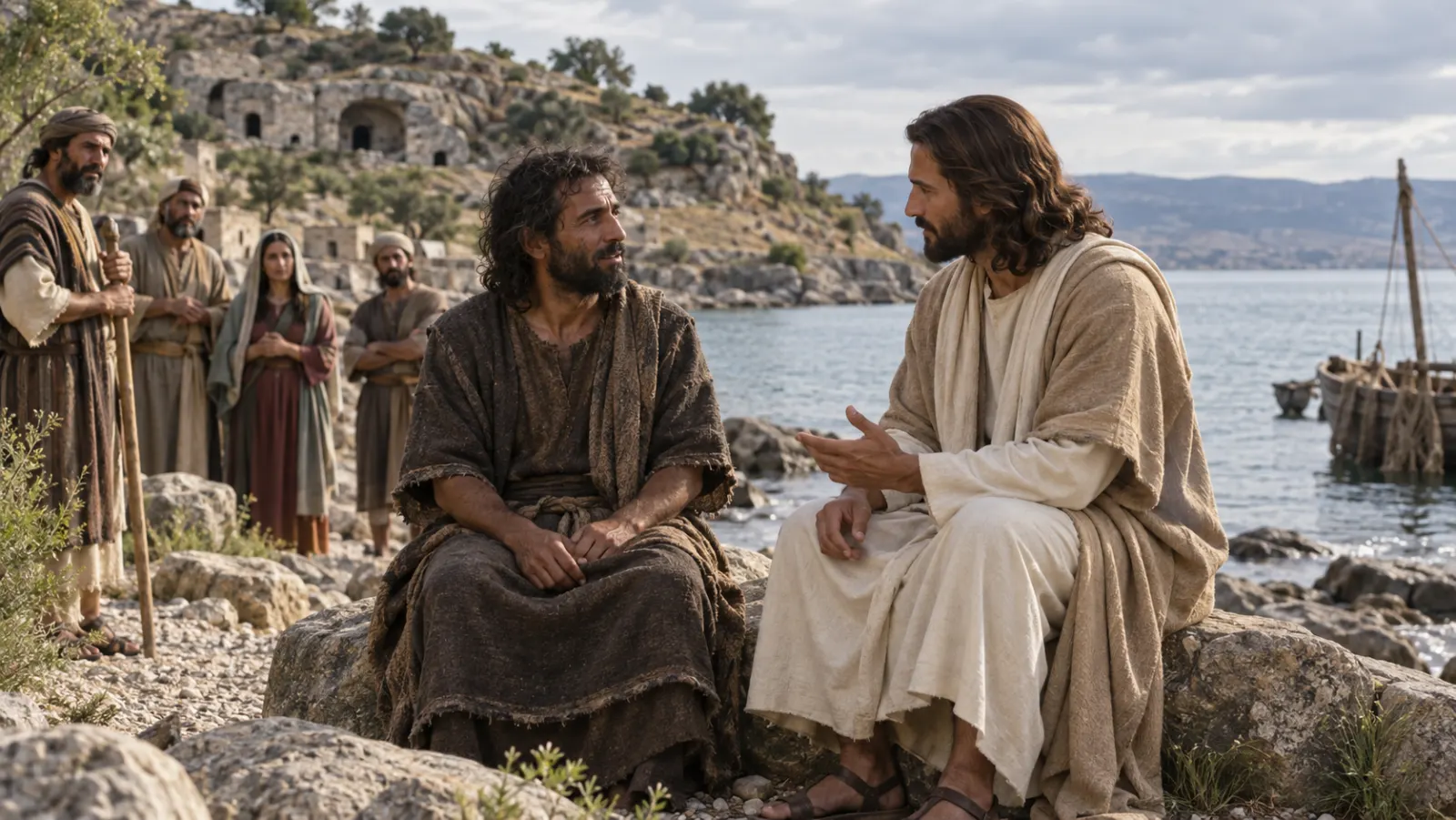
Mark’s terrifying story of a man among the tombs names demonic oppression, social banishment, and Jesus’ authority. It should not be used to label every psychiatric crisis as possession.
The man in Mark 5 lives among tombs, cries out, harms himself, breaks restraints, and terrifies the region that has pushed him beyond ordinary human company. When Jesus asks a name, the answer is “Legion.” The word evokes multiplicity and, for hearers living under Rome, the chilling vocabulary of military occupation. This is a story about a life overwhelmed by powers that speak as though they own him.
It is not a diagnostic manual. Depression, bipolar disorder, schizophrenia, post-traumatic stress, epilepsy, substance-use disorder, dementia, and other conditions cannot be identified by matching a neighbor’s behavior to an ancient exorcism narrative. Christians who make that leap may intensify fear, delay treatment, shame families, or place a vulnerable person in the hands of an unqualified religious authority. Taking the Bible seriously requires more care, not less.
Mark distinguishes a person from what torments him
The voices answer Jesus, but the man is not reducible to those voices. At the end he sits clothed and in his right mind, then asks to accompany Jesus. He has desire, history, home, and a future. The story’s grammar of deliverance separates the human being from the forces that have occupied his life. Jesus does not address him as a monster.
That distinction is pastorally precious. Symptoms can dominate a season without becoming a person’s identity. A diagnosis can guide care without naming the whole self. Addiction can cause terrible harm without erasing the image of God. Spiritual struggle can be real without authorizing neighbors to define another person by their worst hour. Jesus moves toward the man everyone else has turned into a threat.
The town’s solution was restraint and distance
Before Jesus arrives, the community has tried chains. Mark does not describe sustained care, safe shelter, companionship, or treatment; he describes control that fails. The man remains among death while the town continues at a safer distance. His isolation protects ordinary life from disruption, but it does not restore him. Social order has been purchased by his exile.
America still knows versions of that bargain. People in acute distress cycle through emergency rooms, jails, encampments, and exhausted households when long-term care is scarce or unaffordable. Churches may call police because they have no plan, then disappear after the immediate crisis. Safety matters for everyone involved, but containment alone is not healing. A faithful response asks what happens after the sirens leave.
Legion carries more than one resonance
A Roman legion was a massive military formation, so the name has political overtones in occupied territory. Mark’s scene also includes a large herd of pigs and a destructive rush into the sea. Interpreters debate how far to press the imagery. We should acknowledge the echo without claiming that every narrative detail is a code that modern readers have finally solved.
The central claim is clearer: the forces are many, the man appears beyond human control, and Jesus is not overmatched. His authority does not require a prolonged contest. The oppressors negotiate; Jesus commands. Yet the victory is measured not by special effects but by the return of a person to dignity, relationship, speech, clothing, and purpose.
Demonic oppression and psychiatric illness are not synonyms
The Bible portrays spiritual evil, and historic Christian faith need not explain it away. The same Bible also speaks of bodily illness, grief, exhaustion, injury, and ordinary human responsibility without labeling all suffering demonic. Even ancient Gospel narratives distinguish healings from exorcisms. Collapsing every category into possession is not more biblical; it is less attentive to the texts.
Pastors should not tell people to stop medication, abandon therapy, or replace medical evaluation with deliverance rituals. Sudden confusion, threats of self-harm, hallucinations, severe agitation, or inability to care for basic needs can require urgent professional help. Prayer can accompany that help. It must never become a reason to withhold it or to expose a person to coercion, humiliation, or physical danger.
The pigs reveal the town’s complicated fear
When the townspeople see the man restored and learn what happened to the herd, they are afraid and ask Jesus to leave. A human life has returned, but an economic loss has occurred and an uncontrollable power stands among them. Their reaction resists an easy ending in which everyone celebrates. Deliverance disrupts arrangements that had become normal.
Communities sometimes prefer a familiar crisis to the changes recovery requires. If a family member becomes sober, old roles must shift. If a church takes abuse seriously, reputations and budgets may suffer. If mental-health care becomes a priority, leaders must admit their limits and share authority with clinicians. Restoration is good news, but it can expose how much stability depended on someone else remaining unwell.
Jesus sends the man home with a testimony of mercy
The restored man asks to join the boat. Jesus instead commissions him to return to his people and tell what the Lord has done and what mercy he has received. This is not rejection. It is a vocation. A person formerly spoken about becomes a speaker. The region that knew him through fear will now hear his own account.
Testimony must remain voluntary and truthful. Churches can pressure people to turn private illness into public proof that a ministry works. The man in Mark is commissioned by Jesus, not harvested by a publicity team. Modern survivors should control what they disclose, to whom, and when. Mercy does not cancel privacy, and a dramatic story is not the price of belonging.
A safer Christian response has several doors
A wise church builds relationships with licensed counselors, physicians, crisis services, addiction programs, and local support networks before emergencies. It trains leaders to recognize risk, document concerns, respect confidentiality, and call qualified help. It also creates ordinary friendship so that people are not noticed only when symptoms become disruptive.
Spiritual care still matters: prayer, Scripture, confession, lament, communion, patient presence, and confidence in Christ’s authority over evil. These practices need not compete with clinical care. The whole person deserves more than one kind of attention. The aim is not to win an argument about causes; it is to protect life, reduce isolation, tell the truth, and accompany a neighbor toward greater freedom.
Self-harm requires immediate seriousness
Mark’s description includes a man cutting himself. If someone today is in immediate danger, spiritual conversation should not delay emergency help. In the United States, people can call or text 988 for crisis support, and emergency services may be necessary when danger is imminent. A pastor can remain present, reduce access to lethal means when safe, involve trusted supports, and refuse promises that exceed training.
Families need care that does not blame them
Relatives often arrive exhausted after months or years of disrupted sleep, financial strain, fear, and repeated crises. Religious explanations can add a second burden by accusing a parent of inviting evil or failing to pray correctly. The Gospel gives no warrant for that cruelty. Families need respite, accurate information, support groups, practical help, and permission to establish boundaries that protect everyone in the home.
The man’s request to travel is understandable
Why return to people who chained and expelled him? The desire to remain with Jesus may include gratitude and safety. Jesus sends him home with a new role, but modern survivors should not be forced back into an abusive environment under the banner of testimony or reconciliation. Home is not automatically safe. Wise pastoral care distinguishes restorative return from renewed exposure to harm.
Economic disruption should be discussed without scapegoating
The herd’s destruction represents a serious loss to owners and workers, even though Mark centers the man’s liberation. Readers need not pretend economics are trivial. They should notice how easily a community can calculate animals and overlook an exiled neighbor. Christian ethics holds livelihoods and human dignity together, seeking repair without deciding that a person’s continued bondage is an acceptable cost of stability.
Legion is the name given by the powers in the story, not a label Christians should attach to a struggling person. Jesus crosses the water, enters the place of death, separates the man from his torment, and restores his voice. That is the shape of the good news.
To follow him is to resist both unbelief in spiritual evil and superstition about human illness. We pray without spectacle, seek skilled care without shame, protect people from coercion, and refuse exile as a community’s final answer. The person before us is never the diagnosis, never the crisis, and never the fear others have learned to call his name.