Thanksgiving is a U.S. civil holiday, not a biblical feast. Churches can practice gratitude without baptizing a simplified national origin story.
The fourth Thursday in November feels religious even before a prayer is offered. Families travel, tables carry inherited recipes, volunteers serve meals, football plays in another room, and congregations gather for worship. Yet Thanksgiving is not one of Israel's appointed feasts or an event in the life of Jesus. It is a U.S. civil holiday with presidential proclamations, regional customs, commercial pressures, and contested national memories.
That distinction is not a reason to avoid the day. Scripture repeatedly commands thanksgiving. It is a reason to resist confusing gratitude to God with loyalty to a flattering national story. A church can give thanks for harvest, family, hospitality, and provision while telling the truth about colonization, Native peoples, land, war, and the ways national myths have hidden suffering.
The origin story is too small
A shared meal between English colonists and Wampanoag people in 1621 belongs to the history, but it does not establish a simple line to the modern holiday or summarize what followed. Later history includes diplomacy, disease, displacement, conflict, survival, and Indigenous agency. Children's pageants with generic costumes turn living peoples into scenery and history into moral comfort.
Thanksgiving remembers dependence
Deuteronomy warns Israel not to interpret abundance as self-creation. When houses are secure and food is plentiful, memory must reach behind achievement to God's provision and covenant responsibility. Christian thanksgiving challenges the myth of the self-made household. Farmers, processors, drivers, store workers, cooks, land, weather, public systems, and grace all stand behind a meal.
Truth does not cancel gratitude
Lament and thanksgiving coexist throughout Scripture. Mature gratitude does not require innocence. A family can name beauty in its inheritance and harm within it. A nation can recognize gifts without imagining itself chosen above others. Confession protects thanksgiving from propaganda because it directs praise toward God rather than an idealized national self.
Invite living voices
Churches should learn which Native nations are connected to their region and rely on sources those communities help produce. Do not ask one Indigenous guest to bless a celebration while leaders avoid material questions. Education may lead to relationships, fair compensation, support for language preservation, or advocacy shaped by actual community priorities. Listening should cost more than a themed craft.
The table exposes inequality
A lavish meal can coexist with food insecurity in the same ZIP code. Charity should preserve choice and dignity rather than distribute leftovers for a photograph. Churches can partner year-round, ask what foods people want, provide culturally familiar options, and address transportation or benefit access. Thanksgiving becomes credible when gratitude loosens possessions and strengthens mutual care.
Make room for complicated homes
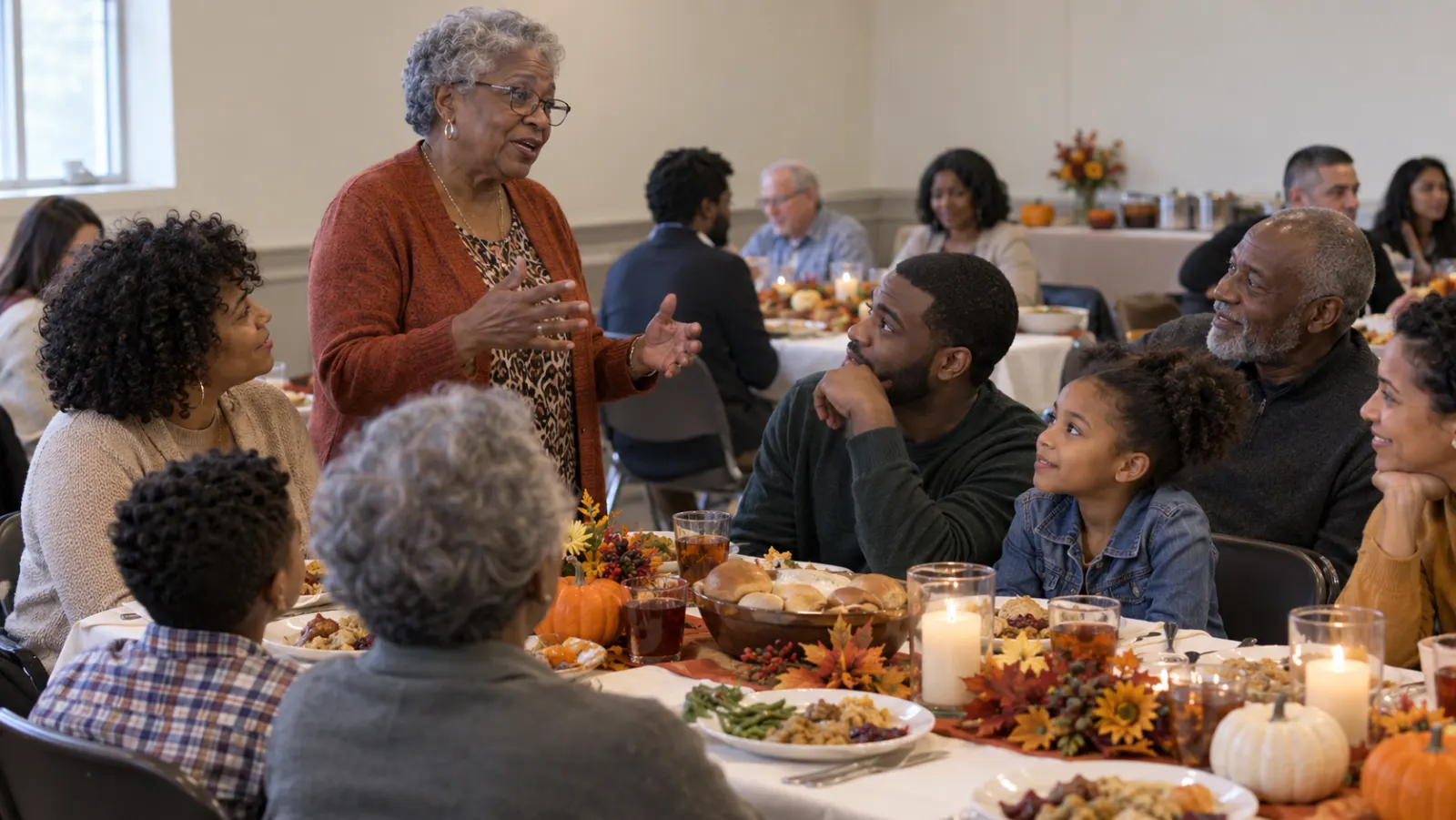
For some, the day brings reunion; for others, addiction, political conflict, loneliness, or exhausting travel. Pastoral advice should not romanticize family access or pressure people into unsafe homes. Congregations can host an open table, help members plan boundaries, remember shift workers, and honor quiet observance. Gratitude is not measured by a crowded dining room.
Questions to carry into community
A responsible community conversation can begin with this question: Which parts of our Thanksgiving story are history and which are mythology? It need not be answered quickly or turned into a test of belonging. Listen to people who live with the consequences, separate a biblical claim from a local custom, and name what information is still missing. Then identify one modest step, a responsible person, and a date for review. A church holiday becomes formative when its meaning takes accountable, correctable shape in ordinary life.
The question also has to reach the calendar and budget: Whose labor and land disappear from our table prayer? People with different histories, work schedules, and family situations may answer differently. Those differences deserve attention before leaders decide. Checking facts, seeking consent, and consulting people with relevant knowledge keeps a good intention from causing preventable harm. The church need not solve everything in one meeting, but it can state what it knows, what boundary it will protect, and how it will report back.
To keep reflection from becoming a slogan, ask: How can gratitude and lament strengthen each other? The most faithful answer may not be the most impressive one. It may require reducing a program, moving money, hearing an objection, or admitting an uncomfortable history. Christian practice becomes concrete when it includes capacity, safety, vulnerable people, and freedom of conscience. Prayer, study, and evaluation belong together; none excuses the absence of the others.
A responsible community conversation can begin with this question: What do local Indigenous communities ask neighbors to learn or support? It need not be answered quickly or turned into a test of belonging. Listen to people who live with the consequences, separate a biblical claim from a local custom, and name what information is still missing. Then identify one modest step, a responsible person, and a date for review. A church holiday becomes formative when its meaning takes accountable, correctable shape in ordinary life.
The question also has to reach the calendar and budget: Who needs a safer or more accessible table this year? People with different histories, work schedules, and family situations may answer differently. Those differences deserve attention before leaders decide. Checking facts, seeking consent, and consulting people with relevant knowledge keeps a good intention from causing preventable harm. The church need not solve everything in one meeting, but it can state what it knows, what boundary it will protect, and how it will report back.
One final check
Before closing “Thanksgiving Is Not a Church Holiday,” the community can return to Deuteronomy 8:7–18 and summarize the difference between what the text claims, a reasonable inference, and a local application. That distinction protects biblical authority from our preferences. It is also wise to hear from someone directly affected and someone with relevant practical knowledge. A small, reviewable decision often serves people better than a grand promise with no owner, resources, or follow-through.
When reviewing Thanksgiving, include people often absent from the planning room: shift workers, households with limited income, children, older adults, and people formed by a different tradition. Their observations may reveal costs the team cannot see. Documenting the decision, explaining why it was made, and opening a way to report problems turns goodwill into institutional care. If the practice does not produce the fruit leaders expected, changing it is not betrayal. It may be humble obedience.
Finally, “Thanksgiving Is Not a Church Holiday” should not be evaluated by a single impression. Watch over a season to see whether the practice strengthens prayer, truth, hospitality, justice, and rest. The community can keep modest records, hear voluntary testimony, and review unintended consequences. Evaluation is not an attempt to control faith; it is a way to care for people and notice when a custom no longer communicates what leaders intended. Grace allows a church to thank God for what was good, confess harm, and begin again without turning change into a crisis.
Around “Thanksgiving Is Not a Church Holiday,” that patience protects against two extremes: preserving from fear and canceling on impulse. A church can change timing, language, budget, or symbols while holding its confession of Christ firmly. Tradition serves the community; the community does not exist to sustain a production. Prayerful review grounded in evidence allows the calendar to remain a teacher of hope instead of becoming a master of conscience.
Thanksgiving can be a good American holiday without becoming a Christian feast or a sacred account of national innocence. Its civil character gives churches freedom to receive what is generous, reject what is false, and practice what is just.
A truthful table thanks God, remembers dependence, names debts, and makes room. It does not need costumes or mythology. It needs bread, honest memory, neighbors treated with dignity, and humility to recognize that every good gift is received rather than possessed.