Archaeology confirms deep settlement history and illuminates Bethlehem’s landscape and infrastructure, but it cannot certify every detail of the birth narratives.
“Has archaeology proved that Jesus was born in Bethlehem?” is the kind of question that sounds simple until an archaeologist answers it. Archaeology can establish settlement, buildings, water systems, burial practices, economic patterns, and long-term occupation. It can identify a town in a period. It is much less capable of proving that one particular birth occurred in one particular room.
Bethlehem is especially complicated because people never stopped caring about it. Ancient, Byzantine, medieval, Ottoman, and modern building sits on top of earlier remains. The site is not an empty mound waiting for a clean excavation. The evidence is scattered, reused, buried, built over, and sometimes accessible only during restoration or salvage work.
Archaeology confirms Bethlehem’s deep history
Bethlehem is not a place invented by the New Testament. The town has a long biblical and historical past. A well-known clay bulla found in Jerusalem preserves the name Bethlehem from the First Temple period, showing the town existed centuries before Jesus.
That find does not say anything directly about the Nativity. It matters because it anchors Bethlehem within the administrative and settlement history of Judah. Archaeology often works this way: not by proving a famous story in one dramatic object, but by building the environmental and chronological framework in which texts make sense.
The first-century layer is hard to expose
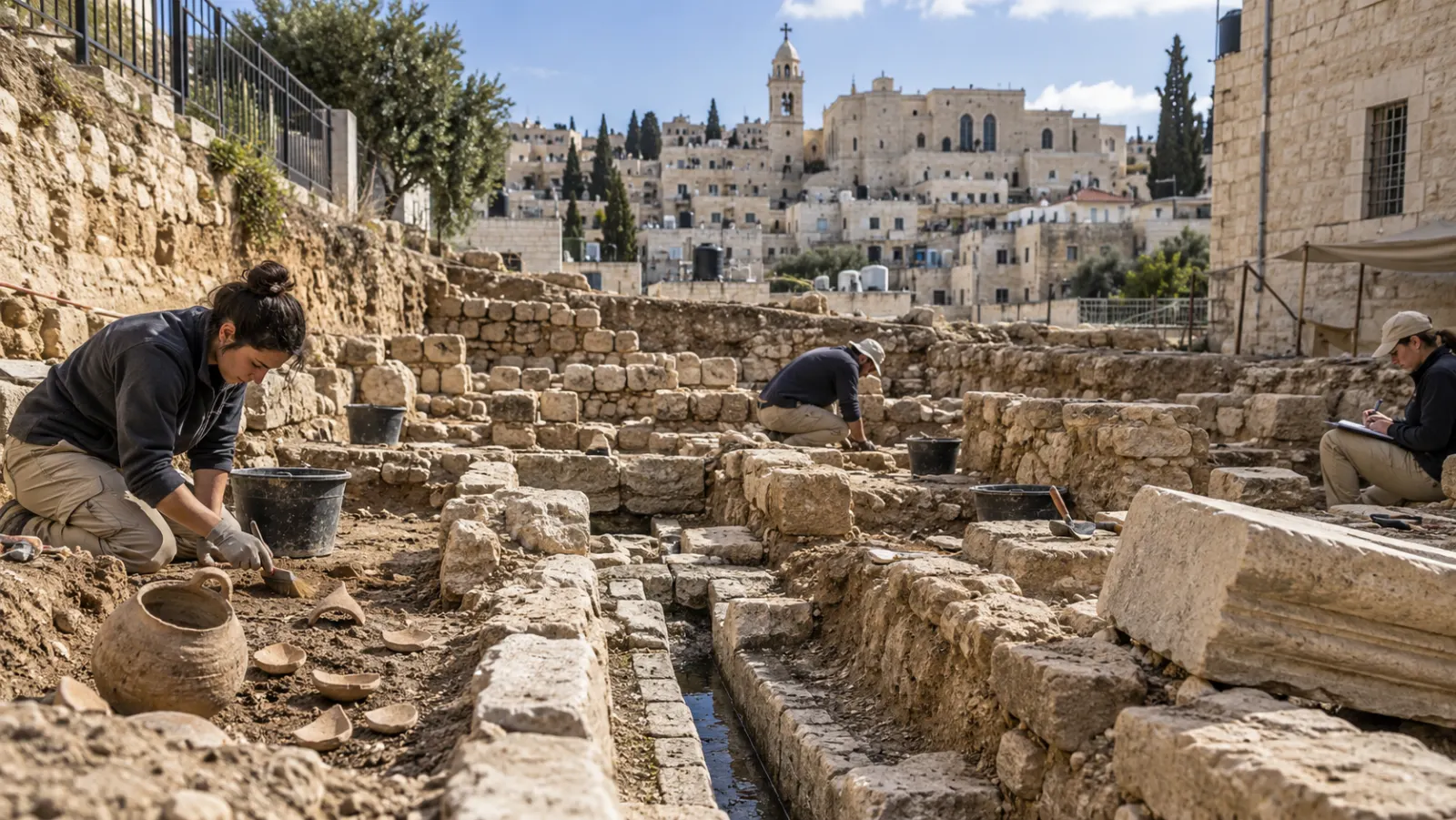
Continuous occupation creates a practical problem. To excavate large areas of first-century Bethlehem, archaeologists would have to work beneath a living city and beneath structures that are themselves historically precious. That sharply limits what can be recovered.
As a result, absence of spectacular first-century remains does not mean absence of settlement. It means the sampling is difficult. Historians must combine archaeology with literary evidence, topography, nearby regional patterns, and cautious inference. This is slower and less satisfying than a headline, but it is how serious work proceeds.
Water systems and stonework matter more than they look
Recent discussion of Bethlehem has paid attention to infrastructure such as water systems and substantial reused masonry. Those clues can affect how scholars imagine the town’s scale and strategic importance. A community with significant water management is not necessarily the tiny cluster of huts familiar from Christmas cards.
At the same time, infrastructure is not a population census. Reused stones can move. Waterworks can serve different periods. Archaeological interpretation depends on dating, context, and comparison. Good arguments are cumulative rather than magical.
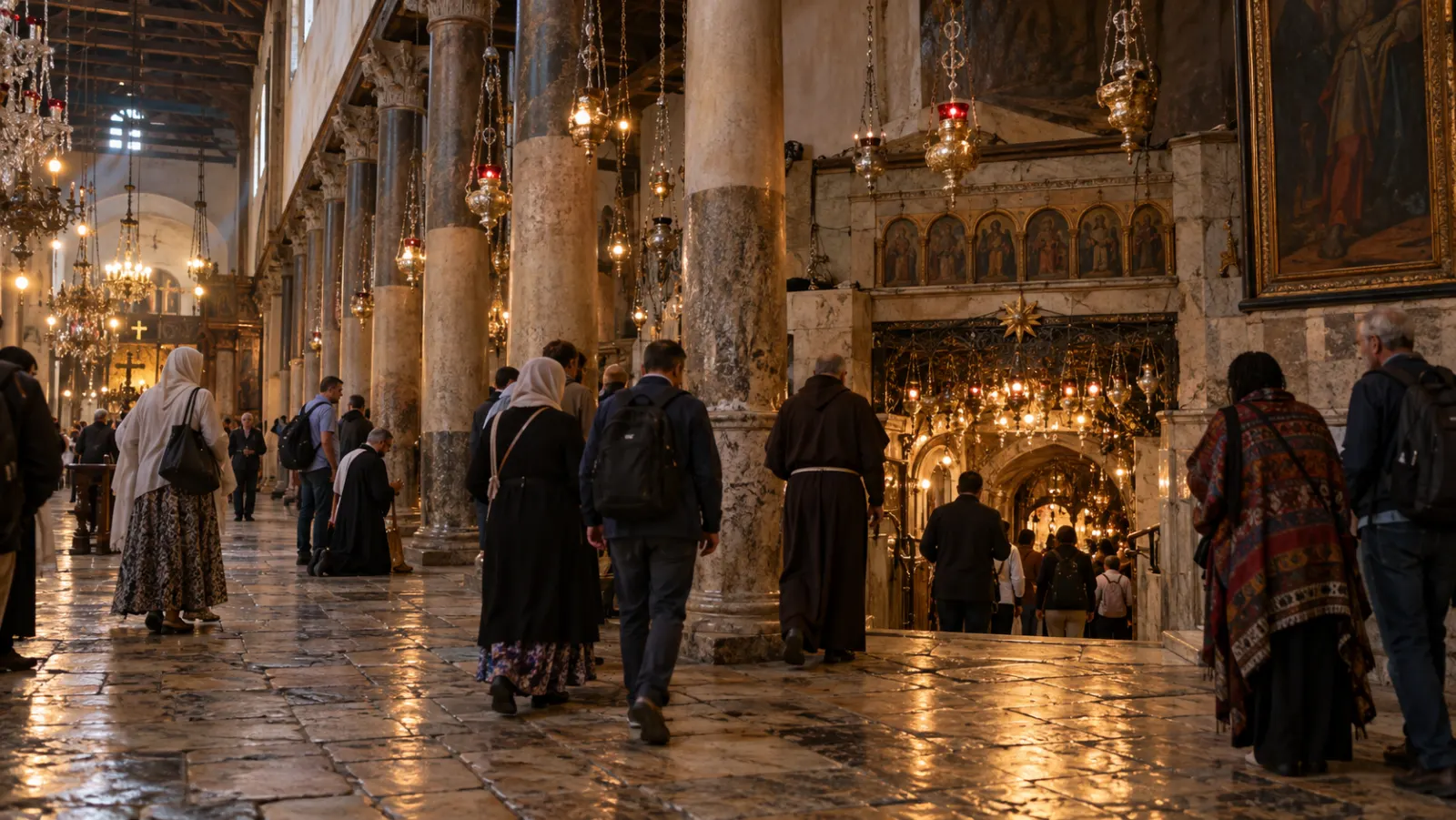
The Church of the Nativity preserves history of memory
Excavation and restoration around the Church of the Nativity reveal early church phases and the long history of Christian use. The fourth-century basilica and the sixth-century rebuilding are historically secure. The cave beneath the church was already associated with Jesus’ birth before the first monumental church was constructed.
What archaeology can show here is continuity of Christian remembrance and architecture. What it cannot independently demonstrate is that the grotto is the exact place where Mary gave birth. That conclusion belongs to the category of tradition—ancient and meaningful tradition, but tradition nonetheless.
Archaeology cannot settle literary questions by itself
Questions about Luke’s census, Matthew’s magi, or the relationship between Bethlehem and Nazareth involve texts, chronology, administration, and theology as well as material remains. An excavation trench cannot answer them all.
This is important because both defenders and critics of Christianity sometimes ask archaeology to do impossible work. A pot does not verify an angel. A wall does not disprove a journey. Material evidence is powerful within its proper range. It becomes misleading when used as a shortcut around the harder work of interpreting sources.
The strongest historical posture is neither hype nor cynicism
Some Christian media treats every archaeological find as “proof of the Bible.” Some skeptical media treats every gap as a disproof. Both approaches flatten the evidence. Archaeology usually gives us probabilities, context, corrections, and constraints.
For faith, that can be healthy. Christianity does not need every Christmas tradition to be archaeologically certified. It does make claims about real history, so evidence matters. The mature posture is to welcome what archaeology genuinely illuminates, admit what remains uncertain, and refuse to manufacture certainty for emotional reassurance.
A single artifact rarely answers the famous question
Popular archaeology is built for headlines: “Discovery proves biblical city,” “artifact confirms king,” “tomb solves mystery.” Real archaeological interpretation is usually slower. An object gains meaning from its layer, location, material, date, and relationship to other evidence.
Bethlehem illustrates that reality well. Even a striking inscription or architectural fragment contributes one piece to a larger reconstruction. The famous question—“Was Jesus born here?”—is too personal and event-specific for most material evidence to answer directly.
Continuous habitation destroys and preserves at the same time
Living cities are archaeologically frustrating because new construction cuts through old layers. Yet continuous habitation also preserves place names, routes, sacred associations, and reused materials that abandoned sites may lose. Bethlehem’s long life therefore creates both obstacles and clues.
The historian has to work with that paradox. We know less about some first-century streets because later generations built over them, but we also know the location retained enough identity for early Christians to attach memory to it and build there.
Archaeology is strongest when it changes the questions
The best discoveries do not merely answer yes or no. They force better questions. Was Bethlehem more substantial than a tiny hamlet? How was water managed? What routes connected it to Jerusalem? How did later builders reuse earlier stone? These questions produce a fuller historical world.
That fuller world can then refine biblical interpretation. The value of archaeology is not that it turns faith into laboratory certainty. It helps readers replace vague imagination with evidence-shaped imagination.
Archaeology cannot hand us a photograph of Bethlehem on the night Jesus was born. It can do something more modest and more useful: show us a long-inhabited Judean town with infrastructure, regional connections, deep biblical roots, and a remarkably early Christian memory attached to a specific place.
That does not “prove Christmas.” It does make the story less abstract. Bethlehem belongs to a real landscape where stone, water, roads, houses, and generations left traces. Faith and history meet best when neither is asked to pretend those traces say more than they do.