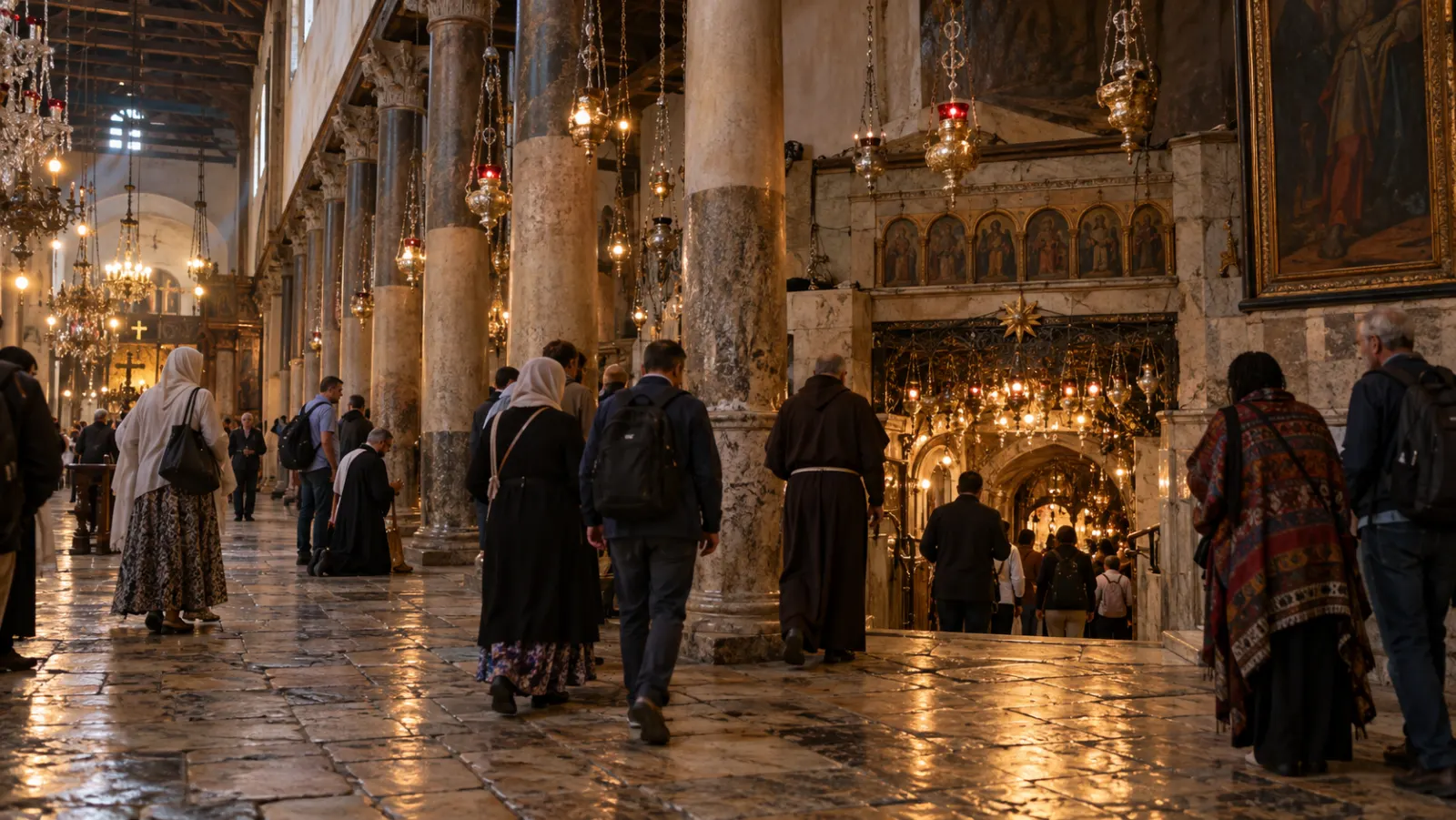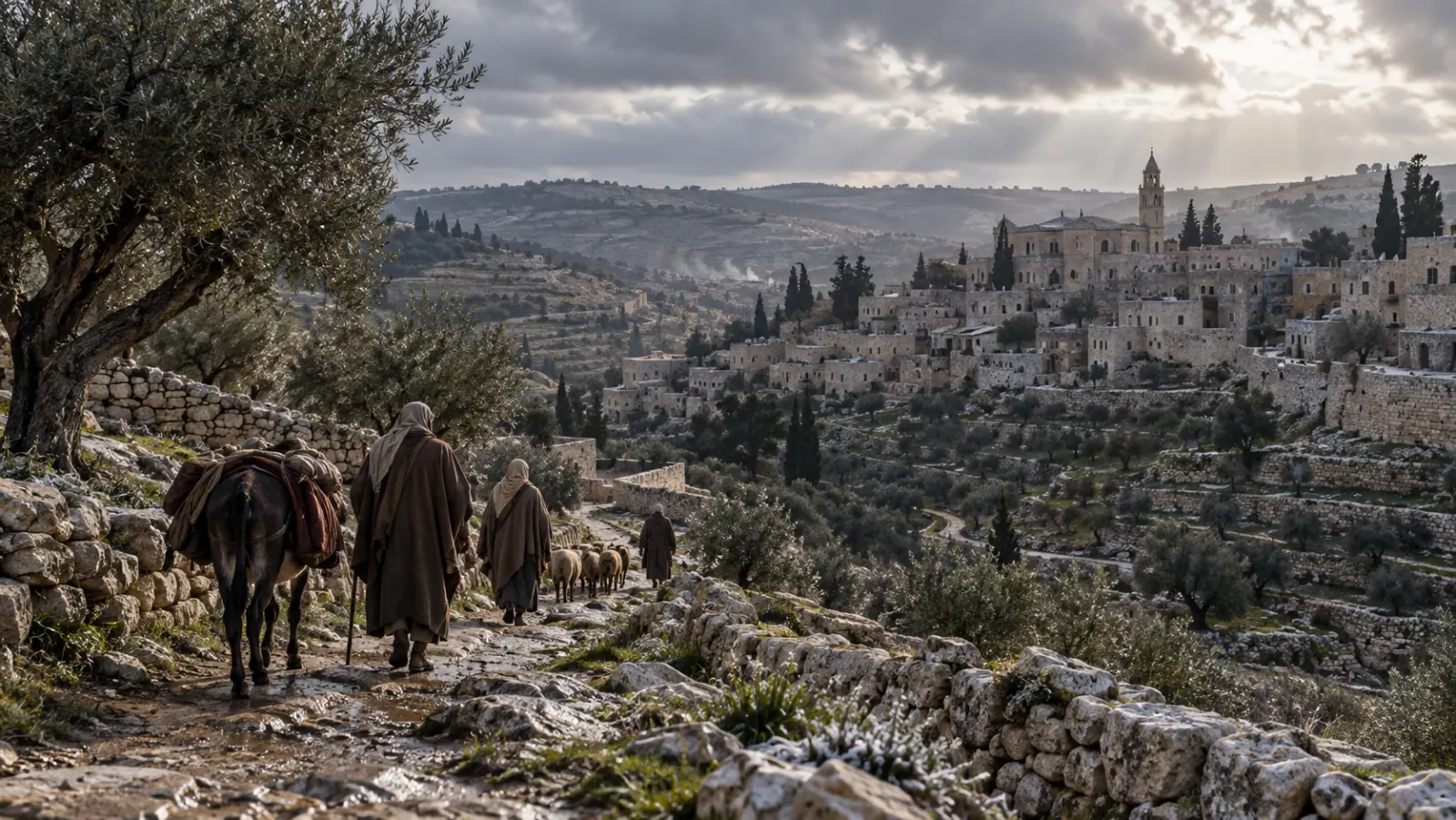
Snowy rooftops, pine trees, and frozen stables belong more to European and American Christmas memory than to Bethlehem’s Mediterranean hill-country climate.
Walk through an American Christmas aisle and Bethlehem begins to look suspiciously like New England. Snow piles on roofs. Pine trees frame the stable. Everyone breathes frosty air. The village sits under the kind of winter sky that belongs on a December postcard from Vermont.
The actual Bethlehem lies in the Judean hill country, with a Mediterranean climate. Winters can be cold and wet, and snow is not impossible, but the Gospels do not tell us that Jesus was born in snow—or even that he was born in December. The snowy Bethlehem of popular art tells us as much about the history of Christmas in Europe and North America as it does about first-century Judea.
The Gospels do not give a birth date
Neither Matthew nor Luke identifies the calendar date of Jesus’ birth. Luke mentions shepherds in the fields at night, but that detail alone does not produce a reliable month. Flocks could be managed in different ways depending on weather, grazing, and local practice.
December 25 belongs to the later history of Christian liturgical celebration. It is a meaningful feast date, but it should not be turned into a weather report from Luke. The text simply does not tell us whether the night was cold, mild, wet, or clear.
Bethlehem has real winters
Correcting snowy art should not swing into another myth—that Judea is hot desert all year. Bethlehem sits at elevation in the hill country. Winters can be chilly, rainy, windy, and occasionally snowy. Stone buildings without modern insulation can feel very cold.
A historically grounded winter Nativity could therefore include cloaks, damp ground, dark skies, and people seeking shelter. What is less grounded is the consistent transformation of Bethlehem into a northern European snow village with deep drifts and evergreen forests.
European artists painted the world they knew
Christian art has always localized biblical scenes. Medieval and Renaissance artists dressed biblical figures in familiar clothing and placed sacred events in recognizable landscapes. Snowy Nativity scenes emerged naturally in cultures where Christmas meant winter darkness, frost, and snow.
Those images were not necessarily attempts to deceive. They made the incarnation local. Christ was pictured entering the artist’s world. The problem appears only when later viewers forget that visual theology is not documentary photography.
America inherited the northern-hemisphere Christmas package
American Christmas absorbed European art, carols, Victorian illustration, commercial printing, and later movies. Snow became part of the holiday’s emotional grammar even in parts of the United States where December is warm. Once Santa, sleighs, evergreens, and nativity scenes entered the same seasonal marketplace, the climates blurred.
That blending is culturally understandable. But it can subtly distance Jesus from his Jewish and Middle Eastern setting. A Bethlehem that looks permanently European can make the incarnation feel less historically particular than the Gospels intend.
The real landscape changes how we read the journey
Picture limestone hills instead of alpine slopes. Picture terraces, olive trees, scrub, stone walls, and paths shaped by elevation. Picture a town built from local stone rather than timber cabins. Suddenly the journey from Nazareth, the proximity to Jerusalem, and the use of caves and rock-cut spaces make more intuitive sense.
Historical geography is not a trivia correction. It restores texture. The Son of God enters a specific land with specific climate, architecture, agriculture, and travel patterns. Christian faith loses nothing by letting Judea look like Judea.
We can keep the snow globe and know what it is
There is no need to throw away every snowy nativity ornament. Art can symbolize. A white Christmas can carry family memory, childhood nostalgia, and the theological idea of light entering winter darkness. Those meanings are real even if the scene is geographically relocated.
The key is literacy. We can enjoy the American image without confusing it with the historical setting. A mature Christmas imagination can hold both: the local art that helped us love the story and the actual Middle Eastern landscape in which the story took place.
Snow is possible, which is different from saying snow was present
Bethlehem’s elevation means winter snow can occur, and modern photographs occasionally show the city under white cover. That fact sometimes gets used to defend snowy Nativity art. But possibility is not evidence for a specific night two thousand years ago.
Historical reasoning requires that distinction. A rare or occasional weather event can be geographically plausible without becoming the most likely reconstruction. Since the Gospel gives no weather report, the honest artistic choice is openness rather than certainty.
Climate affects architecture as well as clothing
The real Judean climate helps explain the built environment. Thick stone walls, flat roofs, water collection, shaded spaces, and rock-cut areas all fit a landscape shaped by dry summers and cooler rainy winters. Climate is not an isolated fact; it connects to how people build and live.
Once we restore that connection, the Nativity looks less like a generic winter fantasy and more like a story embedded in Mediterranean hill-country life. The architecture and terrain begin to belong together.
Localized Christmas art can still be theologically meaningful
Christians in many cultures depict Bethlehem using local materials and landscapes. African, Latin American, Asian, European, and Indigenous artists have all placed the Nativity within familiar visual worlds. That localization can express the Christian claim that Christ comes for every people.
Historical reconstruction and inculturated art therefore serve different purposes. One asks, “What did first-century Bethlehem likely look like?” The other asks, “How does this story enter our world?” Confusion comes only when we demand one genre do the job of the other.
Did it snow when Jesus was born? We do not know. Snow can occur in Bethlehem, but the Gospels give us no basis for making it part of the event. The heavier snow belongs mostly to the artistic history of Christmas.
Recovering Bethlehem’s real landscape does more than correct a postcard. It reminds us that incarnation means specificity. Jesus was not born in a generic holiday village. He was born in Judea, under Judean skies, among Judean stone and hills—and that concrete setting is part of the wonder.