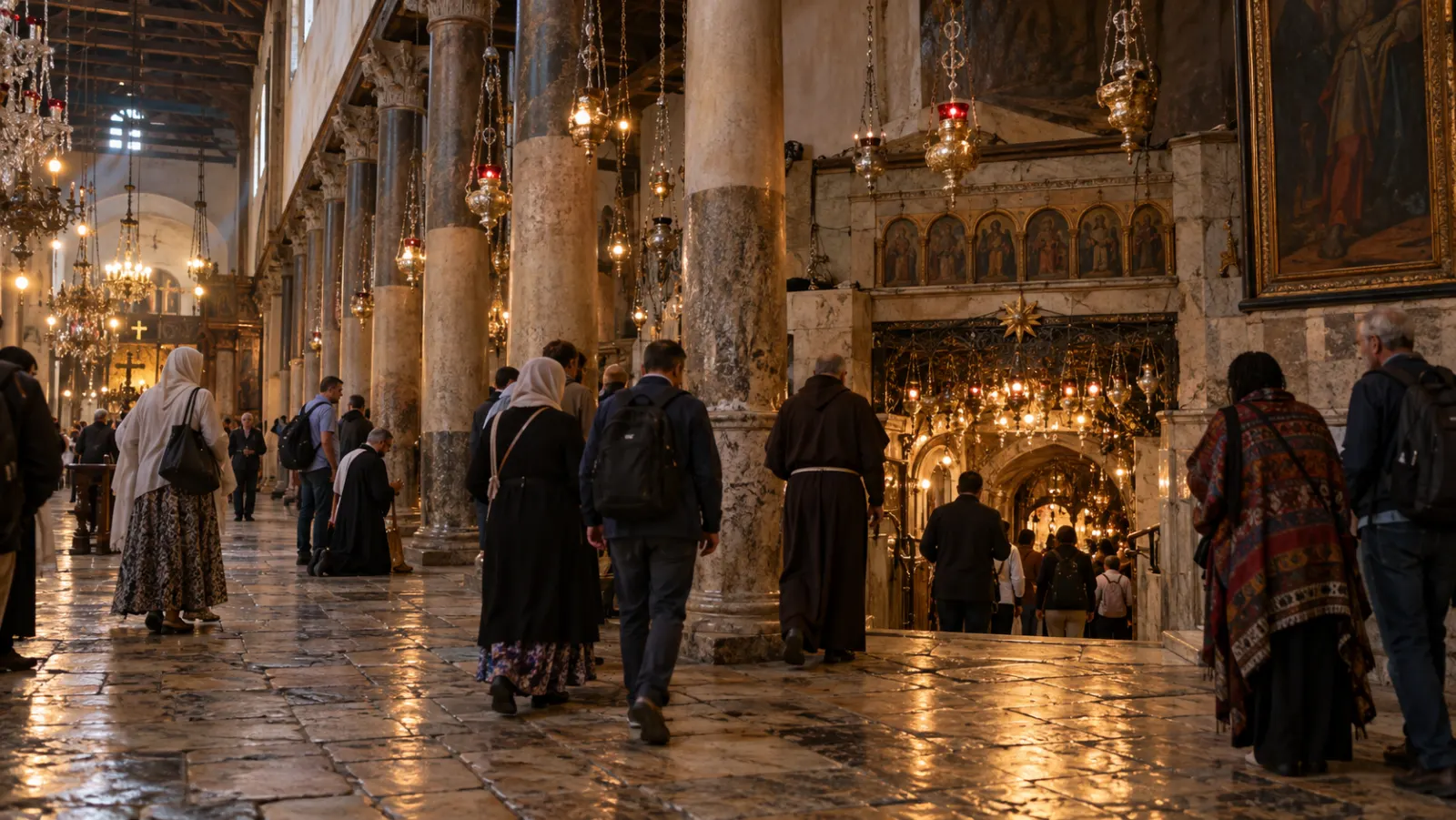
Christmas art often turns the trip to Bethlehem into a single serene donkey ride. The geography was more demanding, and the exact route is uncertain.
Christmas cards have settled the transportation question for us: Mary rides a donkey while Joseph walks beside her beneath a star. It is one of the most recognizable images in Western art. Luke, however, never mentions a donkey. He simply says Joseph went from Nazareth in Galilee to Bethlehem in Judea and that Mary was with him.
The journey was real enough to deserve more attention than a decorative silhouette. Nazareth and Bethlehem are separated by a substantial stretch of country. Ancient travelers had to think about terrain, water, safety, food, lodging, and pace. We can estimate distance and discuss plausible routes, but the Gospel does not hand us a day-by-day itinerary.
The straight-line number is not the travel number
Modern maps tempt us to measure point to point and assume the ancient road followed the same logic. It did not. Travelers moved along established routes shaped by valleys, ridges, settlements, water sources, political boundaries, and security. The practical journey from Nazareth to Bethlehem would have been longer than a simple aerial measurement.
Most modern reconstructions place the trip somewhere in the range of roughly seventy to ninety miles depending on route. The number should be treated as an estimate, not a verse. Luke cares that they went from Galilee to Bethlehem; he does not tell us which road they chose.
There was more than one plausible route
One route could move through the central hill country and Samaria. Another could descend toward the Jordan Valley and then approach Judea from the east, trading distance for different political and topographical considerations. Scholars debate what Jewish travelers from Galilee commonly did in various circumstances.
We should resist the urge to solve the question with certainty. The Gospels show Jews traveling through Samaria at times, and they also show routes that cross the Jordan region. Ancient people were practical. Weather, family connections, safety, and local conditions could influence the choice.
Travel pace depended on the people, not just the road
A healthy adult could cover impressive distances on foot, but a family journey is not a military march. Mary’s stage of pregnancy, the amount of baggage, available lodging, animal use, road condition, and daily light would all affect pace. We do not know enough to calculate an exact number of travel days.
That uncertainty is worth keeping because devotional retellings often turn the journey into a precise ordeal the text never quantifies. It was almost certainly demanding. It does not need an invented mileage log or dramatic collapse scene to be meaningful.
Luke does not tell us Mary rode a donkey
Donkeys were common and useful pack animals in the ancient world, so including one in art is perfectly plausible. The problem is the word “plausible” becoming “biblical fact.” Luke does not say Mary rode. She may have walked, ridden at least part of the way, or traveled with a larger group using several animals.
This is a small example of a larger reading habit. Christmas tradition fills narrative gaps because visual storytelling needs concrete choices. Good historical reading can appreciate the art while remembering where the text stops.
The journey was probably less lonely than our art suggests
Paintings often isolate Mary and Joseph against a vast landscape. Ancient travel, especially over multiple days, could be safer and more practical in groups. Family members, neighbors, or other travelers moving along the same route may have shared stretches of road.
Luke does not mention companions, so we cannot insert them as characters. But we also should not assume the couple was always alone. The ancient Mediterranean world was socially dense. Travel depended on hospitality networks, known stopping places, and the presence of other people far more than modern road-trip imagination usually allows.
Why the physical journey matters
The incarnation is sometimes discussed in highly abstract language: eternal Son, human nature, fulfillment, salvation. Those truths are central, but Luke grounds them in geography. A pregnant woman travels. A man returns to an ancestral town. Feet get dusty. Bodies need water. Night requires shelter.
For Americans accustomed to cars, interstate exits, GPS, and reservations, the ancient trip forces the story back into bodily scale. The Gospel’s claim is not that God hovered above human logistics. It is that God entered a world in which salvation history moved at walking speed.
Ancient travel meant planning around water and daylight
A multi-day journey required more than endurance. Travelers needed water, food, places to rest, and enough daylight to reach a safe stopping point. Routes tended to connect settlements and known resources rather than follow the shortest geometric line. Weather could make a familiar track slower or more difficult.
This practical layer is largely invisible in Luke because ancient audiences did not need every detail explained. For modern Americans, adding it back helps restore scale. The journey was not cinematic wandering through empty wilderness. It was movement through a populated but demanding landscape.
Pregnancy makes the unknowns more important, not less
Because Luke says Mary was pregnant, later retellings understandably emphasize physical difficulty. But the text does not tell us how advanced the pregnancy was when travel began, how often the couple rested, or what support they had. The responsible response is empathy without invention.
We can recognize that travel during pregnancy would require care while refusing to dramatize scenes Luke never describes. Historical imagination works best when it fills in categories—fatigue, water, terrain, lodging—without pretending to know exact incidents.
The road creates a bridge between two identities of Jesus
The journey also connects two place names that remain attached to Jesus throughout the Gospels: Nazareth and Bethlehem. He will be known as Jesus of Nazareth, yet the birth narratives place his origin story in David’s town. The road links ordinary Galilean identity with Judean promise.
That tension becomes important later when people debate Jesus’ origins. Geography is not merely scenery; it becomes part of how characters understand or misunderstand him. The trip to Bethlehem therefore serves narrative identity as well as travel logistics.
How far did Mary and Joseph travel? Far enough that the journey likely took days and required real planning; not so precisely documented that we can reconstruct every turn. The Bible gives us endpoints, not a GPS trace.
That is enough. The road to Bethlehem reminds us that the Christmas story happens in terrain, fatigue, timing, and ordinary human decisions. God’s work unfolds not only in announcements from heaven but also along miles of road no Gospel writer bothered to romanticize.