
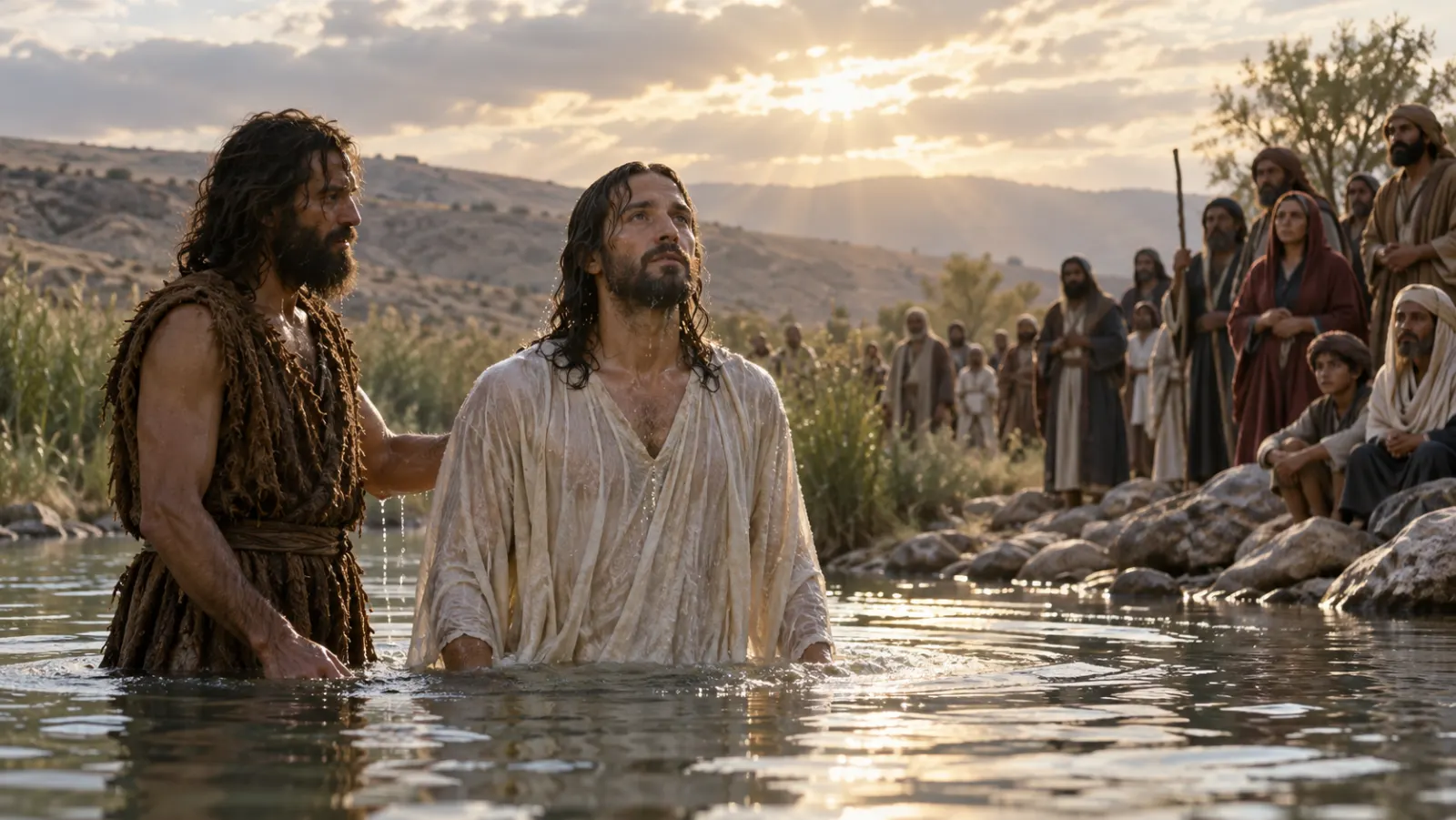
Jesus enters a baptism associated with repentance even though the Gospels present Him as sinless. The scene is not an embarrassment to explain away; it reveals His solidarity, obedience, and mission.
The Jordan is not a polished stage. People arrive with dust on their feet and unresolved stories, and John calls them to turn toward God. Then Jesus steps into the same water. For readers accustomed to baptism as a church program with towels, cameras, and a scheduled service, the strangeness of that choice deserves attention.
This article approaches why was jesus baptized if he had no sin? as a biblical and pastoral question rather than a test of tribal loyalty. American Christians often hear the scene mainly as a model for their own baptism, but Matthew first asks what the act reveals about Jesus. The aim is conviction with proportion: to say what the passages say, acknowledge where Christian traditions differ, and keep baptism connected to the gospel it portrays.
John’s reasonable objection
John recognizes a moral reversal: he needs what Jesus brings, yet Jesus requests John’s baptism. Matthew preserves the objection because the tension matters. Jesus is not confessing personal wrongdoing, and John is not correcting Him; the exchange announces that Jesus will carry out God’s saving purpose in an unexpected way.
Historically, in the discussion of “John’s reasonable objection,” the immediate context prevents a favorite phrase from carrying more weight than the whole scene. People, place, sequence, and Old Testament echoes all matter; they show what the author assumes and what the first hearers would not have needed explained.
For this article’s focus on why was jesus baptized if he had no sin?, careful reading also keeps Christians humble. The church did not invent baptism yesterday, and no present congregation owns the whole history. Learning from earlier believers can expose blind spots without requiring the surrender of scriptural conviction.
One way to carry “John’s reasonable objection” into an ordinary week is to connect belief with one concrete responsibility: listen to the person most affected, tell the truth about limits, invite accountable help, and refuse a shortcut that protects appearances at another person’s expense. In why was jesus baptized if he had no sin?, mature conviction becomes visible through patient, embodied faithfulness.
To fulfill all righteousness
“Righteousness” in Matthew is active faithfulness to God’s will, not a private feeling of spiritual worth. Jesus chooses the path the Father has appointed. His obedience does not begin with a dramatic miracle but with identification among repentant people and submission to a prophetic act.
Historically, in the discussion of “To fulfill all righteousness,” the theological claim becomes clearer when baptism is kept beside Christ’s death and resurrection. Water has meaning because God has acted in Jesus. Detached from Him, the rite can become either religious magic or a thin piece of personal branding.
For this article’s focus on why was jesus baptized if he had no sin?, this is why the article resists a slogan. Strong claims deserve strong context. A reader should be able to explain the passage fairly to someone from another Christian tradition before arguing for a conclusion.
One way to carry “To fulfill all righteousness” into an ordinary week is to connect belief with one concrete responsibility: listen to the person most affected, tell the truth about limits, invite accountable help, and refuse a shortcut that protects appearances at another person’s expense. In why was jesus baptized if he had no sin?, mature conviction becomes visible through patient, embodied faithfulness.
Standing with the people He came to save
The sinless One does not remain safely above sinners. He enters their water and accepts a place in their line. This anticipates a ministry in which He touches the unclean, eats with the disreputable, bears accusation, and ultimately gives Himself for others.
Historically, in the discussion of “Standing with the people He came to save,” pastorally, the distinction is not abstract. People bring family histories, denominational memories, bodily limits, fear, shame, and hope into the water. A faithful church teaches clearly while refusing to use vulnerability as leverage.
For this article’s focus on why was jesus baptized if he had no sin?, in practice, wise leadership offers time for questions, states expectations in advance, and separates invitation from pressure. Candidates should know what will happen to their bodies, stories, images, and membership after the service.
The heavens open over an ordinary river
Matthew describes opened heavens, the Spirit descending like a dove, and a voice naming Jesus as beloved Son. The signs do not turn the riverbank into spectacle for its own sake. They interpret Jesus’ identity and commission through Israel’s language of kingship and the servant of Isaiah.
Historically, in the discussion of “The heavens open over an ordinary river,” the American setting adds pressures the text did not name directly: consumer choice, social media visibility, mobility, individualism, and partisan identity. Application requires care so that contemporary habits are examined rather than smuggled into the passage.
For this article’s focus on why was jesus baptized if he had no sin?, the most revealing question may be what kind of life the baptism is expected to begin. If nothing changes in relationships, money, speech, service, or accountability, the church has celebrated a picture while neglecting the reality it depicts.
The Father, Son, and Spirit together
The scene is one of the New Testament’s clearest narrative windows onto the triune life of God. The Son is baptized, the Spirit descends, and the Father speaks. Christians should resist both collapsing the persons into one actor and imagining three unrelated gods.
Historically, in the discussion of “The Father, Son, and Spirit together,” a congregation can test its practice by asking who has agency, who is heard, who is protected, and what happens after the photographs. The ceremony should tell the truth not only in words but also in its use of power and its quality of welcome.
For this article’s focus on why was jesus baptized if he had no sin?, for skeptical observers, integrity matters as much as explanation. A community that admits failure, protects the vulnerable, and keeps promises makes the symbolism more intelligible than a flawless production surrounding careless discipleship.
A beginning pointed toward the cross
Baptism leads immediately toward testing in the wilderness and a ministry that culminates at Jerusalem. The beloved Son is not promised exemption from suffering. The Father’s delight equips a mission shaped by obedience, conflict, compassion, and finally the cross.
Historically, in the discussion of “A beginning pointed toward the cross,” the final emphasis belongs to grace-shaped obedience. Baptism is neither a performance that earns God nor an empty option for people who feel expressive. It is a received command that directs faith outward, bodily, and toward the people of God.
For this article’s focus on why was jesus baptized if he had no sin?, baptism looks backward to Christ’s finished work and forward to resurrection. That double horizon protects the candidate from both nostalgia and panic. The day is important, but its deepest meaning rests outside the intensity of the day itself.
Why Was Jesus Baptized If He Had No Sin? cannot be reduced to a technical rule or a sentimental photograph. Read within the gospel, baptism names the initiative of God, the lordship of Jesus, the presence of the Spirit, and a person’s embodied response among a people who are also learning obedience.
A useful next step is to read Matthew 3:13–17 slowly with a mature believer or pastor, name the questions the passage raises, and decide what faithful action requires. The goal is not to manufacture certainty on command, but to move truthfully toward Christ with a community prepared to keep walking after the water settles.


