
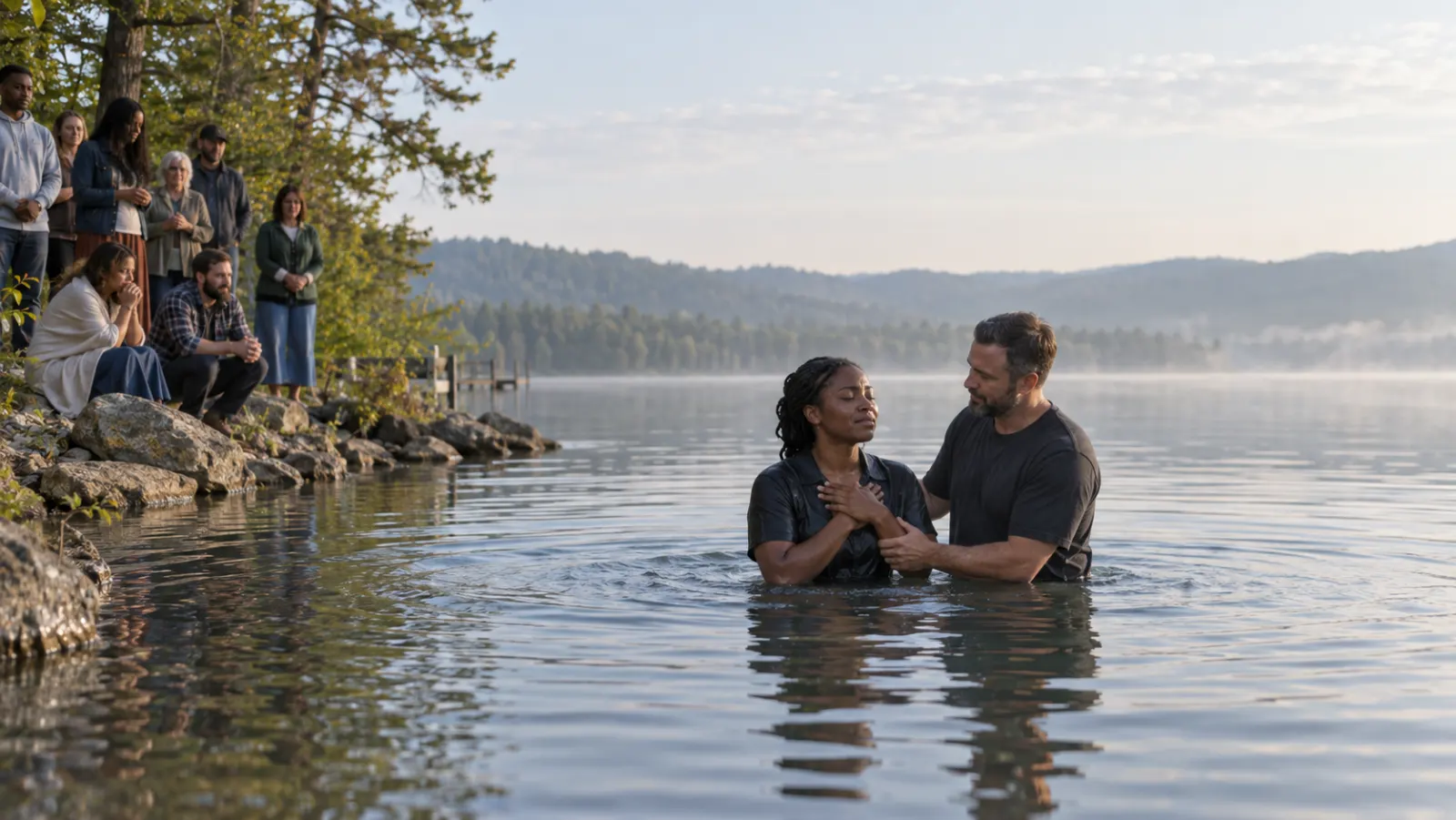
Baptism is deeply personal but never merely private. Jesus sends disciples to baptize among the nations, making allegiance visible within a community that can teach, remember, and help carry the promise.
Americans are accustomed to treating religion as a personal preference: meaningful, protected, and best kept from inconveniencing anyone else. Baptism refuses that arrangement. A body enters water before witnesses, a name is spoken, and private conviction becomes accountable belonging.
This article approaches public faith in a private age as a biblical and pastoral question rather than a test of tribal loyalty. The ceremony challenges both performative social media religion and a faith so private that no neighbor or congregation can recognize it. The aim is conviction with proportion: to say what the passages say, acknowledge where Christian traditions differ, and keep baptism connected to the gospel it portrays.
A command addressed to disciples
The Great Commission is given to a gathered community, not to isolated spiritual entrepreneurs. Making disciples includes going, baptizing, and teaching people to obey Jesus. Baptism therefore belongs inside a continuing ecology of instruction and fellowship.
Communally, in the discussion of “A command addressed to disciples,” the immediate context prevents a favorite phrase from carrying more weight than the whole scene. People, place, sequence, and Old Testament echoes all matter; they show what the author assumes and what the first hearers would not have needed explained.
For this article’s focus on public faith in a private age, careful reading also keeps Christians humble. The church did not invent baptism yesterday, and no present congregation owns the whole history. Learning from earlier believers can expose blind spots without requiring the surrender of scriptural conviction.
One way to carry “A command addressed to disciples” into an ordinary week is to connect belief with one concrete responsibility: listen to the person most affected, tell the truth about limits, invite accountable help, and refuse a shortcut that protects appearances at another person’s expense. In public faith in a private age, mature conviction becomes visible through patient, embodied faithfulness.
A name larger than self-expression
To be baptized in the name of the Father, Son, and Holy Spirit is to receive an identity not invented by the self. The language is intimate but also political in the broad sense: ultimate loyalty is relocated from nation, market, family brand, and personal autonomy to the triune God.
Communally, in the discussion of “A name larger than self-expression,” the theological claim becomes clearer when baptism is kept beside Christ’s death and resurrection. Water has meaning because God has acted in Jesus. Detached from Him, the rite can become either religious magic or a thin piece of personal branding.
For this article’s focus on public faith in a private age, this is why the article resists a slogan. Strong claims deserve strong context. A reader should be able to explain the passage fairly to someone from another Christian tradition before arguing for a conclusion.
One way to carry “A name larger than self-expression” into an ordinary week is to connect belief with one concrete responsibility: listen to the person most affected, tell the truth about limits, invite accountable help, and refuse a shortcut that protects appearances at another person’s expense. In public faith in a private age, mature conviction becomes visible through patient, embodied faithfulness.
Witnesses are not an audience
People present at a baptism do more than consume an inspiring moment. They hear a confession, welcome a believer, and accept responsibility to teach, correct, forgive, feed, and accompany. Applause is appropriate only if it matures into durable care.
Communally, in the discussion of “Witnesses are not an audience,” pastorally, the distinction is not abstract. People bring family histories, denominational memories, bodily limits, fear, shame, and hope into the water. A faithful church teaches clearly while refusing to use vulnerability as leverage.
For this article’s focus on public faith in a private age, in practice, wise leadership offers time for questions, states expectations in advance, and separates invitation from pressure. Candidates should know what will happen to their bodies, stories, images, and membership after the service.
One way to carry “Witnesses are not an audience” into an ordinary week is to connect belief with one concrete responsibility: listen to the person most affected, tell the truth about limits, invite accountable help, and refuse a shortcut that protects appearances at another person’s expense. In public faith in a private age, mature conviction becomes visible through patient, embodied faithfulness.
The danger of turning testimony into content
Churches now livestream baptisms and clip testimonies for social media. Such sharing can encourage others, but consent must be real and revisable. A person’s trauma, addiction, immigration history, or family conflict should never become promotional material without thoughtful boundaries.
Communally, in the discussion of “The danger of turning testimony into content,” the American setting adds pressures the text did not name directly: consumer choice, social media visibility, mobility, individualism, and partisan identity. Application requires care so that contemporary habits are examined rather than smuggled into the passage.
For this article’s focus on public faith in a private age, the most revealing question may be what kind of life the baptism is expected to begin. If nothing changes in relationships, money, speech, service, or accountability, the church has celebrated a picture while neglecting the reality it depicts.
Public does not mean coercive
Public confession is not permission to pressure a spouse, expose a minor, or create risk for someone from a hostile environment. The early church knew both courage and prudence. Pastors should distinguish faithful visibility from unnecessary disclosure.
Communally, in the discussion of “Public does not mean coercive,” a congregation can test its practice by asking who has agency, who is heard, who is protected, and what happens after the photographs. The ceremony should tell the truth not only in words but also in its use of power and its quality of welcome.
For this article’s focus on public faith in a private age, for skeptical observers, integrity matters as much as explanation. A community that admits failure, protects the vulnerable, and keeps promises makes the symbolism more intelligible than a flawless production surrounding careless discipleship.
A promise the church must remember
When doubt or suffering arrives later, witnesses can remind the baptized person of what was confessed and of the community’s welcome. Baptismal memory becomes communal memory: not nostalgia for a perfect day, but a landmark pointing back to Christ’s promise and forward to perseverance.
Communally, in the discussion of “A promise the church must remember,” the final emphasis belongs to grace-shaped obedience. Baptism is neither a performance that earns God nor an empty option for people who feel expressive. It is a received command that directs faith outward, bodily, and toward the people of God.
For this article’s focus on public faith in a private age, baptism looks backward to Christ’s finished work and forward to resurrection. That double horizon protects the candidate from both nostalgia and panic. The day is important, but its deepest meaning rests outside the intensity of the day itself.
Public Faith in a Private Age cannot be reduced to a technical rule or a sentimental photograph. Read within the gospel, baptism names the initiative of God, the lordship of Jesus, the presence of the Spirit, and a person’s embodied response among a people who are also learning obedience.
A useful next step is to read Matthew 28:16–20 slowly with a mature believer or pastor, name the questions the passage raises, and decide what faithful action requires. The goal is not to manufacture certainty on command, but to move truthfully toward Christ with a community prepared to keep walking after the water settles.


